Object file · No. 0007
Caduceus: Count the Snakes Before Calling It Medical
Blazon card
- Field
- No fixed field; drawn here on plain argent (tincture, not official)this page
- Charge
- A staff entwined by two serpents respectant; the medical form adds a pair of wings at the topMet 1989.281.57; Schwamm 2013
- Tincture
- No official colors; this page draws the staff Or and the serpents Vert (tincture, not official)this page
- Difference
- Rod of Asclepius: one serpent on a staff, no wingsRPC III 1324; WHO emblem page
- Issued by
- No single issuer: an ancient herald's staff later taken up by printers, the College of Physicians of London and the US ArmyGarrison 1919; Caius, Annals
- First documented
- Earliest we can document: Greek bronze kerykeion head, late 6th–early 5th century BCE; on a medical book, Froben's device, Basel, 1538Met 1989.281.57; Hippocrates 1538 title page
- Spec source
- No general specification; US Army hospital steward caduceus, 2 in. long: Regulations for the Uniform and Dress of the Army of the United States (1861), para. 107Regulations 1861
Blazon card as CSV caduceus-blazon.csvprovenance and license of caduceus-blazon.csv
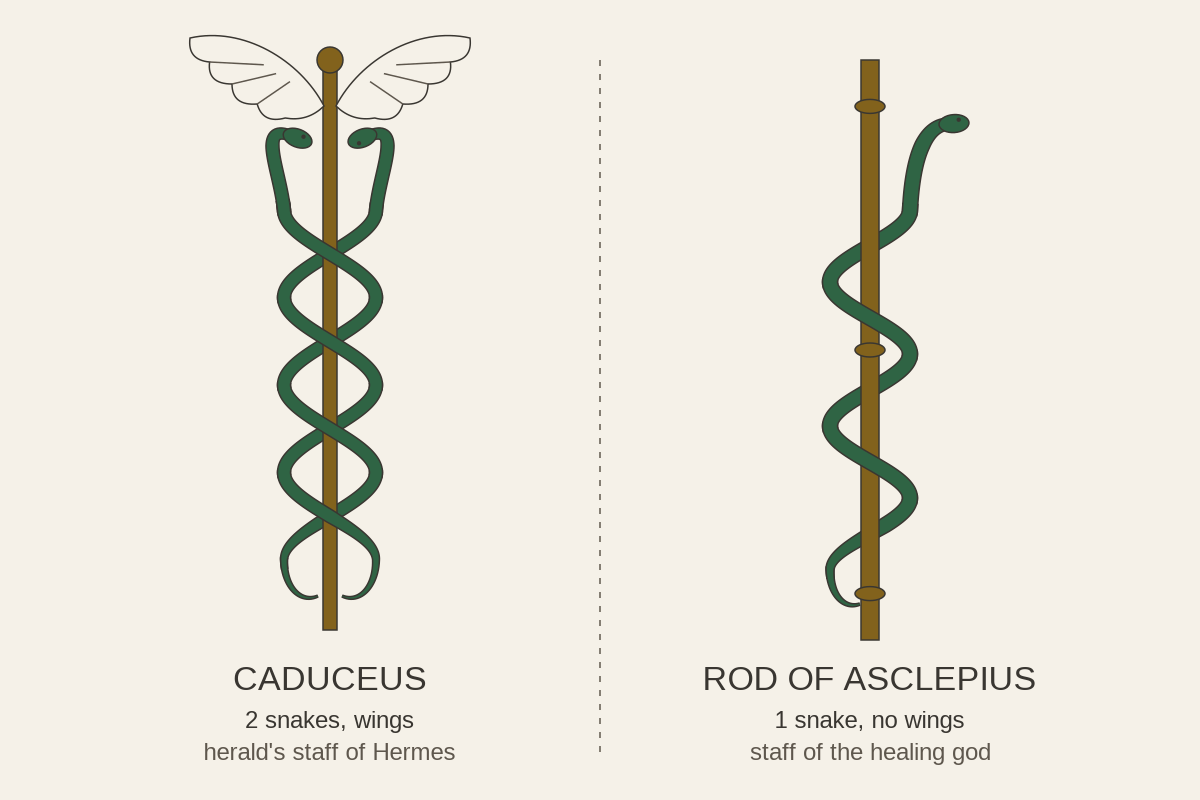
Slide the drawing sideways to read every label, or open it at full size.
The caduceus with two snakes and a pair of wings, beside the staff of Asclepius with one snake and no wings (tincture, not official).
Credit and reuse terms
"Caduceus and rod of Asclepius side by side" by Banners & Banknotes, https://bannersandbanknotes.com/pictograms-icons/caduceus/, licensed under CC BY 4.0 (https://creativecommons.org/licenses/by/4.0/)
TL;DR. The caduceus has two snakes, and often wings, because it began as a herald's staff, the attribute of the Greek god Hermes, while the staff with one snake belongs to Asclepius, the Greek god of healing. The caduceus reached medical badges by dated steps: a Basel printer's device on a 1538 edition of Hippocrates, a London physicians' ensign of 1557/8, and US Army uniforms by 1861 and 1902.
In this file6 sections
The caduceus that US Army medical officers first wore in 1902 began as a herald's wand, not a healer's staff. Count the snakes on any staff badge: the caduceus has two, twined around the shaft and facing each other, and the version on medical badges adds a pair of wings above their heads. The staff of Asclepius, whom the ancient Greeks revered as a god of healing, carries one snake and no wings. In the stranger's read, which names only shapes and colors, the caduceus above is a staff Or (gold) entwined by two serpents Vert (green) respectant, or face to face, under a pair of wings.
How do you tell a caduceus from the rod of Asclepius?
Start with the snakes, because they are the quickest thing to count. Two snakes on one staff make a caduceus, and one snake makes the staff of Asclepius. Wings are a second clue, not a rule. A 2013 editorial in the Journal of the American Heart Association describes the "medical caduceus" as a double serpent staff with "surmounting wings," but the oldest object on this page, a Greek bronze staff head, has no wings at all.
On a silver coin of the Roman emperor Hadrian, Asclepius holds a rod with one snake wound around it, which the catalogue Roman Provincial Coinage calls a "serpent-wreathed rod." The drawing below sets the three forms side by side, each with a dated source.
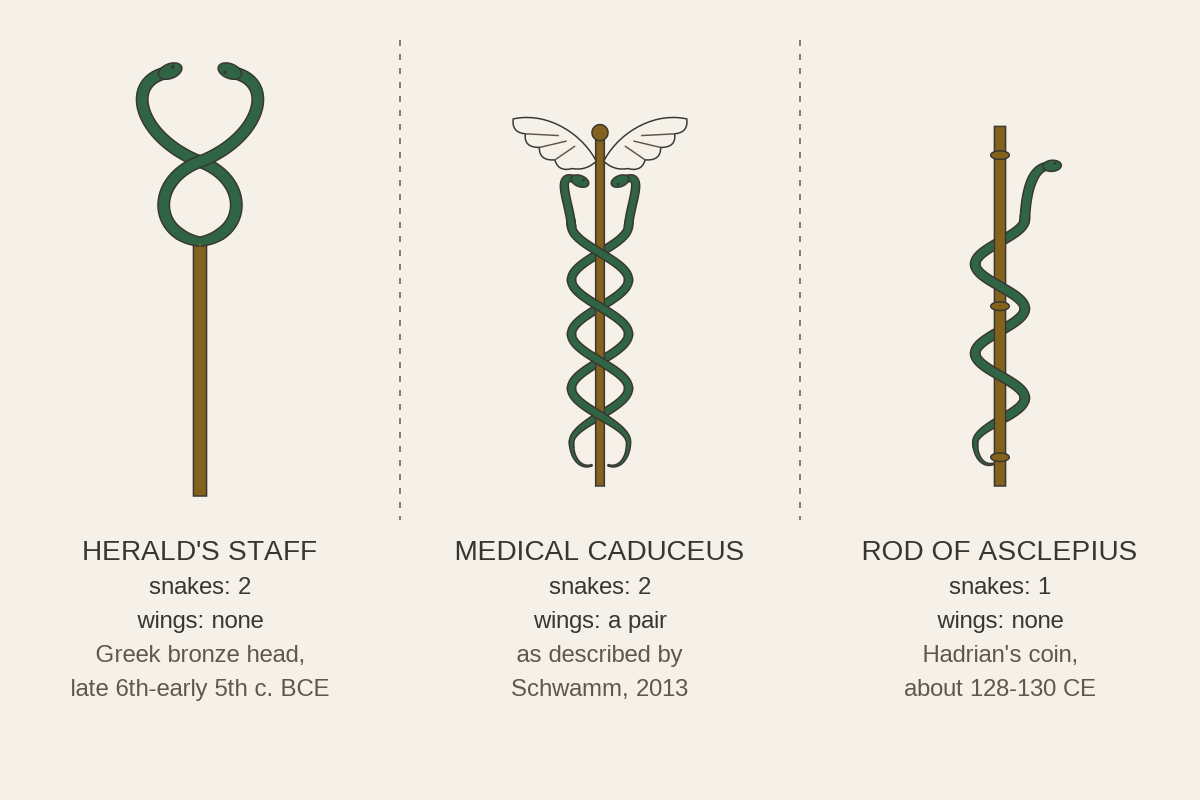
Slide the drawing sideways to read every label, or open it at full size.
Count the snakes: the Greek herald's staff and the medical caduceus have two, and only the caduceus has wings. Asclepius's rod has one snake (tincture, not official).
Credit and reuse terms
"Count the snakes: herald's staff, caduceus and rod" by Banners & Banknotes, https://bannersandbanknotes.com/pictograms-icons/caduceus/, licensed under CC BY 4.0 (https://creativecommons.org/licenses/by/4.0/)
Nothing in either drawing spells out medicine. The tie between a staff and a profession comes from documents and uniforms that can be dated. Picture signs designed for strangers face the same question; see the files on Otto Neurath's Isotype and the DOT/AIGA symbol signs.
Why does the herald's staff of Hermes have two snakes?
The Greek staff was called a kerykeion. The Metropolitan Museum of Art catalogues a bronze head of one as a "herald's staff." It is dated to the late 6th or early 5th century BCE and stands 18.7 cm high. Two snakes knot into a loop above the socket, then rise apart and bend back until their heads face each other.
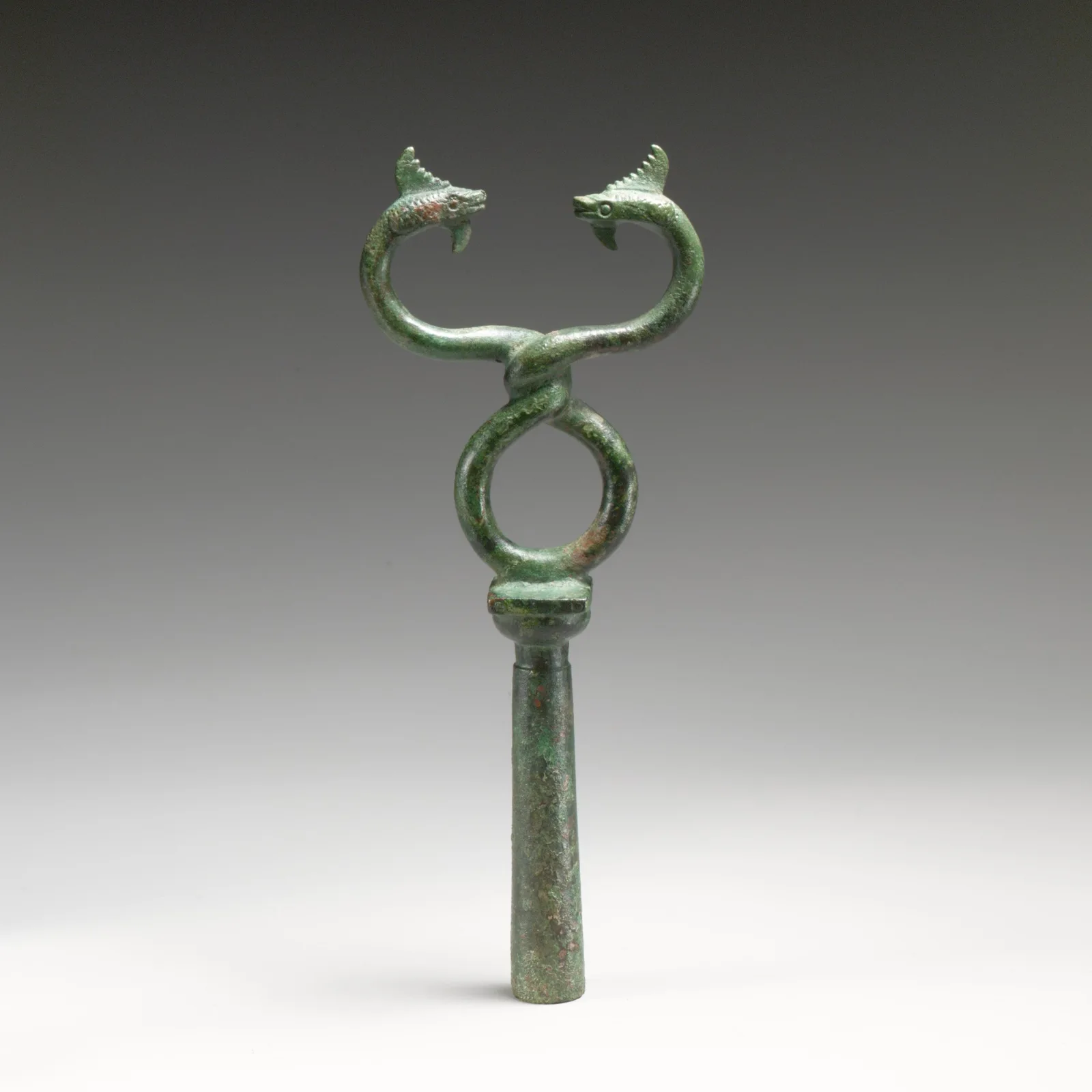
Bronze head of a Greek kerykeion, or herald's staff. Two snakes knot into a loop over the socket and curve up until their crested heads face each other.
Credit and reuse terms
"Bronze finial of a kerykeion (herald's staff) MET DP21009" by The Metropolitan Museum of Art — https://commons.wikimedia.org/wiki/File:Bronze_finial_of_a_kerykeion_(herald%27s_staff)_MET_DP21009.jpg — CC0 1.0 (https://creativecommons.org/publicdomain/zero/1.0/)

Finial of a kerykeion, late 6th–early 5th century BCE, Greek. The Metropolitan Museum of Art, 1989.281.57.
Stop on the top of the finial. Each head carries a spiny crest, and between the two heads there is nothing at all, no wings and no knob.
A Latin handbook of star myths that goes under the name of Hyginus tells one story behind the pair. Mercury, as the Romans called Hermes, receives a wand from Apollo, comes upon two snakes that seem to be fighting and sets the wand between them, and they part. The handbook says he declared the wand established "pacis causa," for the sake of peace, and adds that some people twine two snakes on the caducei they make for that reason (Astronomica 2.7).
The handbook's date is uncertain. William Smith's Dictionary of Greek and Roman Biography and Mythology (1870) reports "the greatest diversity of opinion" about it, with suggested dates from the time of the Roman teacher Quintilian to the last days of the empire.
F. H. Garrison, a lieutenant colonel in the US Army Medical Corps, added in 1919 that in Rome the caduceus passed to the caduceator, "a herald sent to the enemy with a flag of truce." Macrobius, whom Smith's dictionary places early in the fifth century CE, adds wings. His Saturnalia describes two snakes knotted at the middle, their heads bent into a circle with mouths touching, and wings springing from the handle (1.19.16–17).
What does the snake on the rod of Asclepius stand for?
The earliest explanation this page can document is younger than the images of the god with his snake. On the coin below, Asclepius stands with his head turned left, his right hand resting on a rod with a snake wound around it. Roman Provincial Coinage places the type at Pergamum, and the Berlin coin cabinet dates its specimen to about 128–130 CE; Berlin notes that Roman Imperial Coinage gave the type to Ephesus instead.
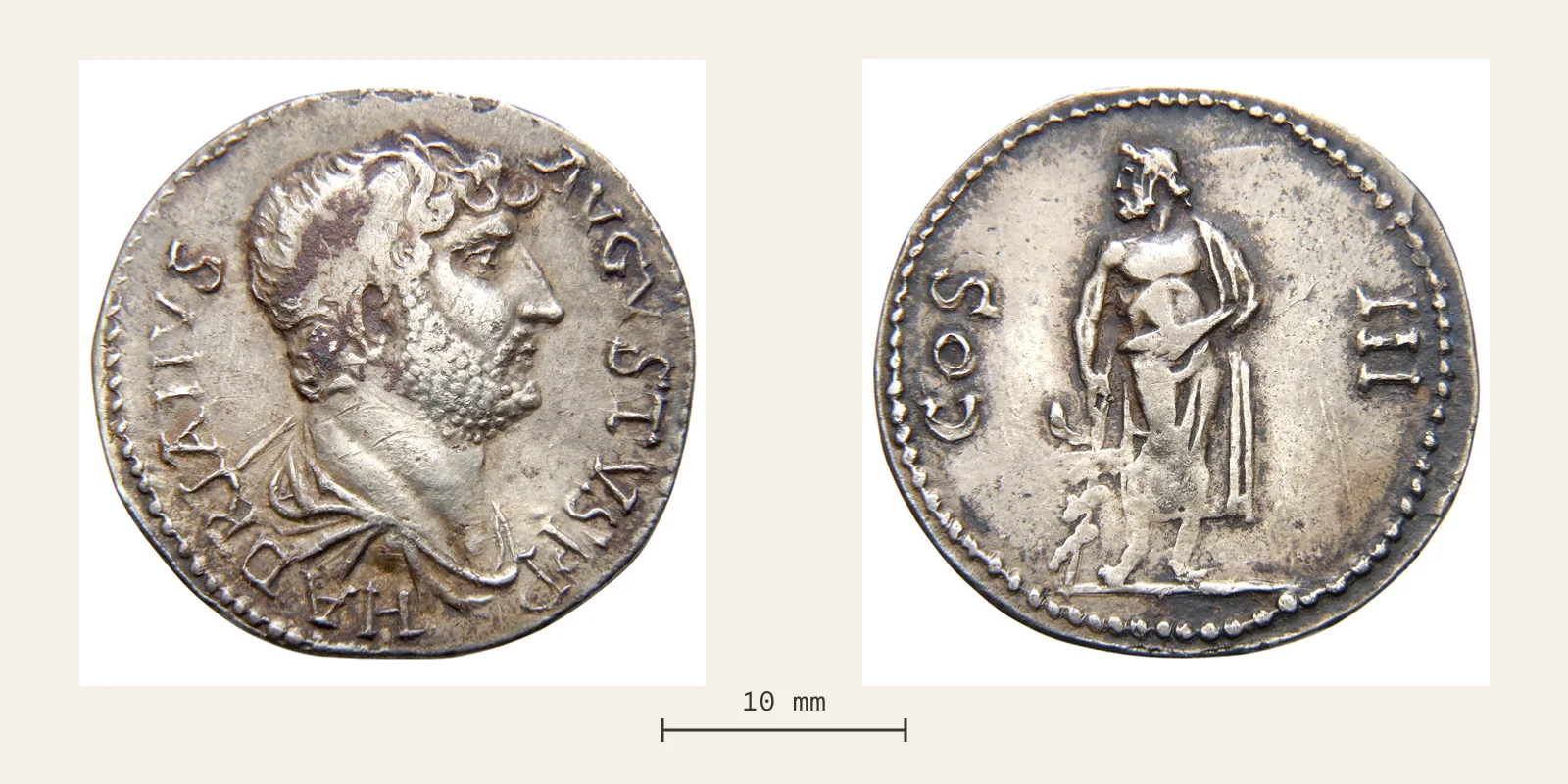
A silver coin of Hadrian, 25 mm across. On the reverse, between the letters COS and III, Asclepius rests his right hand on a staff with one snake.
Credit and reuse terms
"Hadrianus - Münzkabinett, Berlin - 5482610" by Münzkabinett der Staatlichen Museen zu Berlin, 18204919, photo by Reinhard Saczewski — https://commons.wikimedia.org/wiki/File:Hadrianus_-_M%C3%BCnzkabinett,_Berlin_-_5482610.jpg — Public Domain Mark 1.0 (https://creativecommons.org/publicdomain/mark/1.0/); changes: each side cropped to a square with the photo's own white background and set on a paper-colored panel, scaled 1.0016 times, 10 mm scale bar added from the catalogue diameter of 25 mm

Cistophorus of Hadrian, about 128–130 CE, Pergamum mint. Münzkabinett der Staatlichen Museen zu Berlin, 18204919.
Macrobius, writing in the early fifth century CE, about three centuries after the coin, gave one reason. Images of Aesculapius, the Latin name of Asclepius, and of Salus are joined by snakes, he wrote, because the two help human bodies cast off illness like a worn skin and regain their old vigor, just as snakes renew themselves each year by shedding the skin of old age (Saturnalia 1.20.2). The ledger below therefore marks that meaning as first recorded later.
Another reading says the snake is really a Guinea worm, the parasite Dracunculus medinensis, on a removal stick. Lucy Robertson, reviewing a book on the disease in Epidemiology and Infection in 2019, wrote that nearly all medical students are told this, and then: "There seems to be no evidence for this proposal." No earlier source for the idea turned up for this page. So it carries a 2019 date and nothing more.
The World Health Organization's emblem, chosen by the First World Health Assembly in 1948, sets a staff with one snake coiling round it above the United Nations symbol. WHO's own page on the emblem, read in 2026, calls the staff with the snake a long-standing symbol of medicine and traces it to Asclepius.
How did the caduceus get into medicine?
Through printers, by the earliest account found for this page. Garrison wrote in 1919 that the caduceus "suddenly appears as a medical symbol" on the heraldic devices of Sir William Butts, physician to Henry VIII, and of "the Swiss medical printer Froben." He added: "Why it should appear in this relation no one knows."
Froben's mark is a staff wound by two crowned snakes with a bird on top, held upright by two hands reaching out of clouds. Hans Holbein the Younger painted it around 1523, according to the Wikimedia Commons record of the painting, which cites a 2006 catalogue of Holbein's Basel years.
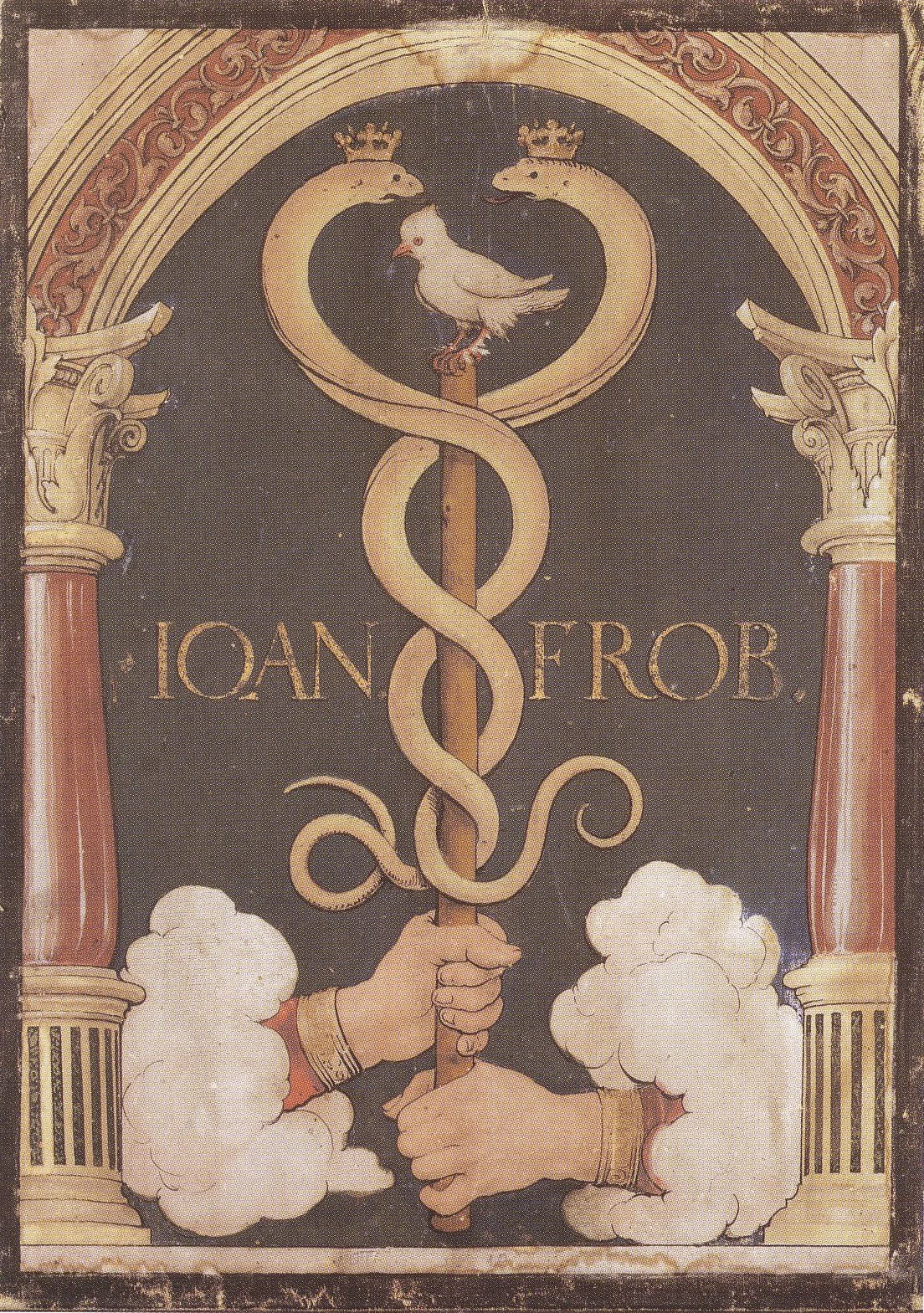
Johann Froben's printer's device as Hans Holbein the Younger painted it: two crowned snakes on a staff with a bird on top, held by two hands from clouds. There are no wings.
Credit and reuse terms
"Printer's Device of Johannes Froben" by Hans Holbein the Younger — https://commons.wikimedia.org/wiki/File:Printer%27s_Device_of_Johannes_Froben.jpg — Public domain (painting by Hans Holbein the Younger (died 1543), about 1523; a faithful photographic reproduction of a two-dimensional public-domain work)

Printer's device of Johannes Froben, about 1523, Hans Holbein the Younger. Kunstmuseum Basel, no number given.
Garrison put these devices in the late sixteenth century, but the dated objects are earlier. Besides the painting of about 1523, the device stands on the title page of the Froben press's Greek edition of Hippocrates, printed in Basel in 1538, with the press name FROBEN split on either side of the staff.
A wooden hand press with a freshly pulled sheet, left blank here. The Froben press printed its device on the title page of its Greek Hippocrates, Basel, 1538.
Illustration: Banners & Banknotes. Generated schematic illustration — not a photograph or historical record. © Banners & Banknotes, all rights reserved.
The earliest meaning this page can document for a caduceus in a medical setting comes from London. John Caius, president of the College of Physicians, gave the president's office a silver caduceus, first used in procession on 10 January 1557/8, and explained it in the annals he kept for the college. "Nam caduceus siue virga argentea, regendum significat mitiùs & clementiùs," he wrote: the caduceus, or silver rod, means ruling more mildly and mercifully than those who once ruled with a rod of iron, and the serpents, signs of prudence, teach ruling and acting prudently.
Garrison's list then jumps to 1844, when the caduceus appears on title pages of the London medical publisher Churchill. In 1901, he notes, a French periodical of military medicine was founded as Le Caducée.
When did the US Army Medical Department adopt the caduceus?
In two steps, first for hospital stewards and later for medical officers. The War Department's uniform regulations of 1861 give the hospital steward "a caduceus two inches long, embroidered with yellow silk on each arm above the elbow" (paragraph 107). Garrison dated the stewards' caduceus to 1856, five years before those regulations. Both dates appear in the timeline below.
Medical officers followed in 1902, when, in Garrison's 1919 words, the caduceus "makes its first appearance on the uniforms of medical officers of the U. S. Army." By 1919 it was on their collars. The coat of arms of the Medical Corps, by contrast, bore "the Æsculapian staff with the single snake."
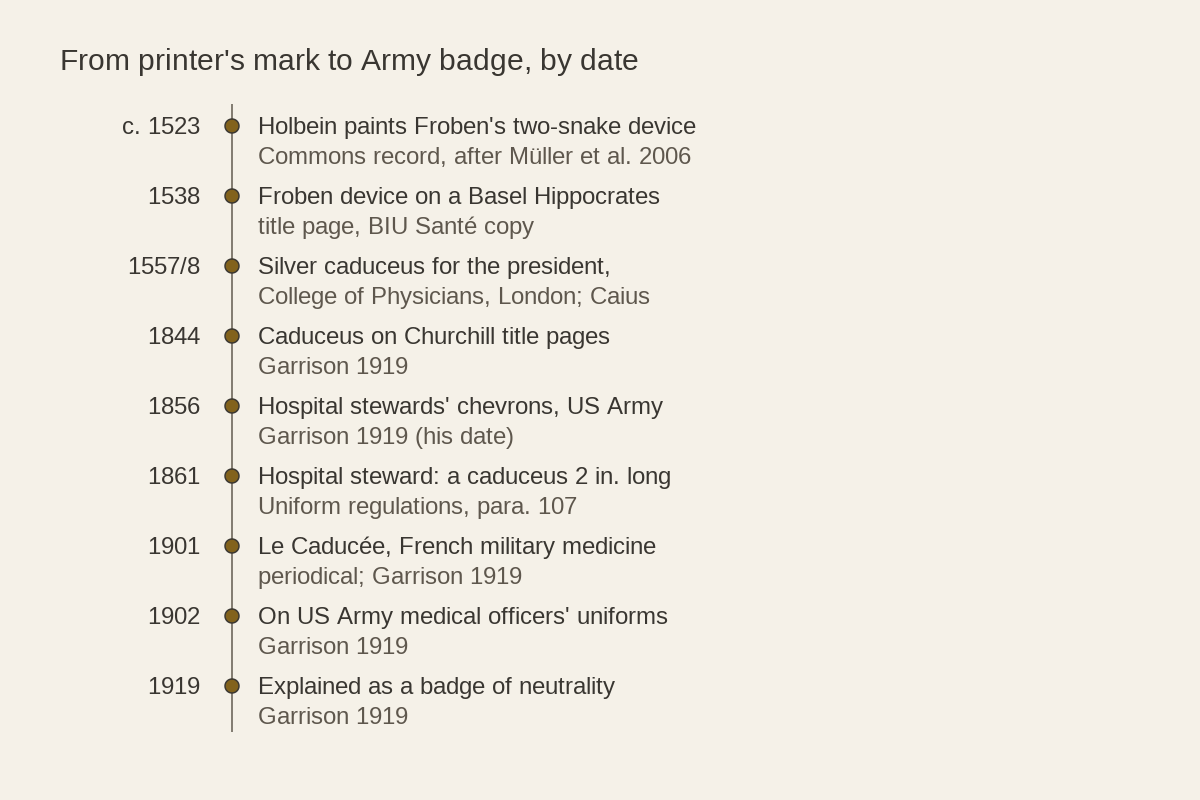
Slide the drawing sideways to read every label, or open it at full size.
Dated steps from Froben's printer's mark to the US Army uniform, with the source for each date. Garrison gives 1856 for the hospital stewards; the 1861 regulations are the earliest text found.
Credit and reuse terms
"From printer's mark to Army badge: the caduceus by date" by Banners & Banknotes, https://bannersandbanknotes.com/pictograms-icons/caduceus/, licensed under CC BY 4.0 (https://creativecommons.org/licenses/by/4.0/)
Garrison also gave reasons for the choice. "The caduceus is then, like the Red Cross, a badge of neutrality in the field or in the open," he wrote, marking the bearer as a non-combatant, "just as the caduceus-bearing herald of ancient Rome was immune from attack." The one-snake staff on the coat of arms, in his view, stood for the corps' medical work.
That is the earliest explanation of the choice this page can document, 17 years after the 1902 change. The 1861 regulations give the caduceus no meaning. The 1902 order itself was not found.
Tents of a field hospital in the distance, with two stretcher-bearers walking toward them. Garrison wrote in 1919 that the caduceus marked its bearer as a non-combatant in the field.
Illustration: Banners & Banknotes. Generated schematic illustration — not a photograph or historical record. © Banners & Banknotes, all rights reserved.
Which staff is on which badge?
The record splits by snake count. Sources on this page use the name caduceus for Froben's device, the London president's rod and the US Army insignia of 1861 and 1902. One snake on one staff appears on the coat of arms of the US Army Medical Corps and on the uniforms of Britain's Royal Army Medical Corps, both described by Garrison in 1919, and on the World Health Organization's emblem of 1948. Every entry, with its source, is in the table of dated uses (CSV) provenance and license of caduceus-dated-uses.csv.
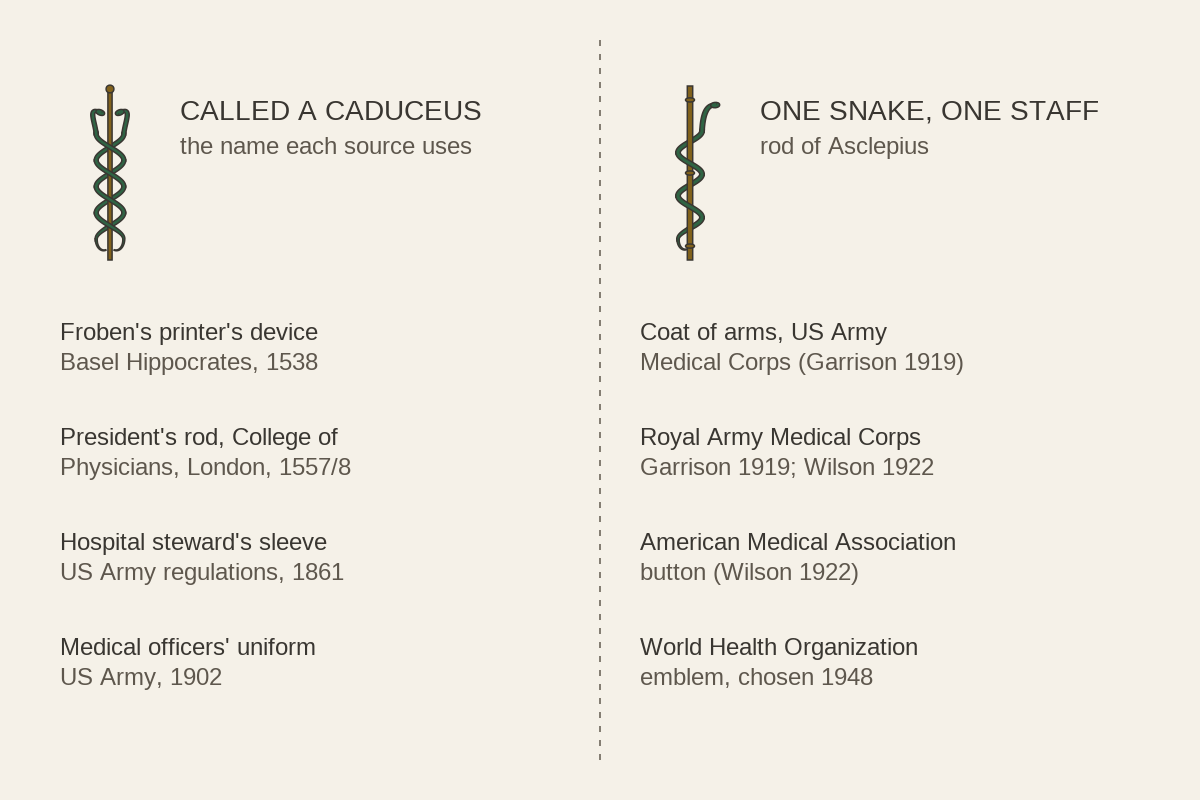
Slide the drawing sideways to read every label, or open it at full size.
Where each staff appears in the sources on this page, with dates. Snake counts follow the sources' own descriptions; no badge or emblem is reproduced (tincture, not official).
Credit and reuse terms
"Which staff on which badge" by Banners & Banknotes, https://bannersandbanknotes.com/pictograms-icons/caduceus/, licensed under CC BY 4.0 (https://creativecommons.org/licenses/by/4.0/)
The 2013 editorial in the Journal of the American Heart Association ties the winged form's spread to the Army. This "modern caduceus became a popular medical symbol after its adoption by the US Army Medical Corps at the turn of the 20th century," it says.
Objections were already in print. Writing in the Annals of Medical History in 1922, Robert Wilson Jr. noted that the caduceus's right to be the emblem of the medical profession "has been called into question," and that the staff with a single serpent "is regarded as the correct emblem." He also pointed to a button. The staff with a single serpent, he wrote, was the form then appearing on the button of the American Medical Association.
Shrink strip
At 16 pixels wide, the caduceus and the rod are nearly the same column of green and gold pixels. At 48 pixels the caduceus's wings show as a pale patch at the top, and at 160 pixels the snakes can be counted.
Shown at its drawn size. On a narrow screen, scroll sideways to see the whole strip.
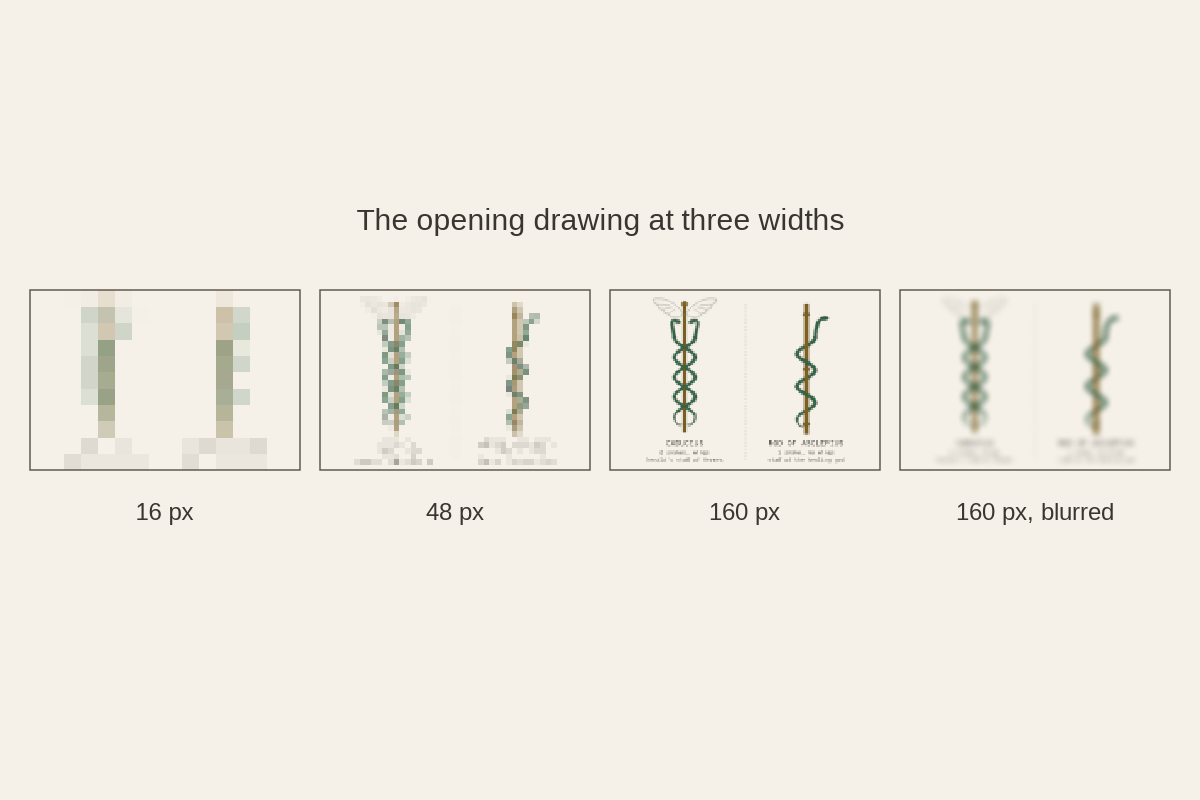
The opening drawing at 16, 48 and 160 pixels wide, plus a blurred copy of the 160-pixel version (tincture, not official). Reduction preview, not a legibility test.
Credit and reuse terms
"Caduceus shrink strip" by Banners & Banknotes, https://bannersandbanknotes.com/pictograms-icons/caduceus/, licensed under CC BY 4.0 (https://creativecommons.org/licenses/by/4.0/). Derived from "Caduceus and rod of Asclepius side by side".
Meaning ledger
| Meaning | Earliest we can document | Year | Label | Notes |
|---|---|---|---|---|
| The two snakes on Mercury's wand stand for peace: he parted two fighting snakes with it | Hyginus, Astronomica 2.7 (Bunte edition, pp. 43–44) | Roman period, date disputed | [first recorded later] | Greek two-snake herald's staffs are older, for example the Met finial of the late 6th or early 5th century BCE. Garrison (1919) also quotes Varro, "Caduceus pacis signum"; not checked against an edition of Varro. |
| The silver caduceus means ruling mildly and mercifully; its serpents teach prudence | John Caius, annals of the College of Physicians, London (Works, 1912, Annales p. 42) | 1557/8 | [at adoption] | Caius introduced the president's caduceus and wrote down its meaning in the college annals he kept. Garrison (1919) calls these the annals of the "Royal College of Surgeons"; the 1912 edition he cites prints them as the College of Physicians'. |
| The caduceus is a medical symbol | Garrison, describing the devices of Butts and Froben as a "medical symbol" | 1919 | [first recorded later] | Froben's device appears on a medical book in 1538, but beside the press's name, FROBEN; Caius's meaning of 1557/8 concerns governing. Wilson (1922) reports that the caduceus's right to the role "has been called into question." |
| On a US Army uniform, the caduceus marks the wearer as a non-combatant | Garrison, Bulletin of the Medical Library Association, p. 15 | 1919 | [first recorded later] | The 1861 regulations give no meaning; the 1902 order was not found. No evidence found that the reason was added after 1902. |
| The staff with one snake stands for medicine | Garrison, on the Medical Corps coat of arms: "an appropriate symbol of its medical" functions | 1919 | [first recorded later] | Images of Asclepius with his snake staff are older, for example Hadrian's coin of about 128–130 CE. WHO's emblem page (read 2026) calls the staff with the snake a long-standing symbol of medicine. |
| The snake beside Asclepius stands for renewal, as a snake sheds its old skin each year | Macrobius, Saturnalia 1.20.2 | early 5th century CE | [first recorded later] | The date is the one Smith's dictionary (1870) gives for Macrobius. Older images of the god already show the snake. |
| The snake on the rod is really a Guinea worm wound on a stick | Robertson, book review in Epidemiology and Infection | 2019 | [first recorded later] | Robertson writes that medical students are told this and that "There seems to be no evidence for this proposal." An earlier source for the idea was not found. |
How each label is decided: The After-Meaning, the four labels.
Sources
- F. H. Garrison, "The Use of the Caduceus in the Insignia of the Army Medical Officer," Bulletin of the Medical Library Association 9, no. 2 (October 1919): 13–16. archive.org Read: pages 13–16
- War Department, Regulations for the Uniform and Dress of the Army of the United States (Washington: George W. Bowman, Public Printer, 1861), paragraph 107. archive.org Read: page 14
- John Caius, Annalium Collegii Medicorum Londini Liber (The First Book of the Annals of the Royal College of Physicians, London, 1518–1572), in The Works of John Caius, M.D., ed. E. S. Roberts, with a memoir by John Venn (Cambridge: Cambridge University Press, 1912). archive.org Read: Annales page 42; memoir pages 18–19
- Hippocrates, Hippocratis Coi medici vetustissimi, et omnium aliorum principis, libri omnes, ad vetustos codices summo studio collati & restaurati, ed. Janus Cornarius (Basel: Froben, 1538). Copy in the Bibliothèque interuniversitaire de santé, Paris. archive.org Read: title page
- Hyginus, Astronomica 2.7, in Hygini Astronomica, ed. B. Bunte (1875), pages 43–44. archive.org Read: pages 43–44
- Macrobius, Saturnalia 1.19.16–18 and 1.20.1–3, in Macrobius, ed. Franciscus Eyssenhardt, 2nd ed. (Leipzig: Teubner, 1893), pages 111–112. archive.org Read: pages 111–112
- "Bronze finial of a kerykeion (herald's staff)," Greek, late 6th–early 5th century BCE, The Metropolitan Museum of Art, 1989.281.57; Wikimedia Commons file page. commons.wikimedia.org Read: file page
- Münzkabinett der Staatlichen Museen zu Berlin, object 18204919: Hadrian, cistophorus, Pergamum, about 128–130 CE, online catalogue (IKMK). ikmk.smb.museum Read: catalogue record
- Roman Provincial Coinage III, no. 1324 (Hadrian, Pergamum), RPC Online, University of Oxford. rpc.ashmus.ox.ac.uk Read: catalogue record
- "Printer's Device of Johannes Froben," Hans Holbein the Younger, about 1523, Kunstmuseum Basel; Wikimedia Commons file page, citing Christian Müller and others, Hans Holbein the Younger: The Basel Years, 1515–1532 (Munich: Prestel, 2006), page 295. commons.wikimedia.org Read: file page
- World Health Organization, "The WHO Logo and Emblem." who.int Read: full text
- American Institute of Graphic Arts, Symbol Signs: The Development of Passenger/Pedestrian Oriented Symbols for Use in Transportation-Related Facilities, final report for the U.S. Department of Transportation, Office of Facilitation, contract DOT-OS-40192 (November 1974), NTIS PB-239 352. archive.org Read: page 21
- Robert Wilson Jr., "The Caduceus and Its Symbolism," Annals of Medical History 4, no. 3 (September 1922): 301–303. pmc.ncbi.nlm.nih.gov Read: full text
- Lee H. Schwamm, "When in Rome, Do Like the Romans: Certifying Stroke Centers With the Rod of Aesculapius or the Medical Caduceus of Hermes?" Journal of the American Heart Association 2, no. 2 (2013): e000120. doi.org Read: full text
- Lucy J. Robertson, review of The Eradication of Dracunculiasis (Guinea Worm Disease) in Nigeria: An Eyewitness Account, by Luke Ekundayo Edungbola, Epidemiology and Infection 147 (2019): e202. doi.org Read: full text
- William Smith, ed., Dictionary of Greek and Roman Biography and Mythology, vol. 2 (Boston: Little, Brown, and Company, 1870), entries "Hyginus" (pages 534–535) and "Macrobius" (page 888). archive.org Read: pages 534–535 and 888
Counter-sign
Counter-sign: The World Health Organization's emblem, chosen in 1948. It answers the caduceus with a single snake on a single staff, set above the United Nations symbol.
- DOT/AIGA Symbol Signs: the 1974 report for the US Department of Transportation recommended that a cross "alone should be used to represent First Aid," with no staff in sight.
- Coin Legend Decoder: Hadrian's coin above reads P P, which Roman Provincial Coinage expands as Pater Patriae, "Father of the Fatherland," and COS III, consul for the third time.
Cite this page
Banners & Banknotes. “Caduceus: Count the Snakes Before Calling It Medical.” Published 14 October 2026. https://bannersandbanknotes.com/pictograms-icons/caduceus/. Accessed [date you read it].
Corrections
No corrections yet.