Skip to the text
About

Field 4 of 4

Playing Cards

French, German, Italian, Spanish and Swiss suit systems, the history of card faces and court figures, and the rules and history of classic non-gambling card games.

Quarterly, the fourth sable · 3 files

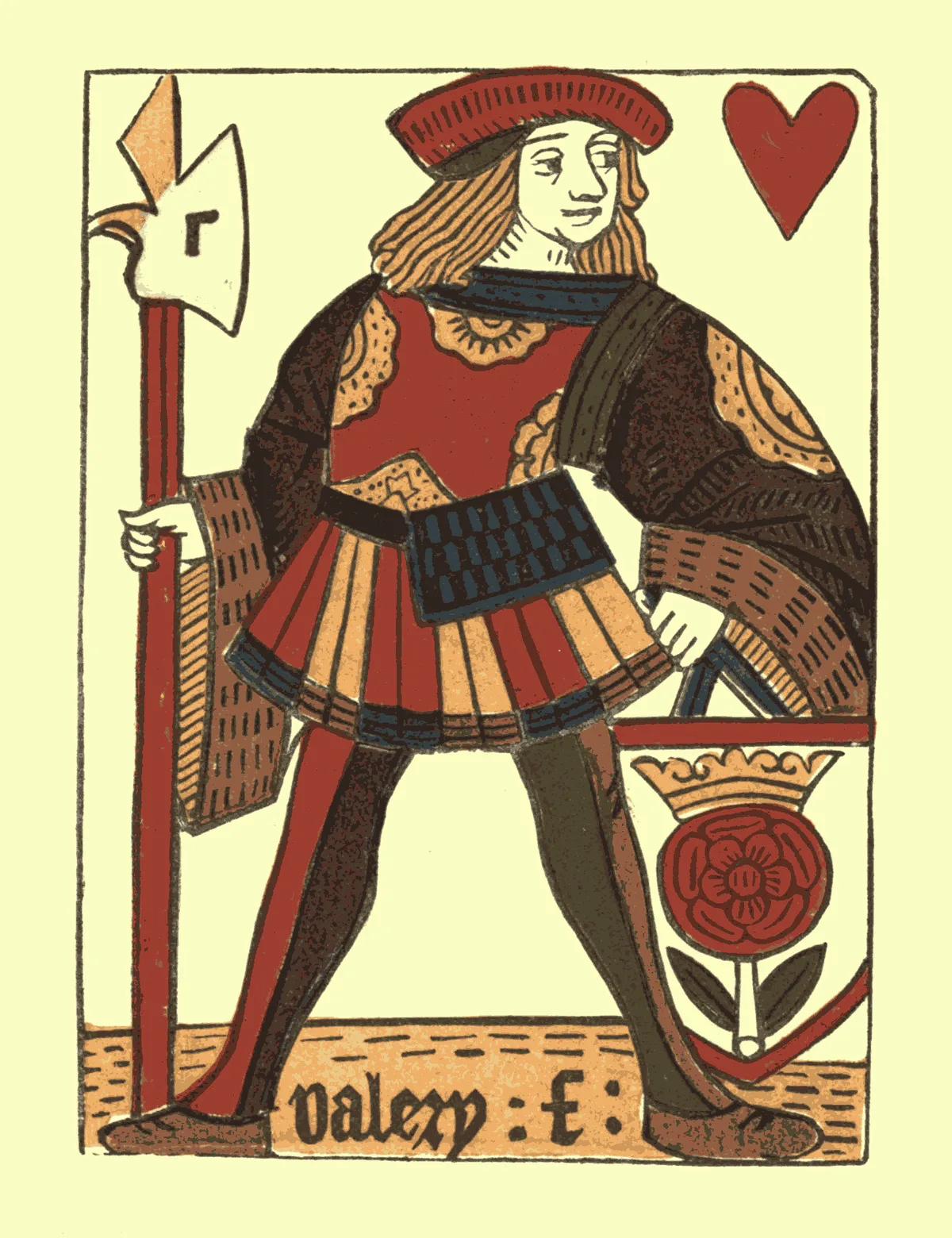
Pale field, a young man in red and black holding a long-handled weapon, a heart top right and a shield with a red rose: jack of hearts
Credit and reuse terms

"History of Playing Cards (1848) 23" by F. W. Fairholt and George Vasey, in W. A. Chatto, Facts and Speculations on the Origin and History of Playing Cards (1848) — https://commons.wikimedia.org/wiki/File:History_of_Playing_Cards_(1848)_23.png — Public domain (colored plate in W. A. Chatto, Facts and Speculations on the Origin and History of Playing Cards, London, 1848, facing p. 214, after a jack of the late 15th or early 16th century; the preface names F. W. Fairholt (died 1866) as the copyist and George Vasey, already engraving in 1848, as the wood engraver, so a death after 1955 would mean a life of more than 120 years; published 1848; the scan is a faithful reproduction of the printed page)

Flagship file

Hearts, Bells, Coins, Acorns: Europe's Five Suit Systems

French, German, Swiss, Italian and Spanish playing card suits side by side: which suits match, which system is oldest, why Latin packs have no queen.

More files in Playing Cards

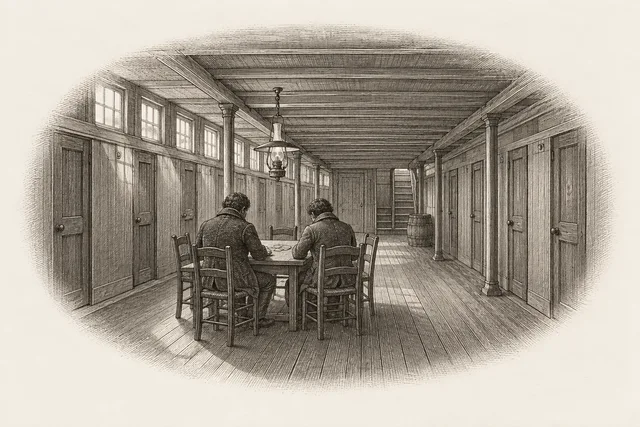
  1. Illustration: pale paper; a long steamboat cabin with stateroom doors, a small table with face-down cards under a lamp

    No. 0008System explainer

    Euchre: Two Jacks Outrank the Ace of Trumps

    How to play euchre from the 1862 and 1887 rule books: the pack, making trump, the right and left bowers, scoring, the joker, and the Alsatian game behind it.

    Credit and reuse terms

    Illustration: Banners & Banknotes. Generated schematic illustration — not a photograph or historical record. © Banners & Banknotes, all rights reserved.
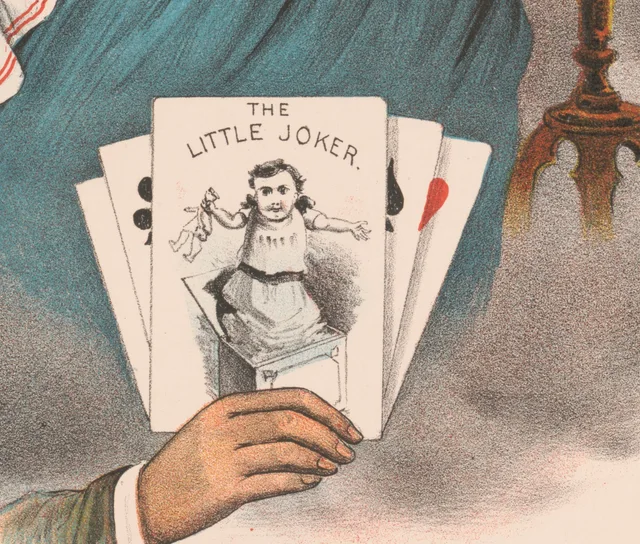
  2. Pale card held in a hand, a child in a white dress standing in an open box with a doll, lettered THE LITTLE JOKER: detail of Euchered, 1884

    No. 0012Object file

    Joker: The Extra Card Began as Euchre's Best Bower

    Why there is a joker in a deck of cards: it began as euchre's best bower in the 1860s, was called the joker by 1875, and often came in pairs by 1950.

    Credit and reuse terms

    "Euchered" by Currier & Ives, New York (publisher), artist signed F.C. — https://commons.wikimedia.org/wiki/File:%22Euchered%22_LCCN2001697234.jpg — Public domain (lithograph published in New York by Currier & Ives in 1884, before 1931; the artist signed only with the initials F.C. and is not identified in the Library of Congress record, so the EU term of 70 years from publication ended in 1954; the image is a faithful reproduction of the flat print); changes: cropped to the hand of cards: 2000 × 1700 pixels from the 5508 × 7132 original, left 1950, top 3850