System explainer · No. 0002
D G REG F D: A Decoder for the Latin Abbreviations on Coins
Blazon card
- Field
- A round coin face in its own metal; on the obverse the legend runs as a ring of capitals inside the rimMünzkabinett Berlin 18226740; Grueber 1899
- Charge
- The ruler's head or bust, ringed by a Latin legend of name and titles; abbreviated words are cut to initials or first syllablesMünzkabinett Berlin 18226740; Grueber 1899 No. 853
- Tincture
- The metal of each coin (gold, silver, copper-faced steel); no colors are set. Diagrams on this page use site tinctures (tincture, not official)Grueber 1899 (gold); CNG CoinID 60594 (silver); Münzkabinett Berlin 18226740 (steel with copper finish)
- Difference
- From the full Latin royal style: the 2011 penny keeps 7 of the 28 letters of Dei Gratia Regina Fidei Defensor (legend squeeze 4.00)Münzkabinett Berlin 18226740; Grueber 1899 p. 148; this page
- Issued by
- No single issuer: each legend was set by the state that struck the coin; this table covers Roman, Byzantine, English and British coinsStevenson 1889; Wroth 1908; Grueber 1899
- First documented
- Earliest we can document with a year in this table: FELIX, written out on a Republican coin of 54 BC (Stevenson 1889); IMP, COS, S C and P for Pius are cited on Republican coins without a year. For D G REG F D exactly: 1983 in the sources read, a royal proclamation setting the legend of the one-pound coin (London Gazette 49328), not a year of first use; the example coin is a penny of 2011 (Münzkabinett Berlin 18226740)Stevenson 1889 s.v. Cornelia, IMP., COS., EX. S. C. and Q. C. M. P. I.; London Gazette 49328 p. 5509; Münzkabinett Berlin 18226740
- Spec source
- Münzkabinett Berlin 18226740 for the 2011 penny; every other example coin by collection or catalogue number in the CSVabbreviations CSV on this page
Blazon card as CSV coin-legend-decoder-blazon.csvprovenance and license of coin-legend-decoder-blazon.csv
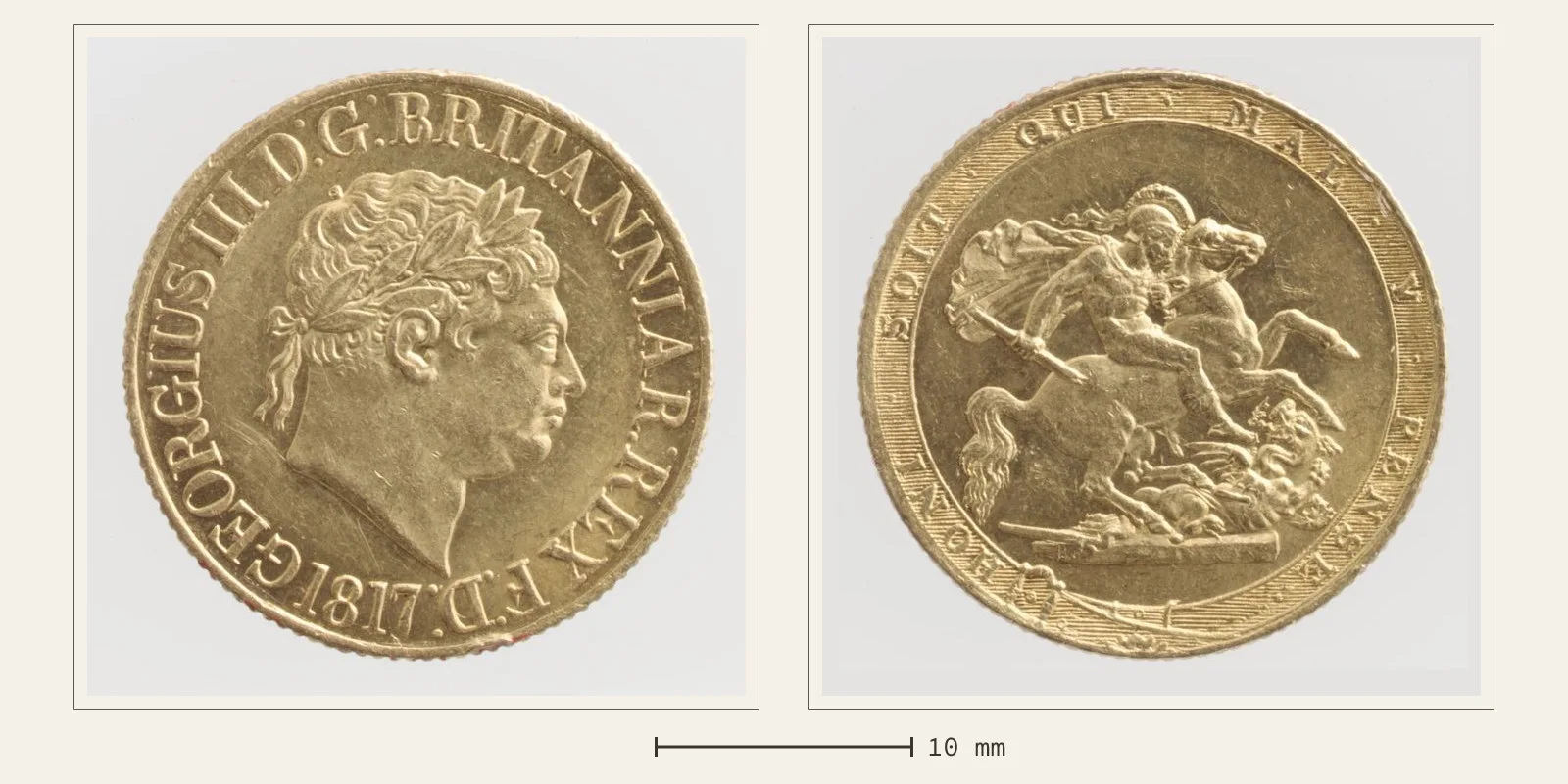
George III's sovereign of 1817. The obverse legend cuts Dei Gratia to D:G:, Britanniarum to BRITANNIAR: and Fidei Defensor to F:D:; the reverse shows St George inside the Garter.
Credit and reuse terms
"George III sovereign MET DP100391" by The Metropolitan Museum of Art — https://commons.wikimedia.org/wiki/File:George_III_sovereign_MET_DP100391.jpg — CC0 1.0 (https://creativecommons.org/publicdomain/zero/1.0/); changes: obverse placed beside the reverse, File:George III sovereign MET DP100392.jpg (CC0 image), each side cropped to a square and scaled to the same coin size on a paper-colored panel, 10 mm scale bar added from the museum diameter of 23 mm

Sovereign of George III, 1817, dies by Benedetto Pistrucci. The Metropolitan Museum of Art, 2001.217.14.
TL;DR. D G REG F D stands for Dei Gratia Regina Fidei Defensor, "by the grace of God, Queen, Defender of the Faith," struck as 7 of its 28 letters on a British penny of 2011. Each letter group is the start of one Latin word in the royal title, and the table on this page decodes 39 such cuts, from TR P on a Roman denarius of 188 to that penny.
In this file10 sections
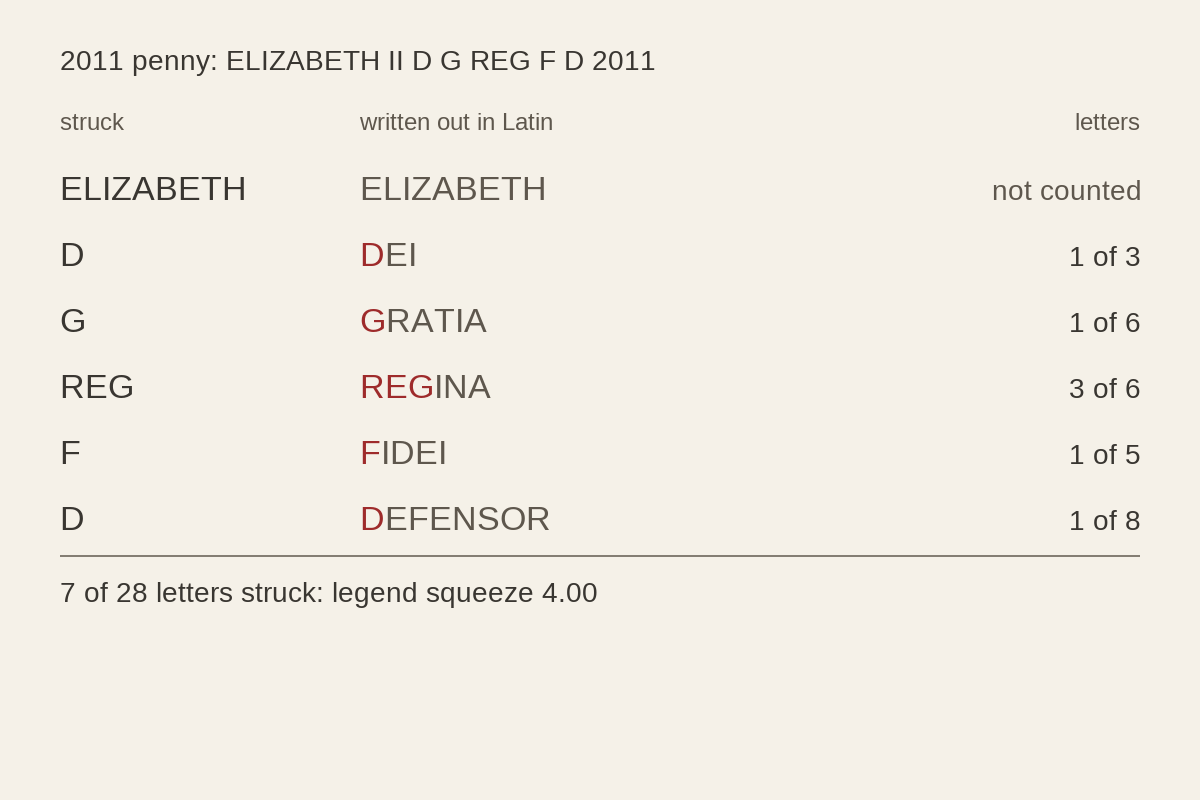
A British penny of 2011 spells out its queen's name and then cuts five Latin words to seven letters. Follow the ring of letters around the portrait: ELIZABETH II, then D, G, REG, F and D, then the date, as the coin cabinet of the Berlin State Museums records the legend of its penny of that year (Münzkabinett Berlin, object 18226740). The groups stand for Dei Gratia Regina Fidei Defensor, "by the grace of God, Queen, Defender of the Faith." In blazon terms the coin is a disc of copper-faced steel, the queen's head wearing a diadem and facing right, ringed by the name in full and the titles in initials.
The example coins in the decoder cut their words the same way. A Roman denarius shortens an emperor's offices to TR P and COS, a Byzantine solidus stamps CONOB under its reverse figure, and English gold lists a king's titles for France and Ireland as FRANC and HYB. The decoder expands 39 of these cuts, each with its Latin, an English gloss, the earliest date found for it and an example coin. The whole table downloads as a spreadsheet: coin legend decoder, CSV provenance and license of coin-legend-decoder-abbreviations.csv.
What do D, G, REG, F and D stand for?
The long form of the title appears in Herbert Grueber's 1899 handbook to the British Museum's coins. On 1 January 1801, Grueber writes, George III's title was ordered to be "Georgius Tertius, Dei Gratia, Britanniarum Rex, Fidei Defensor," as one consequence of the Act of Union with Ireland passed the year before. The flag of that union has its own page, the Union Jack.
Victoria's title in English shows how the words line up. A proclamation of 28 April 1876 recites it as "Victoria, by the Grace of God, of the United Kingdom of Great Britain and Ireland, Queen, Defender of the Faith." Her coins put the queen's word in Latin as REGINA, spelled out on the sovereign of 1838 and cut to REG on the penny of 1841 (Grueber Nos. 925 and 939).
Fidei Defensor reached the coins late. Grueber calls George I's gold, with five guineas dated from 1716, the first coinage to carry it, although the title had been on the Great Seal since Henry VIII. The same handbook lists an Irish crown of Charles II, dated with a question mark to 1649, whose legend already ends REX F D.
Written out, the five words on the 2011 penny come to 28 letters. The coin strikes 7. Banners & Banknotes calls that ratio, 28 divided by 7, the legend squeeze; for the penny it is 4.0, and the term page works the count through letter by letter.
Slide the drawing sideways to read every label, or open it at full size.
The 2011 penny's titles beside their Latin words, with the struck letters in red. ELIZABETH II and the date are not counted (tincture, not official).
Credit and reuse terms
"D G REG F D written out: the 2011 penny" by Banners & Banknotes, https://bannersandbanknotes.com/coins-banknotes/coin-legend-decoder/, licensed under CC BY 4.0 (https://creativecommons.org/licenses/by/4.0/)
How is a coin legend laid out?
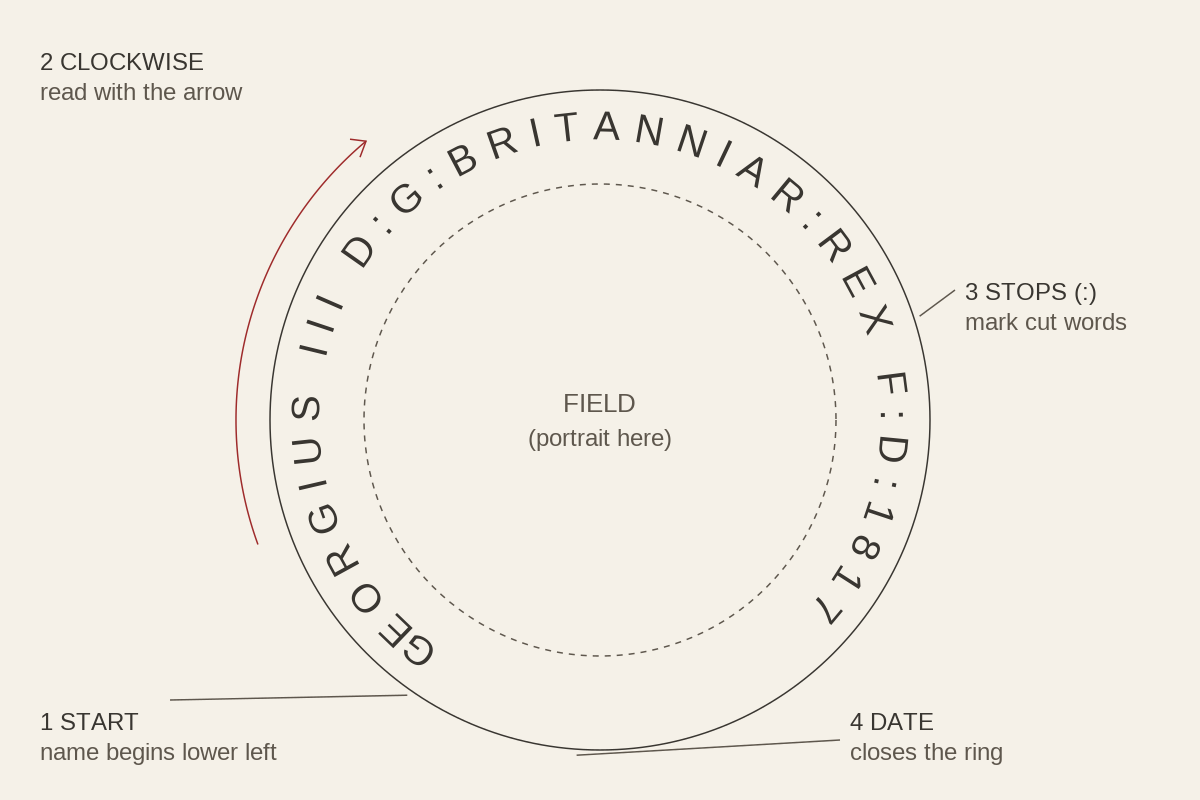
Start where the name starts. On the 1817 sovereign at the top of this page, GEORGIUS begins at the lower left and the legend runs clockwise over the head to the date at the bottom. Grueber's catalogue gives the same order: GEORGIUS III D : G : BRITANNIAR : REX F : D : 1817 (No. 853).
Look next at the stops. In Grueber's reading a colon follows each cut word, D, G, BRITANNIAR, F and D, while REX, struck in full, has none. Victoria's bronze penny of 1860 marks a queen's cuts the same way, D : G : BRITT : REG : F : D : (No. 942).
Stop on BRITANNIAR. Ten of its twelve letters are struck, the lightest cut on the coin.
The other cuts on the same ring go much deeper: D keeps one letter of DEI and G one of GRATIA. That is why the decoder gives every abbreviation its own row, and why the legend squeeze, counted later on this page, adds them up for the whole ring.
Slide the drawing sideways to read every label, or open it at full size.
The 1817 sovereign's legend as a diagram: it starts at the lower left, reads clockwise, marks cut words with colons and ends with the date (tincture, not official).
Credit and reuse terms
"How a coin legend is laid out: George III sovereign, 1817" by Banners & Banknotes, https://bannersandbanknotes.com/coins-banknotes/coin-legend-decoder/, licensed under CC BY 4.0 (https://creativecommons.org/licenses/by/4.0/)
What do IMP, AVG, TR P and COS mean on Roman coins?
A denarius of Commodus struck in 188 names the emperor on one side and lists his offices on the other. The obverse, around his head, reads M COMM ANT P FEL AVG BRIT; the reverse reads PM TR P XIII IMP VIII COS V PP, in the transcription of the Classical Numismatic Group catalogue (CoinID 60594).
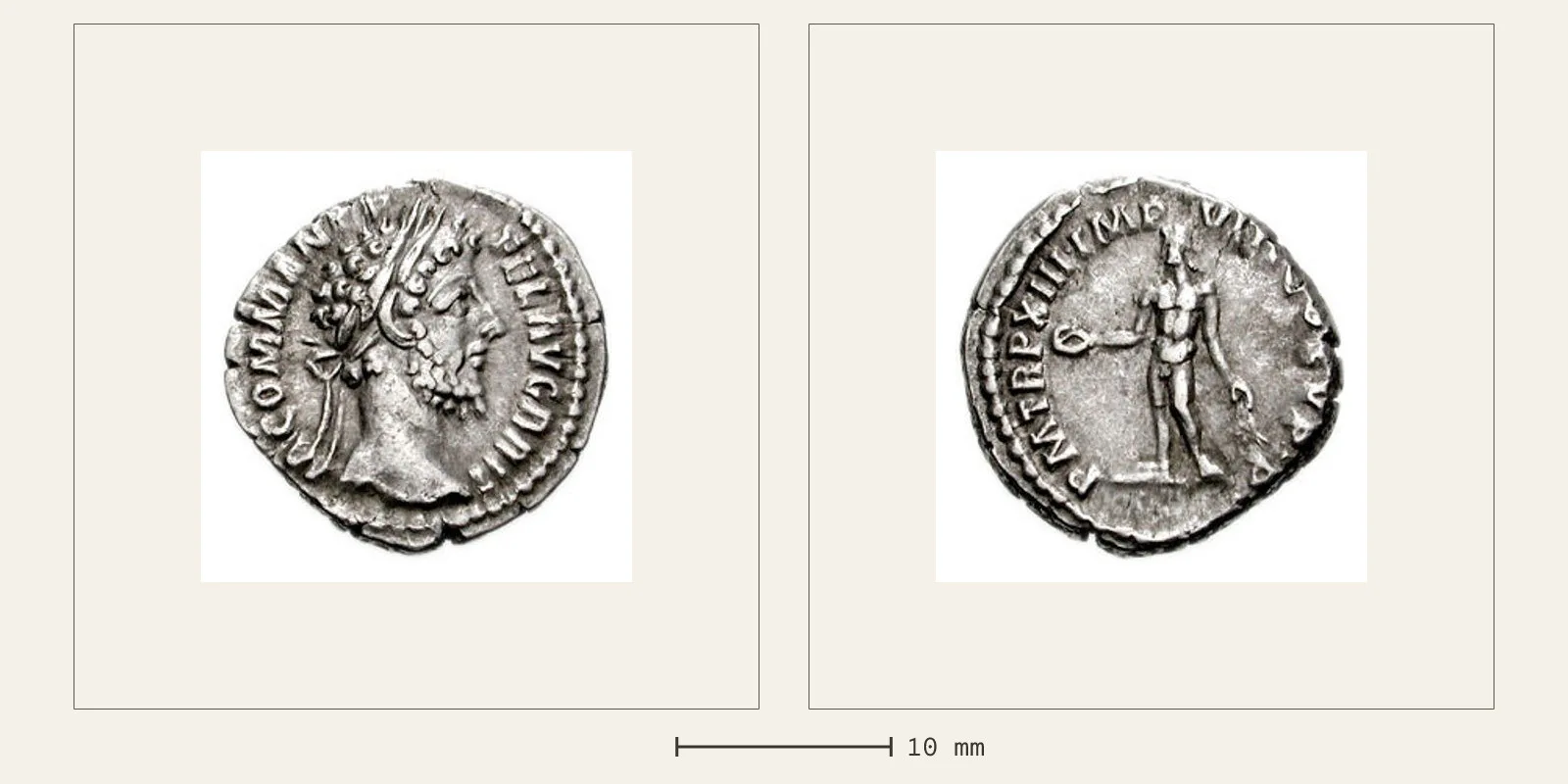
A denarius of Commodus, struck in 188. Around the head run his name and titles; around the standing figure, his offices with their counts: TR P XIII, IMP VIII, COS V.
Credit and reuse terms
"Commodus AR Denarius 188 752192" by Classical Numismatic Group, Inc. http://www.cngcoins.com — https://commons.wikimedia.org/wiki/File:Commodus_AR_Denarius_188_752192.jpg — CC BY-SA 2.5 (https://creativecommons.org/licenses/by-sa/2.5/); changes: each side cropped to a square, padded with the photo background and set on a paper-colored panel, scaled about 1.6 times, 10 mm scale bar added from the catalogue diameter of 18 mm

Denarius of Commodus, 188, issued under Commodus. Classical Numismatic Group catalogue, CoinID 60594.
The expansions below follow the Dictionary of Roman Coins of 1889, begun by Seth Stevenson and completed by Frederic Madden. Its English for a legend of Titus, "the August, Sovereign Pontiff, enjoying the Tribunitian power. Father of the country. Consul for the eighth time," supplies most of the glosses.
| On the coin | Latin | English |
|---|---|---|
| M | Marcus | Marcus (first name) |
| COMM | Commodus | Commodus |
| ANT | Antoninus | Antoninus |
| P | Pius | the Pious |
| FEL | Felix | the happy or lucky |
| AVG | Augustus | the August, the emperor's title |
| BRIT | Britannicus | a title taken for victories in Britain |
| PM | Pontifex Maximus | Sovereign Pontiff, the chief priest |
| TR P | Tribunitia Potestate | holding the tribune's power |
| IMP | Imperator | hailed Imperator for a victory; the number counts the times |
| COS | Consul | consul; the number counts the consulships |
| PP | Pater Patriae | Father of the country |
| S C | Senatus Consulto | by a decree of the Senate |
A sestertius of Commodus, a copper-alloy coin recorded by the Portable Antiquities Scheme, ends its reverse legend with SC (FindID 401165). When two emperors ruled together, the dictionary adds, mints doubled the G, AVGG for two Augusti and AVGGG for three, a custom it dates on coins to Septimius Severus.
Read the portrait and the legend together. The head shows whose coin this is. The legend states his rank with a precision no likeness has, down to the thirteenth year of tribunician power and the fifth consulship. By this page's count the obverse strikes 19 of 51 letters, a legend squeeze of 2.68, and the reverse strikes 13 of 61, or 4.69.
How do you date a Roman coin from TR P and COS?
TR P carries a number because the tribune's power was renewed every year. The 1889 dictionary explains that emperors reckoned the years of their reigns by these renewals and places the first coins dated this way in 23 BC. It also reports Eckhel's view that from the eighth year of Antoninus Pius the renewal fell on 1 January, a rule Eckhel himself did not give as certain.
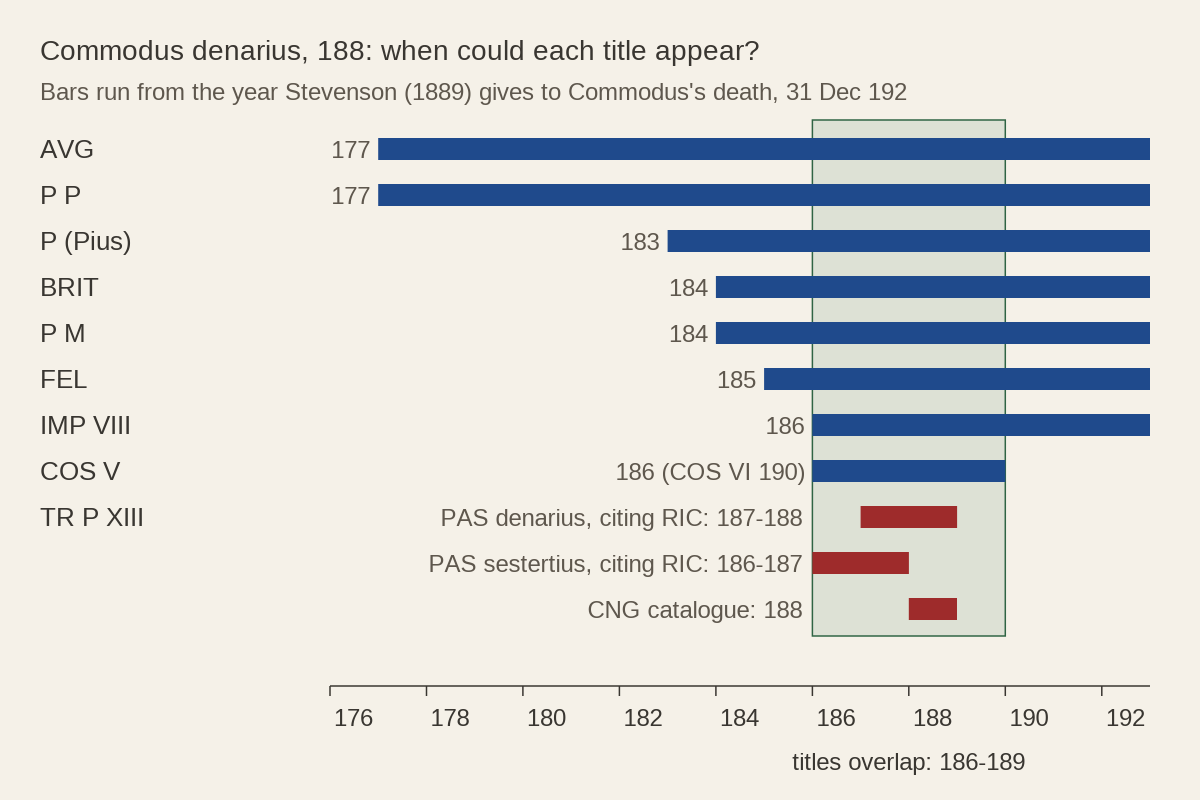
COS works differently, because an emperor did not hold the consulship every year. Commodus was consul for the fifth time in 186 and for the sixth in 190, so COS V covers 186 to 189 in the dictionary's chronology of his reign.
To date a coin from its titles:
- List every title that carries a number, and every title granted in a known year.
- Look up the years each one covers in a chronology of the emperor.
- Keep only the years in which all of them overlap.
- Use TR P, which changes every year, to narrow the span.
On the denarius of 188, AVG and PP date from 177, P from 183, BRIT and PM from 184, FEL from 185, and IMP VIII and COS V from 186, all by the dictionary's chronology. Their overlap is 186 to 189. TR P XIII narrows it, but the catalogues read for this page write the year three ways. One Portable Antiquities Scheme record citing Roman Imperial Coinage dates a denarius with TR P XIII to 187–188 (FindID 606624), another dates a sestertius that also reads TR P XIII to 186–187 (FindID 401165), and the CNG catalogue gives 188 for this one.
Slide the drawing sideways to read every label, or open it at full size.
Each blue bar runs from the year the 1889 dictionary gives for a title to Commodus's death in 192, COS V only to 189; the green band marks where all eight overlap (tincture, not official).
Credit and reuse terms
"Dating a Roman coin by its titles: Commodus denarius, 188" by Banners & Banknotes, https://bannersandbanknotes.com/coins-banknotes/coin-legend-decoder/, licensed under CC BY 4.0 (https://creativecommons.org/licenses/by/4.0/)
What does CONOB mean on a gold coin?
Under the standing Victory on a solidus of Anastasius I, in the exergue, the strip below the ground line, five letters read CONOB. Warwick Wroth's 1908 catalogue of the British Museum's Byzantine coins explains CONOB as CON, the mint name of Constantinople, with OB added, "an abbreviation of obryzum, 'refined gold'," and calls that reading "now generally admitted."
The 1889 dictionary reads the same letters another way. Its entry takes OB as the number 72, after a law of Valentinian I and Valens of about AD 367 that reckoned 72 solidi to the pound of gold. The same entry places the first CONOB under Gratian, Valentinian II and Theodosius I.
Both books agree that CON names Constantinople. Wroth adds that CONOB stayed on the gold until the reign of Leo III and was struck on the gold of Carthage, Rome and Ravenna as well, so on later coins the letters alone do not fix the mint.
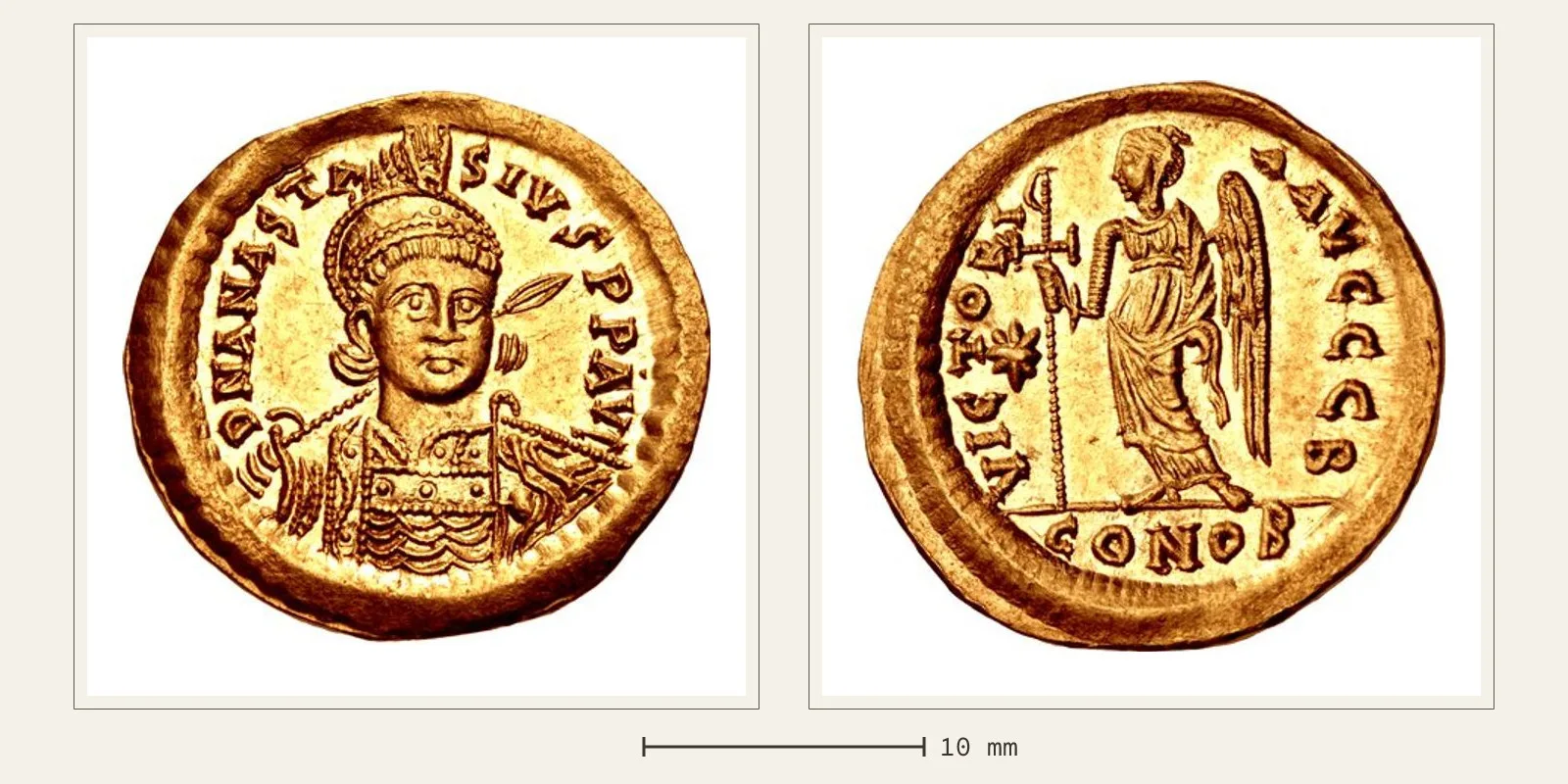
A solidus of Anastasius I from Constantinople. CONOB sits in the exergue below Victory's feet; the obverse names the emperor as D N ANASTASIVS P P AVG.
Credit and reuse terms
"Anastasius I, solidus, AD 507-517, DOC 7b" by Classical Numismatic Group, Inc. http://www.cngcoins.com — https://commons.wikimedia.org/wiki/File:Anastasius_I,_solidus,_AD_507-517,_DOC_7b.jpg — CC BY-SA 2.5 (https://creativecommons.org/licenses/by-sa/2.5/); changes: each side cropped to a square, padded with the photo background and set on a paper-colored panel, scaled 1.5 times, 10 mm scale bar added from the catalogue diameter of 21 mm

Solidus of Anastasius I, c. 507–518, Constantinople mint. Classical Numismatic Group catalogue, CoinID 325153.
The CNG catalogue dates this coin to about 507–518, and Wroth lists the same type under the Constantinople mint for the reign of Anastasius, 491 to 518. The coin's obverse shows how one pair of letters can change words between centuries.
| On the coin | Latin | English |
|---|---|---|
| D N | Dominus Noster | our lord |
| P P AVG | Perpetuus Augustus | perpetual Augustus |
| P F | Pius Felix | the Pious, the happy |
| CONOB | CON + OB | Constantinople + refined gold (Wroth), or + 72 (1889 dictionary) |
Wroth expands D N as Dominus noster and P P AVG as Perpetuus Augustus, the form he finds on coins from Anastasius I to Justinian II. On Commodus's denarius the same two Ps stood for Pater Patriae. By this page's count the solidus obverse strikes 7 of 30 letters, a legend squeeze of 4.29, while CONOB, an exergue mark with two expansions in print, gets no ratio.
What do ANGL, FRANC and DNS HYB mean on an English noble?
A gold noble of Henry VI in the Metropolitan Museum of Art shows a king standing in a ship on one side and a cross inside a frame of arches on the other. Grueber gives the legend around the ship as HENRIC' DI' GRA' REX ANGL' Z FRANC' DNS' HYB' (No. 331). Written out in Grueber's own spellings it is Henry, by the grace of God, King of England and France, Lord of Ireland: Rex Anglie, Francie, Dominus Hybernie.
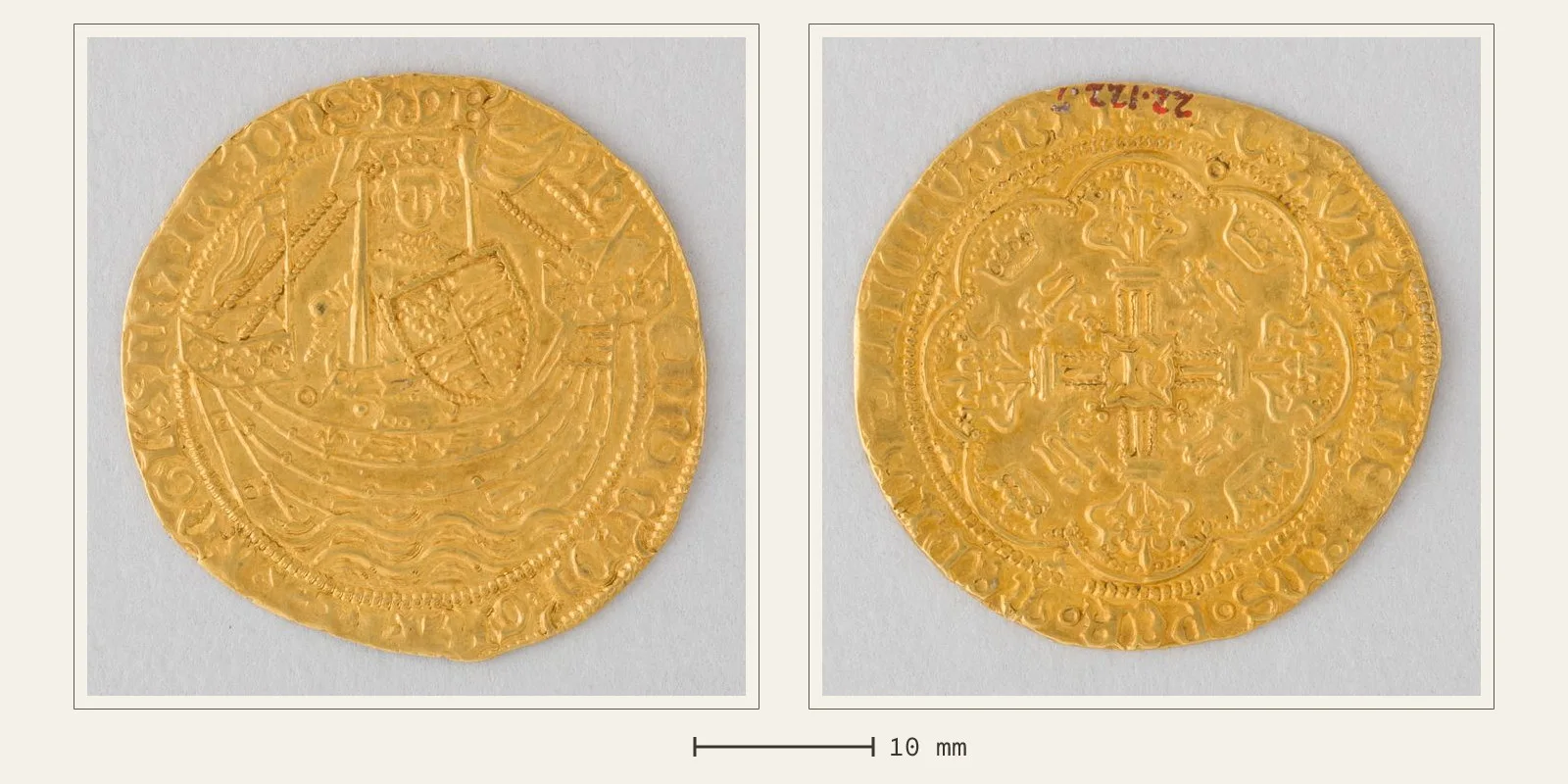
A gold noble of Henry VI. The legend around the ship carries his titles; the museum number 22.122.7 is inked on the reverse rim.
Credit and reuse terms
"Coin (Noble) Showing Henry VI MET 22.122.7 001nov2014" by The Metropolitan Museum of Art — https://commons.wikimedia.org/wiki/File:Coin_(Noble)_Showing_Henry_VI_MET_22.122.7_001nov2014.jpg — CC0 1.0 (https://creativecommons.org/publicdomain/zero/1.0/); changes: obverse placed beside the reverse, File:Coin (Noble) Showing Henry VI MET 22.122.7 002nov2014.jpg (CC0 image), each side cropped to a square and scaled to the same coin size on a paper-colored panel, 10 mm scale bar added from the museum diameter of 3.3 cm

Noble, 1422–1461, issued under Henry VI. The Metropolitan Museum of Art, 22.122.7.
The museum dates the coin 1422–61. Grueber's handbook places nobles of this design in Henry's first reign, the "heavy money" of 1422 to 1461. The same formula already stands on Edward III's noble of 1344, the earliest dated example of the whole formula in the table (No. 259).
Grueber prints the sign between ANGL and FRANC as Z and does not expand it on the noble. In his Irish series, though, he describes a groat of 1561 whose legends differ from the matching shilling's by "reading Z for ET" (Ireland No. 66). So the decoder reads the sign as ET, "and." Later legends spell the word out, as in FRAN' ET HIB' on James I's unite below.
| On the coin | Latin | English |
|---|---|---|
| DI GRA | Dei Gratia | by the grace of God |
| ANGL | Anglie or Angliae | of England |
| Z (a sign) | et | and |
| FRANC | Francie | of France |
| DNS | Dominus | Lord |
| HYB | Hybernie or Hiberniae | of Ireland |
| IHC | Iesus | Jesus |
| IMP (Matilda) | Imperatrix | empress |
The noble's titles get no legend squeeze here. Grueber's own prose spells the full words two ways, Anglie and Angliae, Hybernie and Hiberniae, so a count would depend on the spelling chosen rather than on the coin. The French title stayed in the legends until 1801, when, Grueber notes, the French arms and title were dropped along with the king's German titles.
IMP is not always an emperor. On pennies of Matilda, which Grueber thinks were probably struck in 1141, IMP stands for Imperatrix (empress). His reading prints the first two letters of [MA]TILDI in brackets, which the decoder marks as restored; those letters fall inside the name, which is not counted, so the legend scores 3.33.
The noble's reverse, IHC AVT' TRANSIENS PER MEDIVM ILLORV' IBAT, is a Bible verse rather than a title. Grueber's list of coin mottoes gives it as Luke 4:30, "But Jesus, passing through the midst of them, went His way," and his introduction reports that the legend "was considered to be a charm against thieves, or rather a warning against the practice of clipping." The Meaning ledger below dates that reading.
Why does James I's coin say MAG BRIT?
James I's first coins style him King of England and Scotland, ANG SCO. In the second year of his reign, Grueber writes, he took the title King of Great Britain, and his second issue, 1604 to 1619, reads MAG BRIT, Magnae Britanniae.
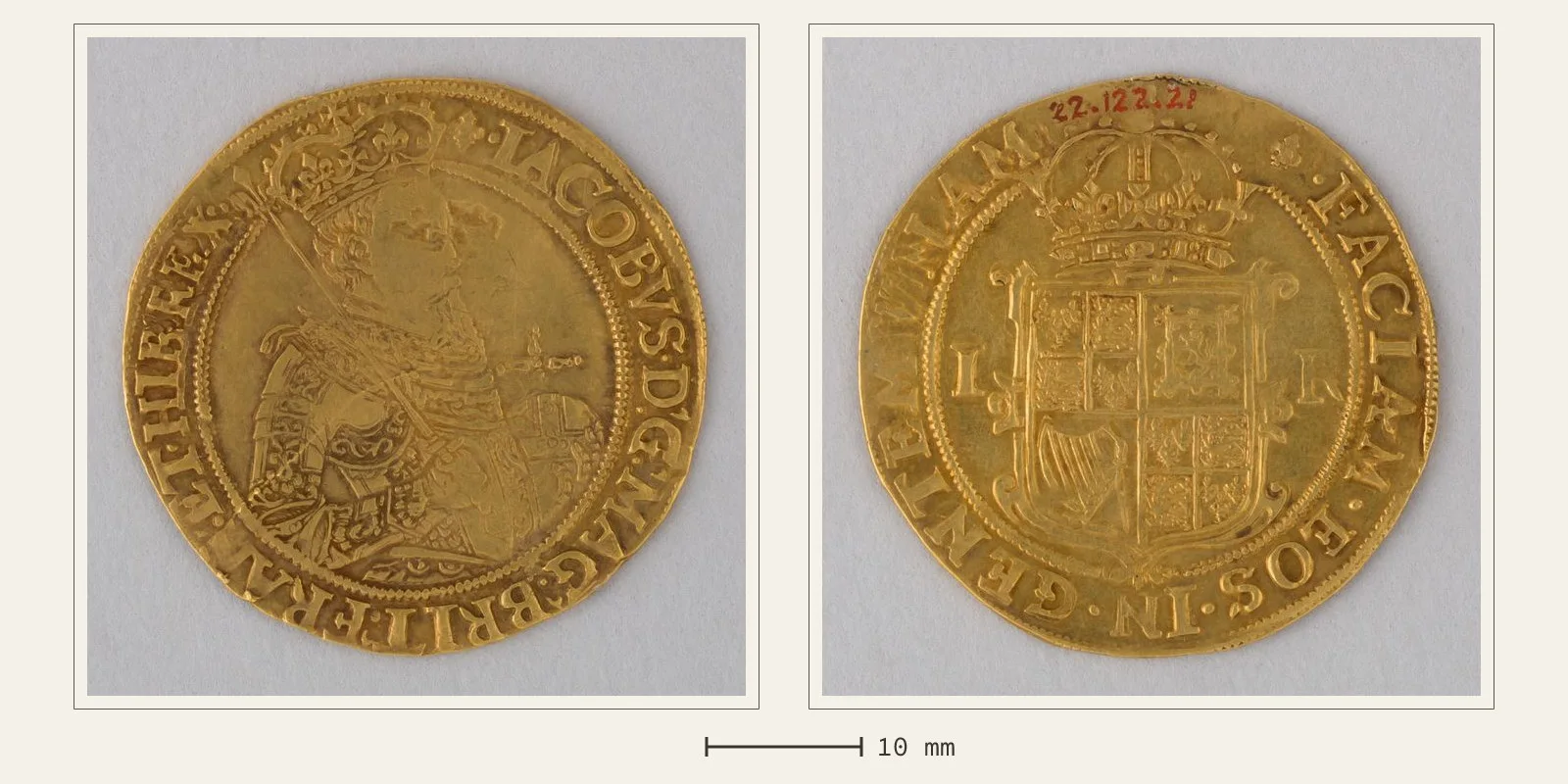
James I's unite, the gold type struck from 1604, with MAG BRIT now leading his titles. The reverse verse is spelled out in full, and the museum number is inked above the shield.
Credit and reuse terms
"Coin (Sovereign) Showing James I MET 22.122.21 004nov2014" by The Metropolitan Museum of Art — https://commons.wikimedia.org/wiki/File:Coin_(Sovereign)_Showing_James_I_MET_22.122.21_004nov2014.jpg — CC0 1.0 (https://creativecommons.org/publicdomain/zero/1.0/); changes: obverse placed beside the reverse, File:Coin (Sovereign) Showing James I MET 22.122.21 005nov2014.jpg (CC0 image), each side cropped to a square and scaled to the same coin size on a paper-colored panel, 10 mm scale bar added from the museum diameter of 3.8 cm

Unite (catalogued by the museum as a sovereign), 1605, issued under James I. The Metropolitan Museum of Art, 22.122.21.
Grueber describes this design as the unite of the second issue, reading IACOBVS D' G' MAG' BRIT' FRAN' ET HIB' REX (No. 533). The Metropolitan Museum catalogues its coin as a sovereign of 1605. The two names differ, and both are given here. The museum's 1605 falls inside Grueber's 1604 to 1619.
Cuts can change between coins of one issue. On the smaller Britain crown, Grueber notes, the same title reads FRA. for FRAN. (No. 535).
The reverse, FACIAM EOS IN GENTEM VNAM, has no abbreviations at all. Grueber traces it to Ezekiel 37:22, "I will make them one nation," and reads it as a reference to the union of the kingdoms. The Meaning ledger dates that reading too. The unite gets no ratio here, because HIB has two spellings in the sources: HIBERNIE on James's own Scottish copper, Hiberniae in Grueber's prose.
What do the long Georgian legends stand for?
George I brought a second set of titles, from his German lands. The reverse of his five guineas of 1717 reads BRVN ET L DVX S R I A TH ET EL, which Grueber writes out as "Brunsvicensis et Lunenburgensis Dux, Sacri Romani Imperii Archi-Thesaurarius et Elector" (No. 809). In English that is Duke of Brunswick and Luneburg, Arch-Treasurer and Elector of the Holy Roman Empire, the Royal Mint Museum's rendering of the same titles on George II's gold.
Stop on the L. One letter stands in for Lunenburgensis, fourteen letters long.
By this page's count the reverse strikes 13 of 69 letters, a legend squeeze of 5.31, the highest in the table. George II's five guineas of 1729 moved his titles to the reverse in initials, M B F ET H REX F D B ET L D S R I A T ET E (No. 824). No source read for this page spells every one of those words in Latin, so that legend gets no ratio.
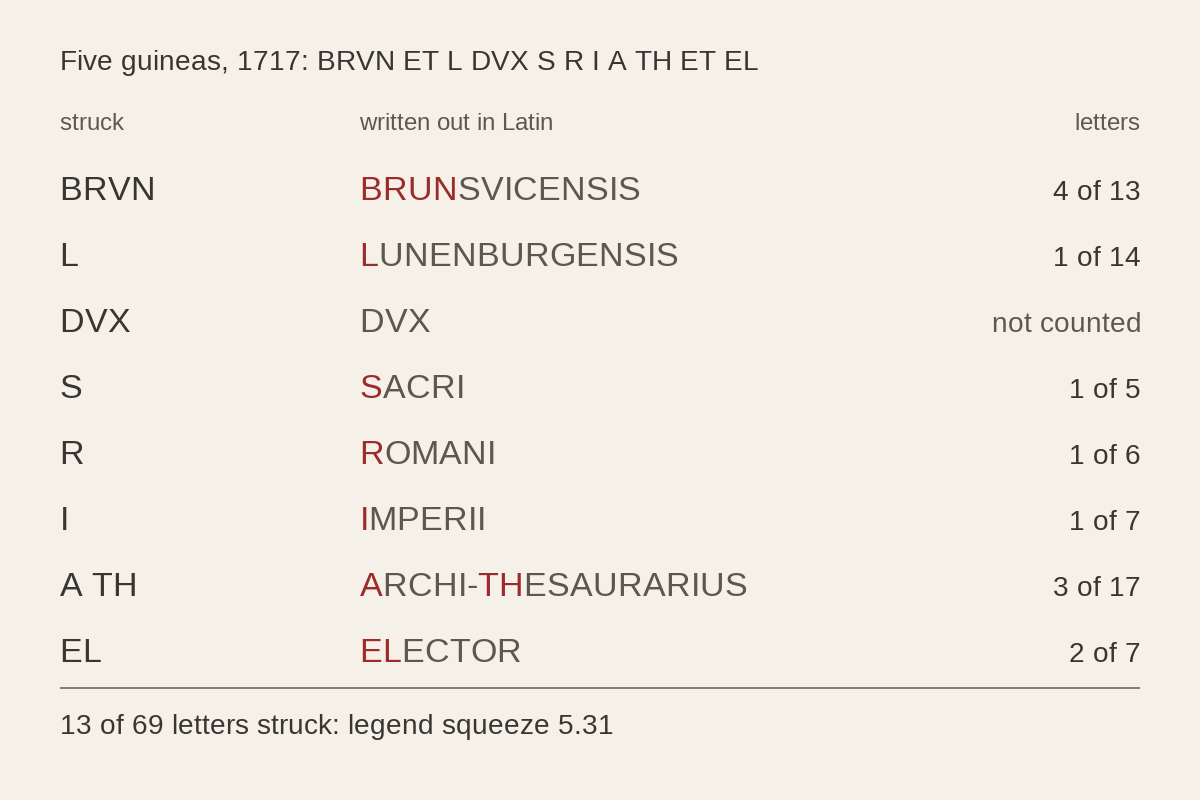
Slide the drawing sideways to read every label, or open it at full size.
George I's reverse legend of 1717 written out word by word, with the struck letters in red. ET and DVX are struck in full and not counted (tincture, not official).
Credit and reuse terms
"George I's German titles written out: five guineas, 1717" by Banners & Banknotes, https://bannersandbanknotes.com/coins-banknotes/coin-legend-decoder/, licensed under CC BY 4.0 (https://creativecommons.org/licenses/by/4.0/)
The German titles left the coins with the new style of 1801. Grueber records that the king's German titles "were also no longer used," and the Royal Mint Museum notes that the legend on the guineas of 1813 was simplified to BRITANNIARUM REX FIDEI DEFENSOR.
George III's sovereign of 1817, the coin at the top of this page, keeps five words of the 1801 title in cut form: D:G: for Dei Gratia, BRITANNIAR: for Britanniarum and F:D: for Fidei Defensor. By this page's count that is 14 of 34 letters, a legend squeeze of 2.43. A shilling of 1816 already cuts Britanniarum harder, to BRITT (No. 862).
When did IND IMP disappear from British coins?
IND IMP entered the royal style years before it reached British coins. A proclamation of 28 April 1876, printed in The London Gazette, added "Indiae Imperatrix" in Latin and "Empress of India" in English to Victoria's titles (issue 24319, p. 2667).
On British coins it arrives in 1893. Grueber gives the Jubilee gold of 1887 as VICTORIA D : G : BRITT : REG : F : D :, without it, and the new portrait of 1893 as VICTORIA DEI GRA BRITT REGINA FID DEF IND IMP (Nos. 945 and 959).
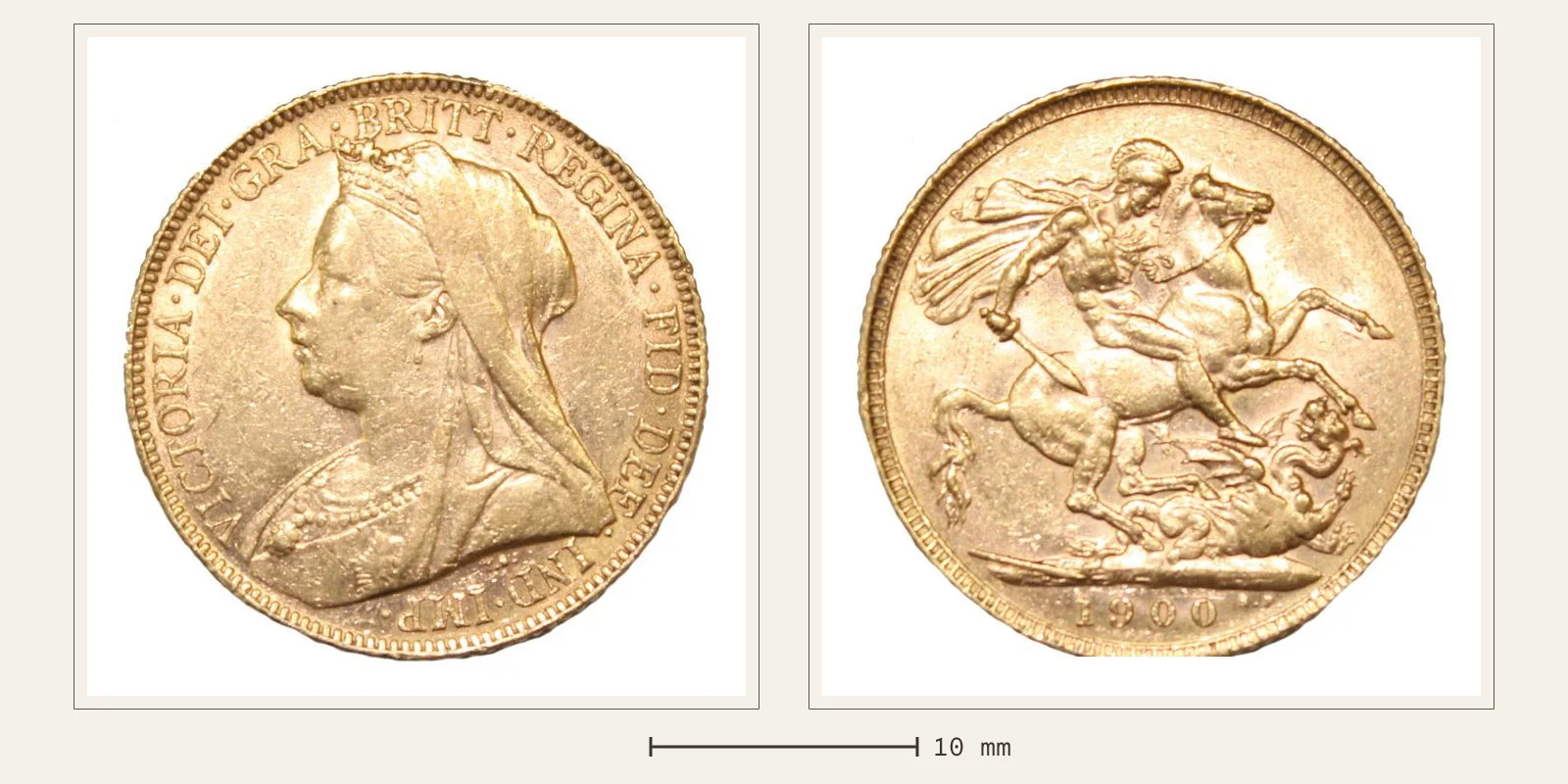
A sovereign of Victoria dated 1900. The legend runs on past FID DEF to IND IMP, the Latin title proclaimed in 1876 and struck on British coins from 1893.
Credit and reuse terms
"COIN (FindID 980648)" by Dyfed Archaeological Trust — https://commons.wikimedia.org/wiki/File:COIN_(FindID_980648).jpg — CC BY 2.0 (https://creativecommons.org/licenses/by/2.0/); changes: photographed centimeter scale cropped out, each side cropped to a square and set on a paper-colored panel, 10 mm scale bar added from the recorded diameter of 22.05 mm

Sovereign, 1900, issued under Victoria. Portable Antiquities Scheme, FindID 980648.
This sovereign, recorded by the Portable Antiquities Scheme, carries the full sequence around the veiled bust. By this page's count it strikes 20 of 47 letters, a legend squeeze of 2.35, the lowest in the table, because DEI and REGINA are struck whole.
For a king the same letters expand to Indiae Imperator. The Indian Independence Act 1947 gave Parliament's assent to "the omission from the Royal Style and Titles of the words 'Indiae Imperator' and the words 'Emperor of India'" (section 7(2)).
The latest IND IMP read for this page is on a shilling of George VI dated 1948, whose reverse reads FID:DEF: IND: IMP (Portable Antiquities Scheme, FindID 431941). By 2011 the penny's titles stop at F D.
The legend squeeze, counted
The legend squeeze divides the letters of a legend written out in full by the letters actually struck. Its fixed rules expand Latin into Latin, count letters only (no spaces, stops, dates or numerals), count a ligature by the letters it stands for, leave out words struck in full, and mark letters a catalogue supplies as restored.
Eight legends on this page meet those rules. The chart below ranks them by this page's count: George I's German titles top the table at 5.31 and Victoria's 1900 sovereign comes last at 2.35; the 2011 penny, at 4.00, is fourth.
Other legends get no ratio, each for a stated reason: two spellings of the full words (the noble and the unite), a word no source read writes out (FOR RED on the sestertius, BR OMN on the 1948 shilling), a catalogue spelling of AVG as AVC, or an exergue mark rather than a legend (CONOB). The ratio shows how far a title was cut down and nothing more. It does not measure how crowded a coin is, or what anyone reading it understood.
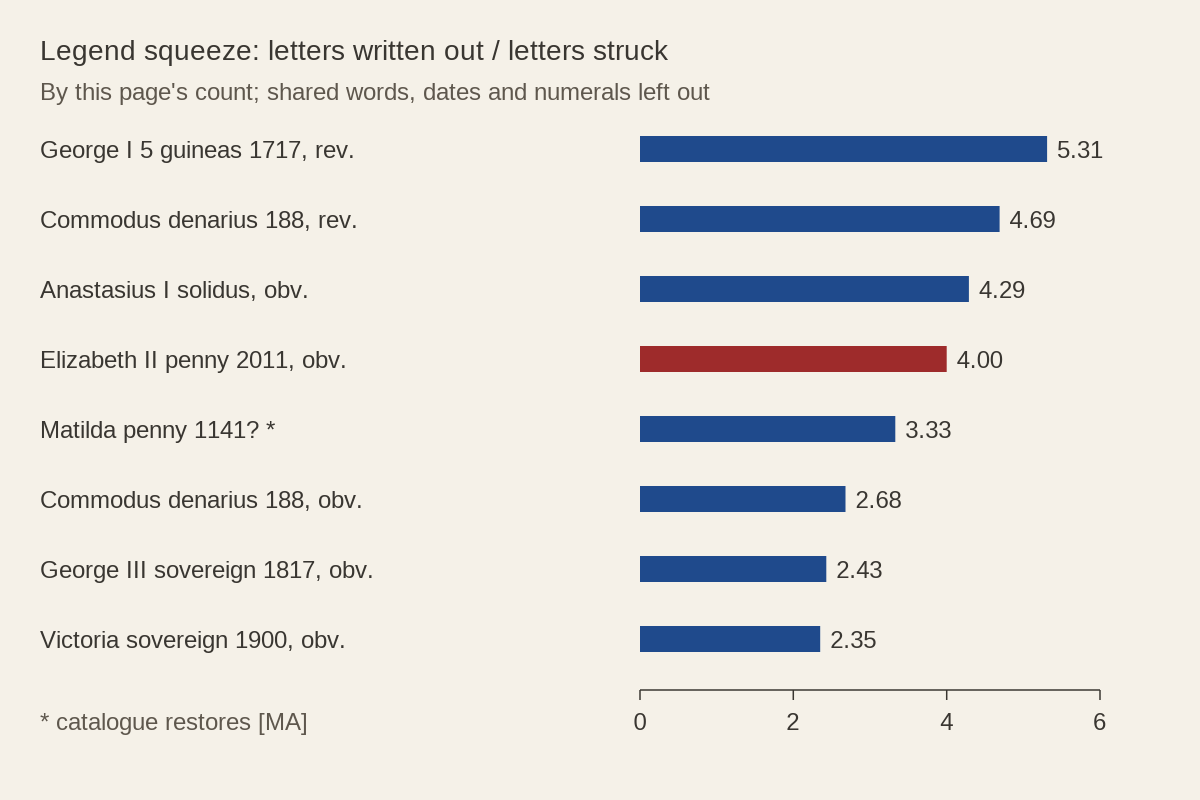
Slide the drawing sideways to read every label, or open it at full size.
Legend squeeze for the eight legends that meet the counting rules, by this page's count; the 2011 penny is drawn in red (tincture, not official).
Credit and reuse terms
"Legend squeeze of eight coin legends" by Banners & Banknotes, https://bannersandbanknotes.com/coins-banknotes/coin-legend-decoder/, licensed under CC BY 4.0 (https://creativecommons.org/licenses/by/4.0/)
Every count, expansion and example coin is in the decoder table (CSV) provenance and license of coin-legend-decoder-abbreviations.csv. Playing cards have their own small signs to decode, and the archive's comparison of Europe's five suit systems sets them side by side.
Shrink strip
At 16 and 48 pixels wide, the letters of the legend diagram break up into blocks. At 160 pixels the words of the 1817 legend can be made out again.
Shown at its drawn size. On a narrow screen, scroll sideways to see the whole strip.
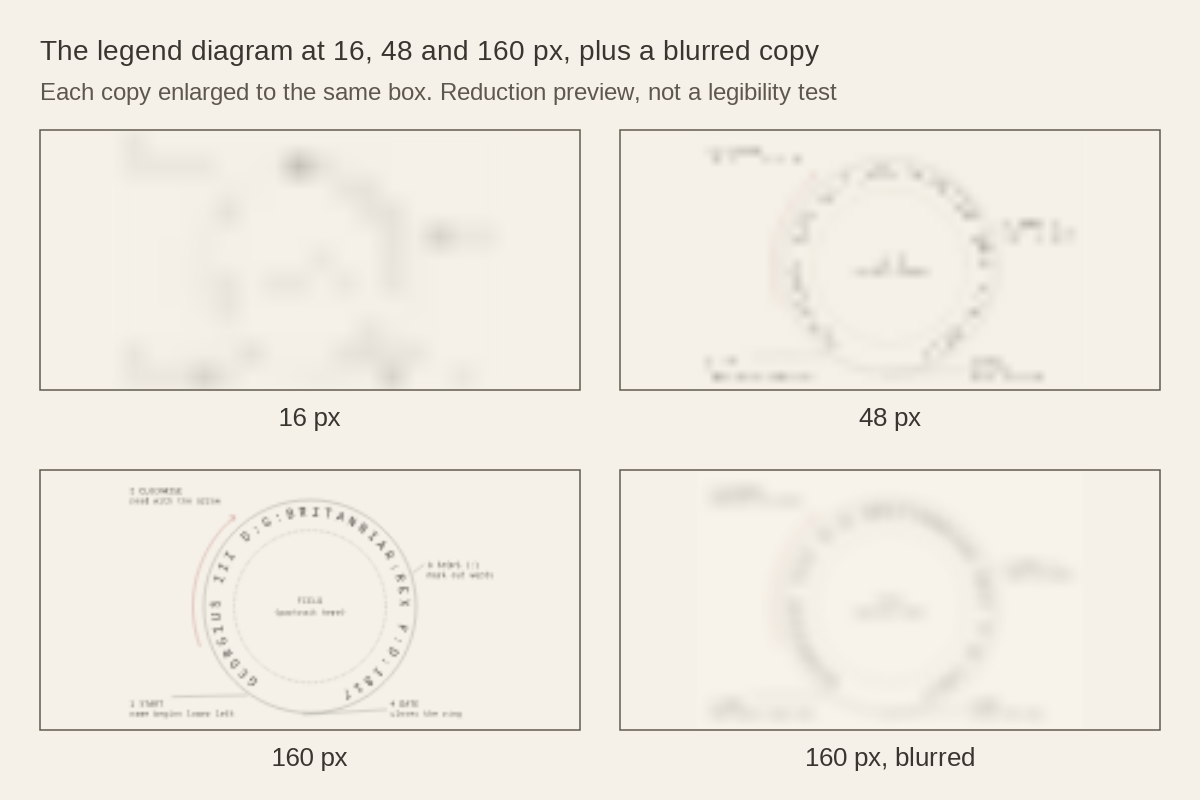
The 1817 legend diagram at 16, 48 and 160 pixels wide, plus a blurred copy (tincture, not official). Reduction preview, not a legibility test.
Credit and reuse terms
"Shrink strip: the 1817 legend diagram at 16, 48 and 160 px" by Banners & Banknotes, https://bannersandbanknotes.com/coins-banknotes/coin-legend-decoder/, licensed under CC BY 4.0 (https://creativecommons.org/licenses/by/4.0/). Derived from "How a coin legend is laid out: George III sovereign, 1817".
Meaning ledger
| Meaning | Earliest we can document | Year | Label | Notes |
|---|---|---|---|---|
| The noble's reverse legend, IHC AVT TRANSIENS PER MEDIVM ILLORV IBAT, served as a charm against thieves or a warning against clipping | Grueber, Handbook of the Coins of Great Britain and Ireland (1899), p. xxix: the legend "was considered to be a charm against thieves" | 1899 | [first recorded later] | The legend is already on Edward III's noble of 1344 (Grueber No. 259). Grueber also suggests a reference to the victory the noble's type commemorates. No earlier statement found. |
| The unite's reverse, FACIAM EOS IN GENTEM VNAM, refers to the union of the kingdoms | Grueber (1899), p. 101 | 1899 | [first recorded later] | The verse is Ezekiel 37:22. The unite belongs to James I's second issue, 1604–1619. No document of the issue read for this page states the reason. |
How each label is decided: The After-Meaning, the four labels.
Sources
- Münzkabinett der Staatlichen Museen zu Berlin, 18226740: Great Britain, penny, 2011 (Berlin Münzkabinett Online Catalogue). ikmk.smb.museum Read: catalogue record
- The London Gazette, issue 24319, 28 April 1876, p. 2667: royal proclamation adding "Indiae Imperatrix" in Latin and "Empress of India" in English to the royal style. parliamentum.org Read: page 2667 (scanned copy)
- Indian Independence Act 1947 (10 & 11 Geo. 6 c. 30), section 7, as enacted. legislation.gov.uk. legislation.gov.uk Read: section 7
- Herbert A. Grueber, Handbook of the Coins of Great Britain and Ireland in the British Museum (London: Trustees of the British Museum, 1899). archive.org Read: pages xxix, lvii, 11, 17–19, 38, 42–45, 48, 55, 62, 96, 100–101, 143–145, 148–150, 156–160, 198–199, 223, 228, 232, 233, 239 and 254
- Warwick Wroth, Catalogue of the Imperial Byzantine Coins in the British Museum, vol. 1 (London: Trustees of the British Museum, 1908). archive.org Read: pages xcix, civ and 1
- Seth William Stevenson, C. Roach Smith and Frederic W. Madden, A Dictionary of Roman Coins, Republican and Imperial (London: George Bell and Sons, 1889). archive.org Read: entries Commodus, COMM., IMP., COS., P. F., D. N., EX. S. C., CAES. DIVI. F., AVGG., Tribunitia Potestas, Brittania, Augustus Caesar, Antoninus Pius, P. P., P.M., PIVS, Q. C. M. P. I., Cornelia and ADSERTORI LIBERTATIS PVBLICAE; pages 835–836 (OB and CONOB)
- The Metropolitan Museum of Art, 2001.217.14, George III sovereign (Benedetto Pistrucci), 1817: museum record as mirrored on Wikimedia Commons. commons.wikimedia.org Read: file page
- The Metropolitan Museum of Art, 22.122.7, Coin (Noble) Showing Henry VI, 1422–61: museum record as mirrored on Wikimedia Commons. commons.wikimedia.org Read: file page
- The Metropolitan Museum of Art, 22.122.21, Coin (Sovereign) Showing James I, 1605: museum record as mirrored on Wikimedia Commons. commons.wikimedia.org Read: file page
- Classical Numismatic Group, catalogue description of a denarius of Commodus struck in 188 (CoinID 60594; RIC III 167), as given on Wikimedia Commons. commons.wikimedia.org Read: file page
- Classical Numismatic Group, catalogue description of a denarius of Commodus struck in 182 (CoinID 60586; RIC III 42), as given on Wikimedia Commons. commons.wikimedia.org Read: file page
- Classical Numismatic Group, catalogue description of a solidus of Anastasius I, Constantinople, struck about 507–518 (CoinID 325153; DOC 7b), as given on Wikimedia Commons. commons.wikimedia.org Read: file page
- Classical Numismatic Group, catalogue description of a solidus of Valentinian II, Constantinople, struck 382/383 (CoinID 300830; RIC IX 67a4), as given on Wikimedia Commons. commons.wikimedia.org Read: file page
- Portable Antiquities Scheme, record FindID 606624: silver denarius of Commodus, AD 187–88, citing RIC III 164, as given on Wikimedia Commons. commons.wikimedia.org Read: file page
- Portable Antiquities Scheme, record FindID 401165 (BUC-669311): copper-alloy sestertius of Commodus, AD 186 to 187, citing RIC III 513, as given on Wikimedia Commons. commons.wikimedia.org Read: file page
- Portable Antiquities Scheme, record FindID 980648: gold sovereign of Victoria dated 1900 (Dyfed Archaeological Trust), as given on Wikimedia Commons. commons.wikimedia.org Read: file page
- Portable Antiquities Scheme, record FindID 431941: shilling of George VI dated 1948, as given on Wikimedia Commons. commons.wikimedia.org Read: file page
- Royal Mint Museum, "George II" (British Monarchs). royalmintmuseum.org.uk Read: full text
- Royal Mint Museum, "George III" (British Monarchs). royalmintmuseum.org.uk Read: full text
- The London Gazette, issue 49328 (22 April 1983), page 5509: royal proclamation of 20 April 1983, "Determining the Specification and Design of a One Pound Coin and Determining the Amount for which the Said Coin is to be Legal Tender" (new nickel-brass coin; obverse inscription "ELIZABETH · II D · G · REG · F · D ·"; in force 21 April 1983). thegazette.co.uk Read: page 5509


Counter-sign
Counter-sign: The Godless florin of 1849. Its obverse reads only VICTORIA REGINA 1849, with no Dei Gratia in any form, and Grueber records the name that absence earned it, the "Godless or Graceless Florin" (No. 930).
- Joachimsthaler: the next coin in the archive's decoder, its legends counted by the same five rules and the same CSV columns.
- Da Ming Tongxing Baochao: what happens to a legend when it is printed on paper money instead of struck into metal.
Cite this page
Banners & Banknotes. “D G REG F D: A Decoder for the Latin Abbreviations on Coins.” Published 14 October 2026; last substantive revision 23 October 2026. https://bannersandbanknotes.com/coins-banknotes/coin-legend-decoder/. Accessed [date you read it].
Corrections
- 2026-10-23 — The Blazon card and the decoder table (CSV) gave 2011, a penny in the Münzkabinett Berlin (object 18226740), as the earliest year in the sources read for the exact legend D G REG F D, although the Union Jack page cites a royal proclamation of 1983 with the same legend — Both now give 1983: a royal proclamation of 20 April 1983 sets the obverse inscription of the one-pound coin as "ELIZABETH · II D · G · REG · F · D ·". That is the earliest year in the sources read, not a year of first use, and the 2011 penny stays as the example coin — The London Gazette, issue 49328 (22 April 1983), p. 5509 (listed under Sources)