Object file · No. 0006
Da Ming Baochao: Paper Money Drawn as Ten Strings of Coins
Blazon card
- Field
- Upright oblong of mulberry-bark paper, about 34 by 22 cm in two museum records; one chi by six cun in the Ming Shi; color qing (blue-gray) in the Ming Shi.Ming Shi, juan 81; Silk Road Seattle (British Museum record); Valencia museum description
- Charge
- Ten strings of copper coins under the value yi guan, between two columns of seal script; the title Da Ming tongxing baochao in a band across the head; a seven-column text panel below; a patterned border, dragons in the Ming Shi.Valencia note; Ming Shi, juan 81
- Tincture
- No official color values. Paper qing (blue-gray) in the Ming Shi; black print and faded red seal impressions on the Valencia note. Figures here use site tinctures (tincture, not official).Ming Shi, juan 81; Valencia note
- Difference
- The text panel names the Ministry of Revenue (Hubu) where notes printed before 1380 named the Secretariat (Zhongshu Sheng); the 500-wen note shows five strings, not ten.Ming Shi, juan 81; Valencia note
- Issued by
- Ministry of Revenue (Hubu), Ming government, from 1380; the Secretariat (Zhongshu Sheng) issued the notes from 1375 until it was abolished in 1380.Ming Shi, juan 81
- First documented
- 1375, the order to the Secretariat to print Da Ming baochao; earliest we can document (Taizu shilu, juan 98, and Ming Shi, juan 81).Taizu shilu, juan 98; Ming Shi, juan 81; era years from Mayers 1874
- Spec source
- Design, values and text: Ming Shi, juan 81. Valencia note: no number given. British Museum note 1942-8-5-1, as given by Silk Road Seattle.Ming Shi, juan 81; Valencia museum description; Silk Road Seattle
Blazon card as CSV da-ming-tongxing-baochao-blazon.csvprovenance and license of da-ming-tongxing-baochao-blazon.csv
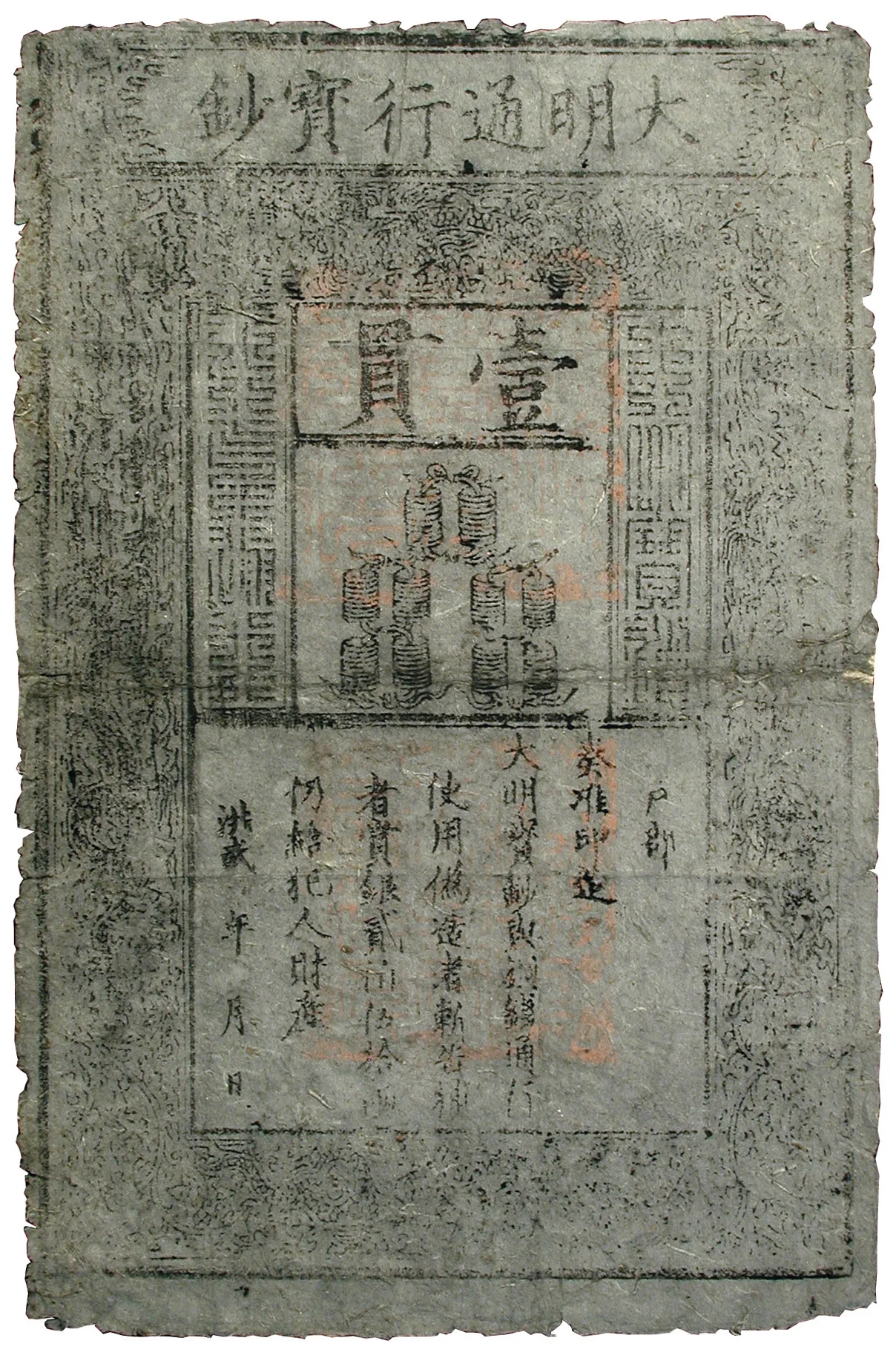
A one-guan Da Ming tongxing baochao, the Ministry of Revenue issue, printed 1380 or later; the museum's description gives circa 1375.
Credit and reuse terms
"Bitllet Ming 1375 - Museu de Prehistòria de València" by Museu de Prehistòria de València — https://commons.wikimedia.org/wiki/File:Bitllet_Ming_1375_-_Museu_de_Prehist%C3%B2ria_de_Val%C3%A8ncia.jpg — CC BY-SA 3.0 (https://creativecommons.org/licenses/by-sa/3.0/)

Da Ming tongxing baochao, one guan, printed 1380 or later, Ministry of Revenue (Hubu). Museu de Prehistòria de València, no number given.
TL;DR. The Da Ming tongxing baochao, paper money the Ming government began printing in 1375, shows ten strings of copper coins because its value, one guan, was set at 1,000 coins. Its printed text names the office that issued it and orders forgers beheaded.
In this file7 sections
The Ming dynasty's one-guan banknote carries a picture of the coins it was worth: ten strings of them. Look below the two large characters in the upper middle of the sheet, which read yi guan, "one string." Two strings hang at the top of the picture and eight more stand below them in two blocks of four, each drawn as a stack of round coins on a cord. In the stranger's read, which names only shapes, colors and positions: an upright gray sheet in a dense patterned border, a band of six characters across the head, a framed panel with two large characters over ten coin strings between two columns of squared script, and below it seven columns of smaller characters, with faded red stamps over both panels.
The title band reads Da Ming tongxing baochao, which a University of Washington exhibit page translates as "Great Ming Circulating Treasure Note." The Ming Shi, the dynasty's official history, records that in 1375 an imperial order told the Secretariat (Zhongshu Sheng) to print Da Ming baochao to circulate among the people, each one-guan note equal to 1,000 coins or one liang of silver. The note in the photograph, from the Museu de Prehistòria de València, names a later issuer, the Ministry of Revenue (Hubu).
What does the text on a Ming banknote say?
The note carries four blocks of writing. Read from the top, they run from the title band down to a seven-column text panel, and the drawing below marks where each one sits.
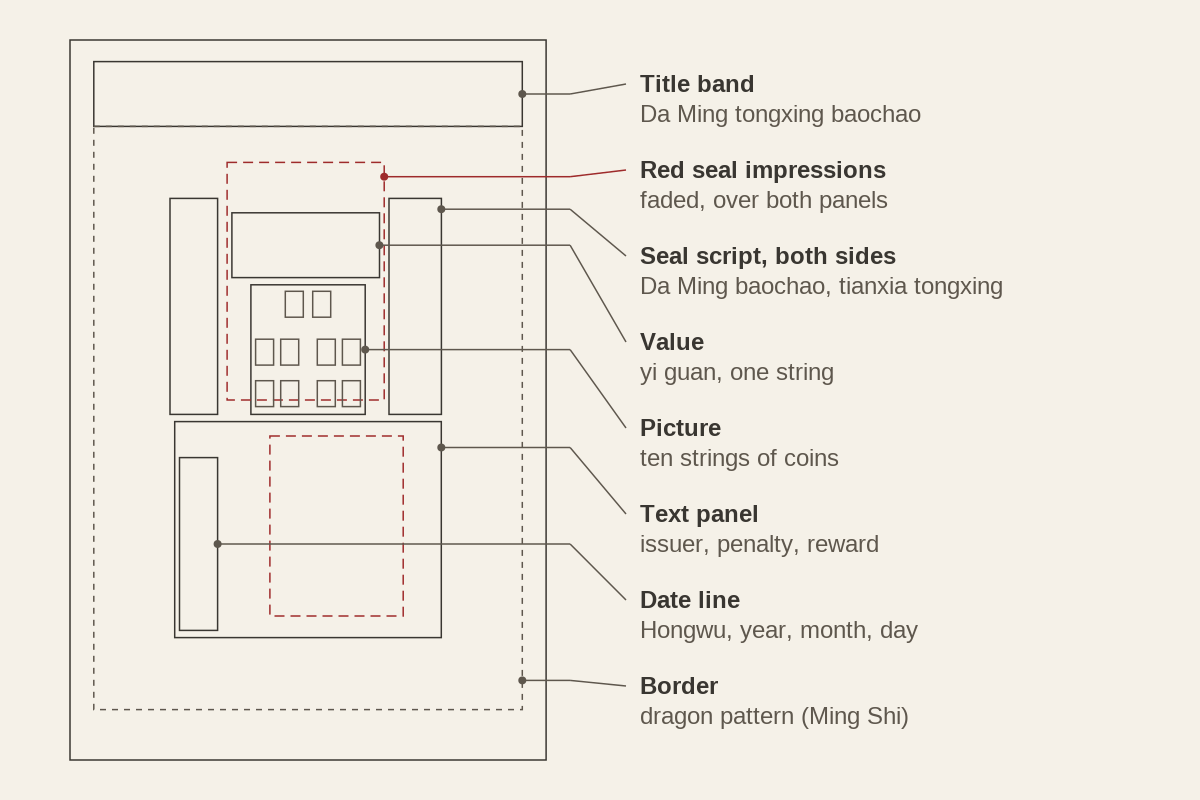
Slide the drawing sideways to read every label, or open it at full size.
Where each block of writing sits on the one-guan note, placed from the Valencia photograph; positions are approximate (tincture, not official).
Credit and reuse terms
"Ming one-guan note: where the writing sits" by Banners & Banknotes, https://bannersandbanknotes.com/coins-banknotes/da-ming-tongxing-baochao/, licensed under CC BY 4.0 (https://creativecommons.org/licenses/by/4.0/)
The title band runs right to left across the head, six characters for Da Ming tongxing baochao. Inside the frame, two much larger characters give the value, yi guan.

The title band, read right to left: Da Ming tongxing baochao, Great Ming Circulating Treasure Note.
Credit and reuse terms
"Bitllet Ming 1375 - Museu de Prehistòria de València" by Museu de Prehistòria de València — https://commons.wikimedia.org/wiki/File:Bitllet_Ming_1375_-_Museu_de_Prehist%C3%B2ria_de_Val%C3%A8ncia.jpg — CC BY-SA 3.0 (https://creativecommons.org/licenses/by-sa/3.0/); changes: cropped to the title band (pixels 0–1208 across, 15–245 down)
Da Ming tongxing baochao, one guan, printed 1380 or later, Ministry of Revenue (Hubu). Museu de Prehistòria de València, no number given.
On either side of the picture stands a column of seal script, drawn here in squared, maze-like strokes. The Ming Shi gives the eight characters of the two columns as Da Ming baochao, tianxia tongxing, which this page translates as "Great Ming treasure note, current everywhere under heaven." It adds that a dragon pattern runs around the outside.
The longest block is the text panel at the bottom, seven columns read from right to left. It names the issuing office and says the note was printed with the throne's approval to circulate alongside copper coins. A penalty and a reward close it. The last column is the date line, printed with gaps: the reign title Hongwu, then the characters for year, month and day, with nothing between them.
Why are there ten strings of coins on the note?
The Ming Shi explains the picture in one phrase: ten strings make one guan. The 500-wen note, it adds, shows five strings, and the smaller values follow the same design with fewer. Six values were issued in 1375, from one guan down to 100 wen, and one wen was a single copper coin at the official rate of 1,000 to the guan.
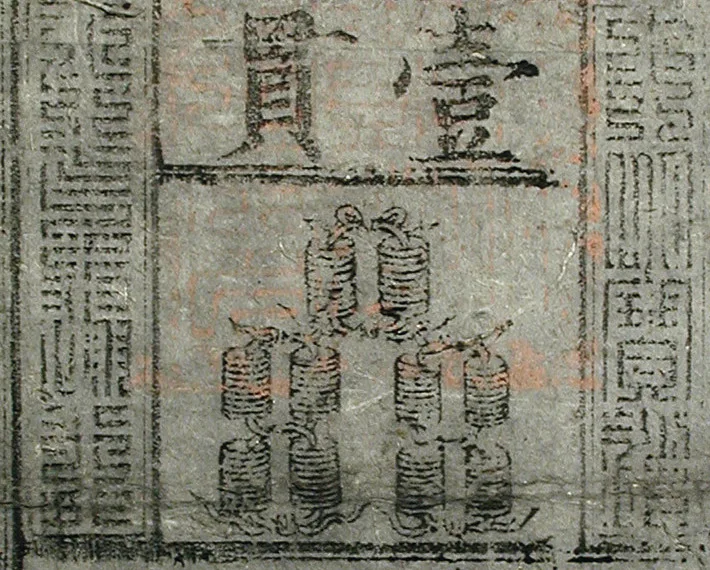
Yi guan, one string, above the ten strings of coins it stands for, between two columns of seal script.
Credit and reuse terms
"Bitllet Ming 1375 - Museu de Prehistòria de València" by Museu de Prehistòria de València — https://commons.wikimedia.org/wiki/File:Bitllet_Ming_1375_-_Museu_de_Prehist%C3%B2ria_de_Val%C3%A8ncia.jpg — CC BY-SA 3.0 (https://creativecommons.org/licenses/by-sa/3.0/); changes: cropped to the value, the ten strings and the two seal-script columns (pixels 240–950 across, 420–990 down)
Da Ming tongxing baochao, one guan, printed 1380 or later, Ministry of Revenue (Hubu). Museu de Prehistòria de València, no number given.
Stop on the top pair of strings. Their cords rise above the coins and curl over in two loops.
By this page's arithmetic, each string therefore stands for 100 coins, although no stack on the note shows anywhere near that many. The Ming Shi describes the picture without giving a reason for it. A University of Washington exhibit page on a British Museum example suggests the strings were printed "presumably for the benefit of the illiterate," and the ledger below dates that reading to the page.
Showing a larger amount with more copies of one sign, rather than with one bigger sign, was written down as a rule much later and in another setting. Otto Neurath set it down in 1936 as the first rule for number fact pictures in International Picture Language: The First Rules of Isotype, the system covered in Isotype: "a greater number of signs is representative of a greater amount of things." The likeness to the Ming design is one of method only. Nothing in these sources connects the two.
What did the note threaten forgers with?
The text panel joins a death sentence to a reward. In pinyin it reads Hubu zouzhun yinzao Da Ming baochao yu tongqian tongxing shiyong, weizao zhe zhan, gaobu zhe shang yin erbai wushi liang, reng gei fanren caichan, followed by the date line Hongwu nian yue ri. In this page's translation: "The Ministry of Revenue, having memorialized the throne and received approval, prints the Great Ming Treasure Note to circulate and be used together with copper coins; forgers will be beheaded; whoever informs on or seizes them will be rewarded with 250 liang of silver and given the criminal's property as well."
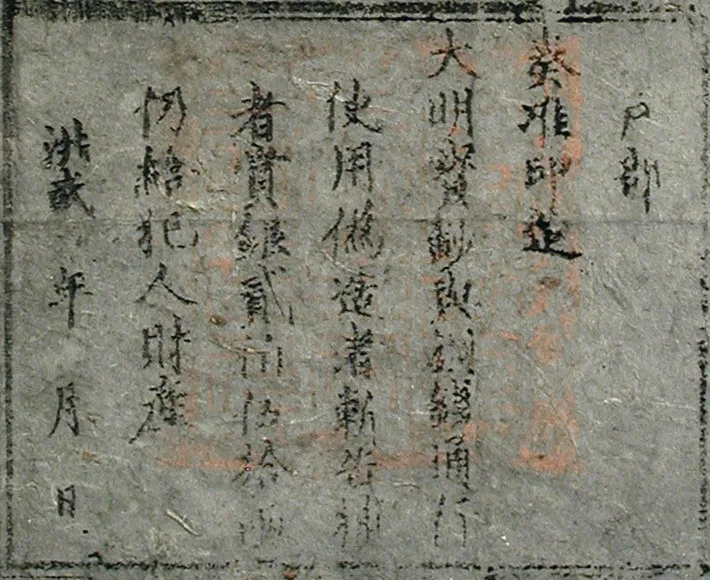
The text panel, read in columns from the right: Hubu, the Ministry of Revenue, at top right, and at the left the Hongwu date line with blanks for year, month and day.
Credit and reuse terms
"Bitllet Ming 1375 - Museu de Prehistòria de València" by Museu de Prehistòria de València — https://commons.wikimedia.org/wiki/File:Bitllet_Ming_1375_-_Museu_de_Prehist%C3%B2ria_de_Val%C3%A8ncia.jpg — CC BY-SA 3.0 (https://creativecommons.org/licenses/by-sa/3.0/); changes: cropped to the seven-column text panel (pixels 250–960 across, 960–1540 down)
Da Ming tongxing baochao, one guan, printed 1380 or later, Ministry of Revenue (Hubu). Museu de Prehistòria de València, no number given.
For the first issue, the Ming Shi gives the same wording, with the Secretariat in place of the Ministry, but its reward is 25 liang, both in the Wikisource transcription and in a scan of the Siku quanshu huiyao edition. The note itself reads two hundred and fifty, and so does the 1375 order as entered in the Taizu shilu, the Veritable Records of the Hongwu reign, still under the Secretariat's name. Both figures stand here side by side.
Read for its political job, the panel works as a decree in small. The copper coins of the Hongwu reign were named for it: Hongwu tongbao. The paper, by contrast, writes out who stands behind it, from the ministry that printed it to the throne that approved it.
How big is a Ming dynasty banknote?
A Ming one-guan note is about 34 cm tall and 22 cm wide, going by two museum records. The British Museum's one-guan note, numbered 1942-8-5-1 on the University of Washington page that quotes its record, measures 34.1 × 22.2 cm. The Valencia museum gives its note as about 22 × 34 cm.
A different shape appears in the Ming Shi: one chi tall and six cun wide, at ten cun to the chi. That sheet would be 1.67 times as tall as it is wide, by this page's calculation, against 1.54 for the British Museum note and 1.55 for Valencia's. The chi is not converted to centimeters here, because its length was never one fixed figure; S. Wells Williams's Chinese Commercial Guide (1863) lists three different Ming chi.
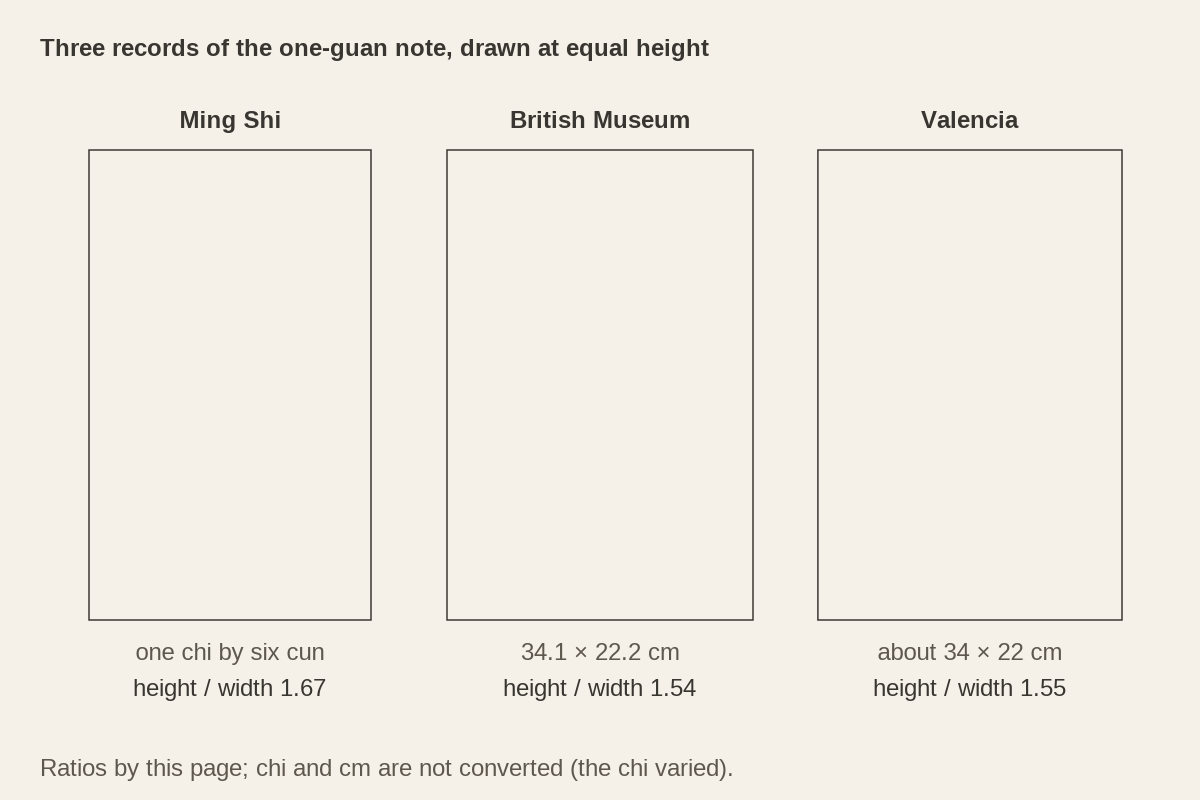
Slide the drawing sideways to read every label, or open it at full size.
The one-guan note's shape in three records, drawn at equal height: the Ming Shi's one chi by six cun, and two museum measurements in centimeters (tincture, not official).
Credit and reuse terms
"Ming one-guan note: three records of its size" by Banners & Banknotes, https://bannersandbanknotes.com/coins-banknotes/da-ming-tongxing-baochao/, licensed under CC BY 4.0 (https://creativecommons.org/licenses/by/4.0/)
The records agree on the material. The Ming Shi says the notes were made of sangrang, mulberry-bark fiber, and gives the paper's color as qing, which this page renders as blue-gray. The British Museum record, as the UW page quotes it, reads "Printed mulberry paper," and the Valencia museum also calls its note mulberry paper. All three sets of figures are in the sizes CSV provenance and license of da-ming-tongxing-baochao-sizes.csv.
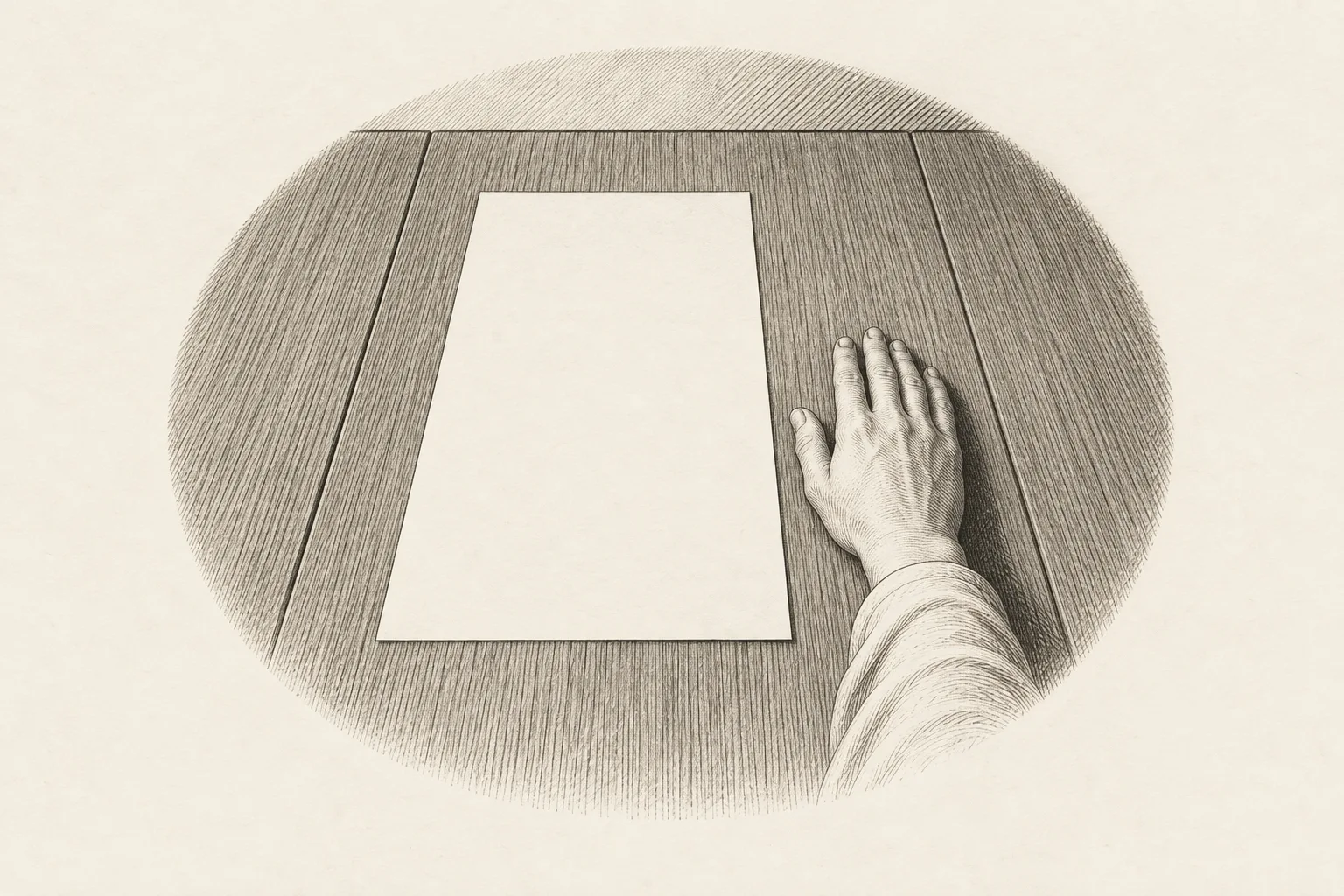
A blank sheet on a table beside a resting hand, to suggest a one-guan note of about 34 by 22 cm. Not to scale; the three recorded shapes are drawn above.
Illustration: Banners & Banknotes. Generated schematic illustration — not a photograph or historical record. © Banners & Banknotes, all rights reserved.
Who issued the Ming banknotes?
The Ming Shi names the offices in order. A Treasure Note Superintendency, the baochao tijusi, was set up in 1374, and the next year the Secretariat was ordered to print the notes. In 1380 the Secretariat was abolished: note-making passed to the Ministry of Revenue and coin-casting to the Ministry of Works, and the notes' text was changed to name the Ministry, with old and new notes in use together. The same year, the court let soldiers, civilians and merchants hand in worn notes at exchange offices for new ones, paying a fee for the labor and ink.
That change of name dates the Valencia note. Its text panel opens with Hubu, so it was printed in 1380 or later, although the museum's description gives circa 1375; the UW page gives the same circa 1375 for the British Museum's note. Reign years on this page are converted with the era tables in W. F. Mayers's Chinese Reader's Manual (1874).
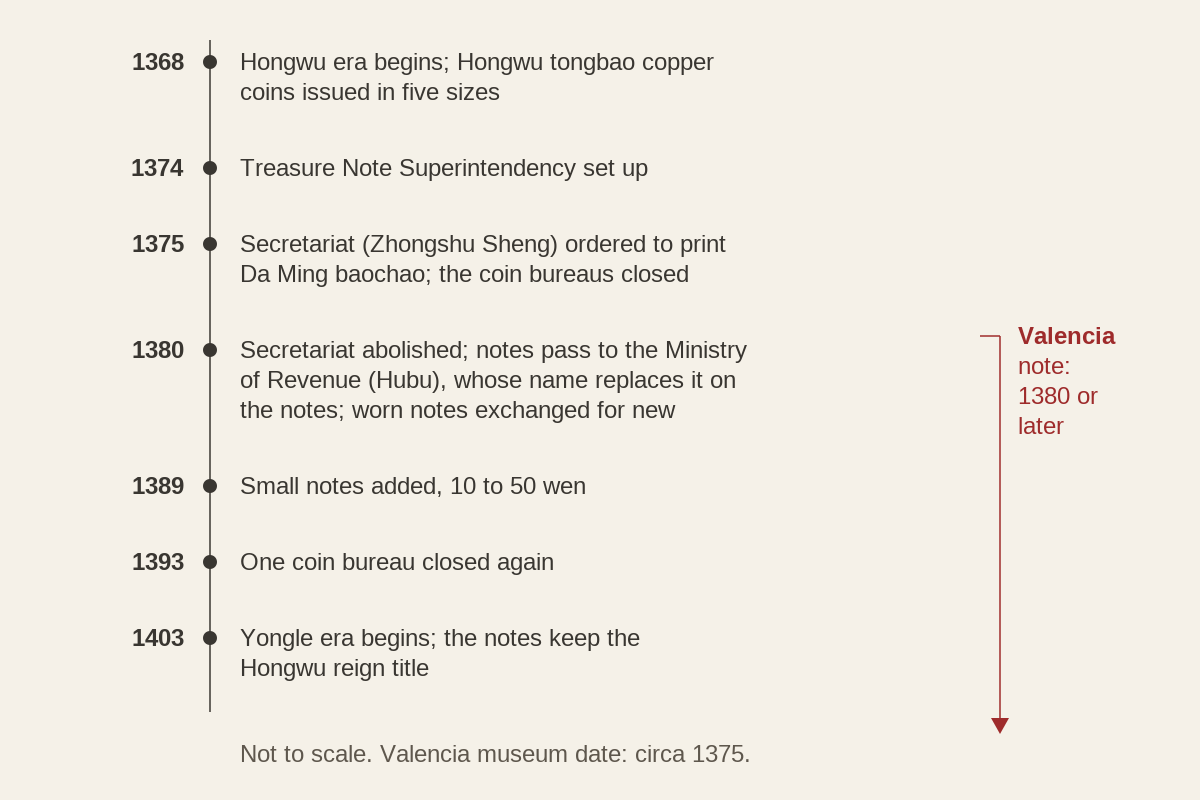
Slide the drawing sideways to read every label, or open it at full size.
Issuing offices and design changes recorded in the Ming Shi, 1368 to 1403, with the span in which the Valencia note was printed (tincture, not official).
Credit and reuse terms
"Ming paper money: issuing offices, 1368 to 1403" by Banners & Banknotes, https://bannersandbanknotes.com/coins-banknotes/da-ming-tongxing-baochao/, licensed under CC BY 4.0 (https://creativecommons.org/licenses/by/4.0/)
The date line cannot narrow that span. When the Yongle emperor came to the throne, the Ming Shi says, his Minister of Revenue, Xia Yuanji, asked to change the characters on the note plates to read Yongle. The emperor kept the old one, and to the end of the Ming the notes carried Hongwu.
A printing workshop with stacks of blank paper, a plain plate and brushes. The Ming Shi has the Secretariat print the notes from 1375 and the Ministry of Revenue from 1380.
Illustration: Banners & Banknotes. Generated schematic illustration — not a photograph or historical record. © Banners & Banknotes, all rights reserved.
Why did Ming paper money lose its value?
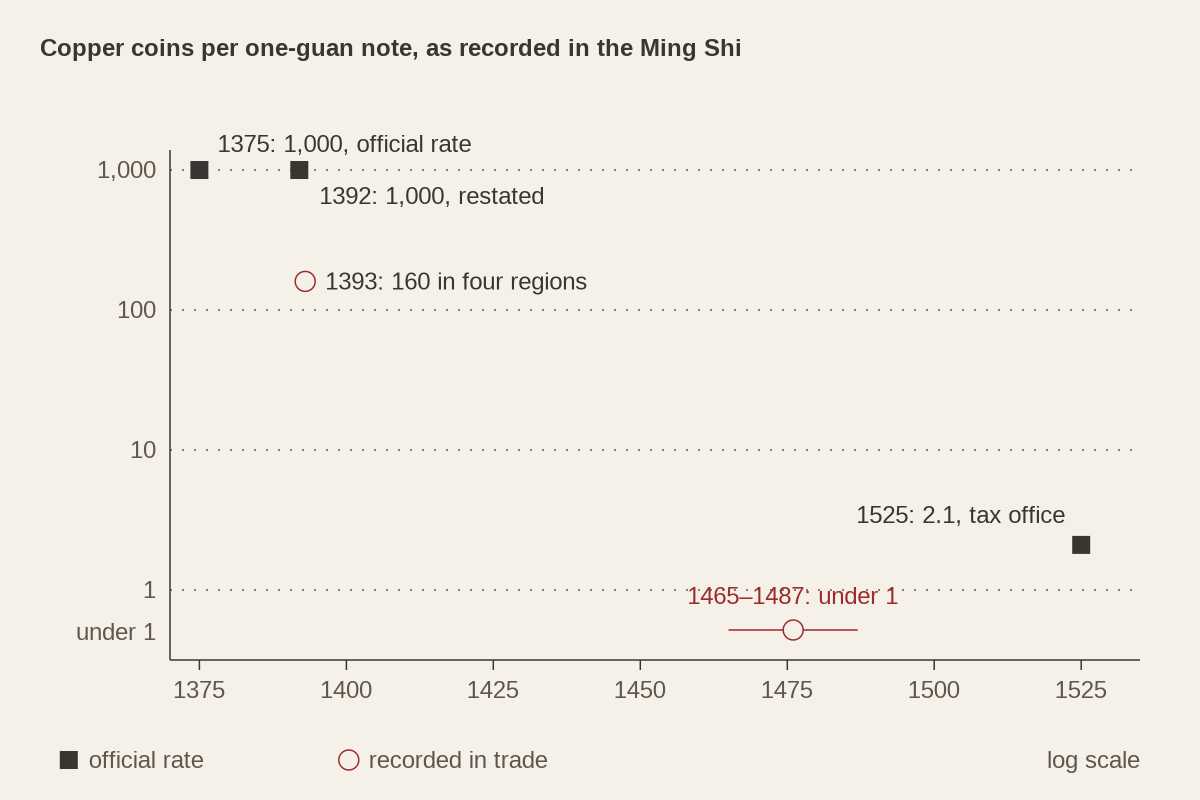
The Ming Shi tracks the fall in its own figures, plotted in the chart below. In 1375 a one-guan note was set at 1,000 coins. Around 1393, it records, some people in Liangzhe, Jiangxi, Fujian and Guangdong gave only 160 coins for one, prices soared, and the note system grew worse and stopped circulating.
Slide the drawing sideways to read every label, or open it at full size.
Copper coins per one-guan note as recorded in the Ming Shi, on a log scale; the 1525 point is this page's calculation from tax-office rates (tincture, not official).
Credit and reuse terms
"Ming one-guan note: copper coins per note" by Banners & Banknotes, https://bannersandbanknotes.com/coins-banknotes/da-ming-tongxing-baochao/, licensed under CC BY 4.0 (https://creativecommons.org/licenses/by/4.0/)
Two officials quoted in the Ming Shi put the cause the same way. In the Yongle era (1403–1424), the censor-in-chief Chen Ying said notes had stopped circulating because the court issued too many and had no means of taking them back. When the Hongxi emperor came to the throne, Xia Yuanji told him that notes are light when many and heavy when few.
The court answered with bans. Using gold, silver or goods in trade had been forbidden since the first issue in 1375, and the ban on gold and silver was renewed in 1397. Early in the Xuande reign, which began in 1426, anyone who used one qian of silver in a deal was fined 1,000 guan in notes. By then a shi of rice cost 50 guan in notes, a price paid in trade; the figure from 1385 is of another kind, the official rate of 2.5 guan a shi at which the court had paid officials' salary rice in notes.
How low did the one-guan note fall?
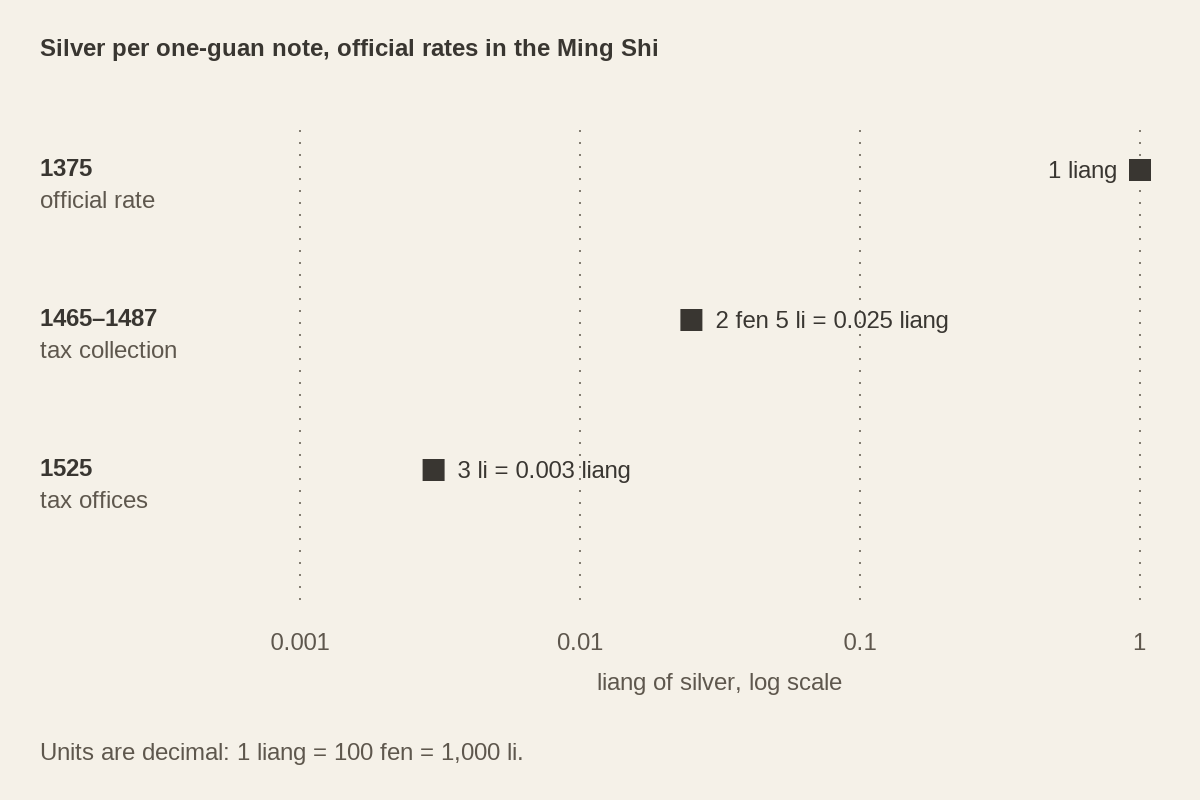
Under the Chenghua emperor (1465–1487), the Ming Shi says, a one-guan note could not fetch a single coin, yet taxes reckoned in notes were collected at 2 fen 5 li of silver for each guan, to the people's great distress. In 1525 the tax offices counted the note as 3 li of silver and seven coins as one fen. A li is a thousandth of a liang in the decimal units S. Wells Williams set out in 1863, so the note stood at three-thousandths of its 1375 rate in silver, or 2.1 coins, by this page's calculation. The figures are in the value record CSV provenance and license of da-ming-tongxing-baochao-value-record.csv.
Slide the drawing sideways to read every label, or open it at full size.
Silver per one-guan note in three official rates from the Ming Shi, on a log scale, with 2 fen 5 li and 3 li given in liang (tincture, not official).
Credit and reuse terms
"Ming one-guan note: silver per note in official rates" by Banners & Banknotes, https://bannersandbanknotes.com/coins-banknotes/da-ming-tongxing-baochao/, licensed under CC BY 4.0 (https://creativecommons.org/licenses/by/4.0/)
By the Longqing reign, which began in 1567, the Ming Shi says the notes had gone unused for about a century, though salary money alone was still paid out in them. In 1570, officials in the capital began to receive their salaries in newly cast Longqing coins.
Shrink strip
At 160 pixels wide the two large characters of the value and the ten strings below them still read as separate marks. At 48 the strings merge into a smudge under two dark blots, and at 16 the note is a gray oblong with a paler middle.
Shown at its drawn size. On a narrow screen, scroll sideways to see the whole strip.
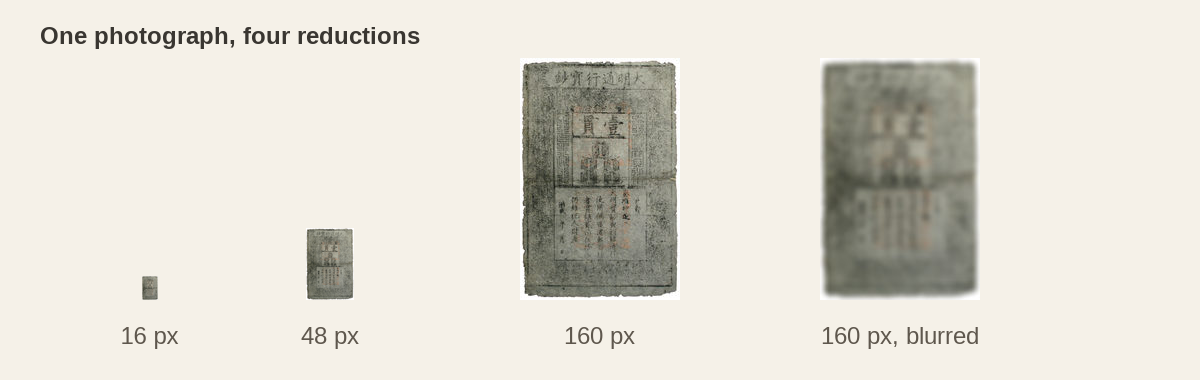
The Valencia photograph reduced to 16, 48 and 160 pixels wide, plus a blurred copy. Reduction preview, not a legibility test.
Credit and reuse terms
"Bitllet Ming 1375 - Museu de Prehistòria de València" by Museu de Prehistòria de València — https://commons.wikimedia.org/wiki/File:Bitllet_Ming_1375_-_Museu_de_Prehist%C3%B2ria_de_Val%C3%A8ncia.jpg — CC BY-SA 3.0 (https://creativecommons.org/licenses/by-sa/3.0/); changes: reduced to 16, 48 and 160 px wide, a 160 px copy blurred, the four set side by side on a pale panel with size labels
Meaning ledger
| Meaning | Earliest we can document | Year | Label | Notes |
|---|---|---|---|---|
| The ten strings of coins stand for the note's value, one guan of 1,000 coins | The note's own face, which prints yi guan directly above the ten strings (Ministry of Revenue issue) | 1380 or later | [first recorded later] | The 1375 order was read only as two later histories enter it: the Taizu shilu, presented to the throne in 1418, and the Ming Shi, presented in 1739, by the dates on their presentation memorials. Both say ten strings make one guan. No copy made in 1375 itself was read. |
| The strings were printed for people who could not read | University of Washington, Silk Road Seattle page on the British Museum's one-guan note (last modified December 2002) | 2002 | [first recorded later] | The page says "presumably" and cites a British Museum page that was not read. The Ming Shi describes the picture but gives no reason for it. |
How each label is decided: The After-Meaning, the four labels.
Sources
- Ming Shi (History of the Ming), juan 81, Shihuo 5 (coins and notes), Wikisource transcription. zh.wikisource.org Read: juan 81, full text
- Da Ming Taizu Gao huangdi shilu (Veritable Records of the Hongwu reign), compiled by Yao Guangxiao and others, juan 98, Hongwu 8, third month; Ming manuscript copy, National Library of China, Wikimedia Commons, vol. 9. commons.wikimedia.org Read: juan 98, PDF page 44
- Ming Shi (History of the Ming), juan 81, Siku quanshu huiyao edition, scan from Zhejiang University Library, Internet Archive. archive.org Read: juan 81, opening leaves
- Museu de Prehistòria de València, "Bitllet Ming 1375 - Museu de Prehistòria de València" (photograph and description of a one-guan Ming note, 2009), Wikimedia Commons. commons.wikimedia.org Read: file page
- University of Washington, Silk Road Seattle, "Paper currency, one guan note" (exhibit page on British Museum note 1942-8-5-1, last modified December 2002). depts.washington.edu Read: full text
- William Frederick Mayers, The Chinese Reader's Manual (Shanghai: American Presbyterian Mission Press, 1874), Part III, pp. 386–388 (reign titles of the Ming and Qing dynasties). archive.org Read: pages 386–388
- S. Wells Williams, The Chinese Commercial Guide (Hongkong: A. Shortrede & Co., 1863), pp. 267 and 283. archive.org Read: pages 267 and 283
- Zhang Tingyu and others, memorial presenting the Ming Shi to the throne (Shang Ming Shi biao), dated Qianlong 4, seventh month, 25th day, Wikisource transcription. zh.wikisource.org Read: full text, with date line
- Xia Yuanji and others, memorial presenting the Taizu shilu to the throne (Jin shilu biao), dated Yongle 16, fifth month, first day, Wikisource transcription. zh.wikisource.org Read: full text, with date line
- Otto Neurath, International Picture Language: The First Rules of Isotype (London: Kegan Paul, Trench, Trubner, 1936), pp. 73–74. archive.org Read: pages 73–74
Counter-sign
Counter-sign: The Hongwu tongbao, the copper coin issued when the Hongwu emperor took the throne in 1368, in five grades from a piece worth ten coins and weighing one liang down to a one-coin piece of one qian. The note names copper coin as its partner, yet the Ming Shi records that the coin bureaus were shut when the notes arrived in 1375, and one of them again in 1393.
- D G REG F D: A Decoder for the Latin Abbreviations on Coins: the archive's table for coin legends that cut their words down, where this note spells out every word of its decree.
- Joachimsthaler: a file on one coin, read like this note from its own lettering outward.
Cite this page
Banners & Banknotes. “Da Ming Baochao: Paper Money Drawn as Ten Strings of Coins.” Published 14 October 2026. https://bannersandbanknotes.com/coins-banknotes/da-ming-tongxing-baochao/. Accessed [date you read it].
Corrections
No corrections yet.