Object file · No. 0010
Joachimsthaler: The Valley Coin That Named the Dollar
Blazon card
- Field
- A round silver coin about 41 mm across; on each side a legend runs in a ring of capitals between bordersNational Museum, Prague, H5-34624 (40.6 mm); Münzkabinett Berlin 18202010 (41 mm)
- Charge
- One side: St Joachim standing with a staff, a quartered shield with a small central shield at his right foot, S and I in the field. Other side: a crowned lion rampant with a double tailMünzkabinett Berlin 18202010; National Museum, Prague, H5-34624
- Tincture
- Silver, the coin's own metal; no colors are set. Diagrams on this page use site tinctures (tincture, not official)National Museum, Prague, H5-34624; Münzkabinett Berlin 18202010
- Difference
- Undated, with the shield at the saint's right foot; the type dated 1525 sets the saint behind the shield, with 15 and 25 in the fieldNational Museum, Prague, H5-34624; Münzkabinett Berlin 18200819
- Issued by
- Count Stefan Schlick and his brothers, at the Joachimsthal (Jáchymov) mint, under the title of Louis, king of BohemiaMünzkabinett Berlin 18202010; National Museum, Prague, H5-34624
- First documented
- Earliest we can document for the type: 1519 in the Berlin catalogue (about 1517 in Davenport, as cited there) and 1519–1526 in the National Museum, Prague; the full name Joachimstaler by 1540 (Alberus, as cited in the New English Dictionary, 1897)Münzkabinett Berlin 18202010; National Museum, Prague, H5-34624; New English Dictionary vol. 3 (1897) s.v. Dollar
- Spec source
- National Museum, Prague, H5-34624 (29.087 g, 40.6 mm); Münzkabinett Berlin 18202010 (28.93 g, 41 mm); Davenport 8138, as cited by BerlineSbírky record H5-34624; Berlin online catalogue 18202010
Blazon card as CSV joachimsthaler-blazon.csvprovenance and license of joachimsthaler-blazon.csv
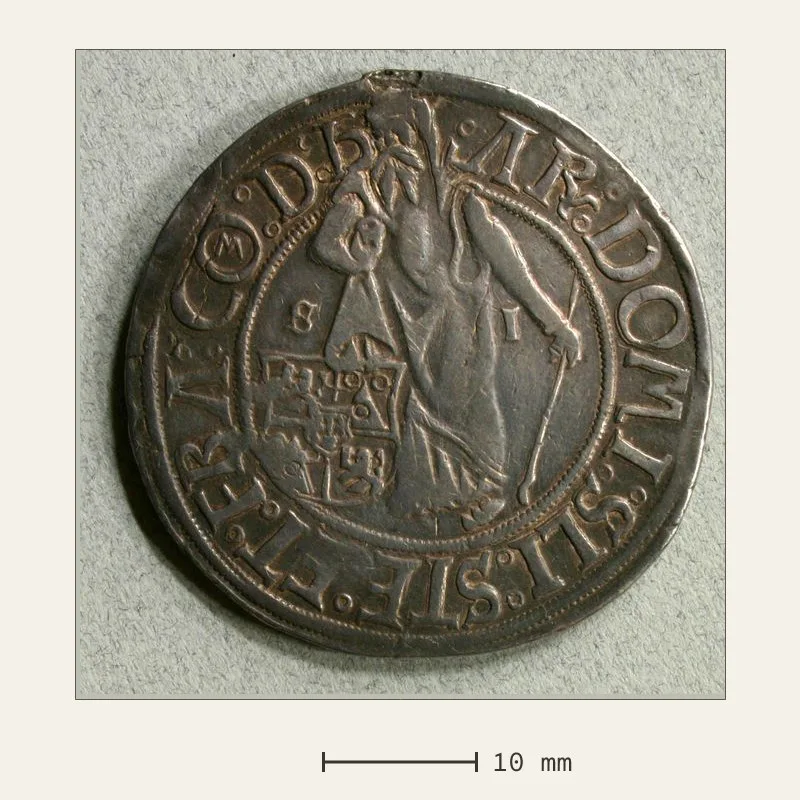
The saint's side of an undated Joachimsthaler in the National Museum, Prague: St Joachim with his staff, a quartered shield at his feet, and S and I in the field.
Credit and reuse terms
"Tolar Štěpána Šlika bez letopočtu H5-34624 01" by National Museum, Prague, H5-34624 (photo by a museum employee, name not given), color correction by Hubert Kororo — https://commons.wikimedia.org/wiki/File:Tolar_%C5%A0t%C4%9Bp%C3%A1na_%C5%A0lika_bez_letopo%C4%8Dtu_H5-34624_01.jpg — CC BY 4.0 (https://creativecommons.org/licenses/by/4.0/); changes: cropped to a square around the coin with the photo's own background, scaled 0.395 times and set on an 800 x 800 paper-colored panel, 10 mm scale bar added from the museum diameter of 40.6 mm

Joachimsthaler, undated (1519–1526), issued by the Schlick counts at Joachimsthal (Jáchymov). National Museum, Prague, H5-34624.
TL;DR. The Joachimsthaler has two different sides because two powers stand behind it: the Schlick counts who struck it put a saint, their shield and their names on one side, and the other carries the lion and title of Louis, king of Bohemia. Shortened to thaler, its name passed through Low German and Dutch daler into English, where it became dollar before 1600.
In this file5 sections
The coin that gave the dollar its name never names the valley it was named for. Look first at the two letters beside the standing saint, S on the left and I on the right, for Sanctus Ioachimus, Saint Joachim. The town of Joachimsthal, "Joachim's dale" in Walter Skeat's dictionary of 1910, is present only through him. Before any meaning, the stranger's read gives a silver disc about 41 mm across: on one side a bearded figure standing with a staff, a quartered shield at his feet and S and I beside him; on the other a crowned lion rampant with a forked tail; each ringed by Latin capitals.
The Schlick counts struck these coins at Joachimsthal in Bohemia, now Jáchymov in the Czech Republic, from the late 1510s. The coins' full name, Joachimsthaler, was soon cut to Taler. The New English Dictionary of 1897 traces the English dollar to the Low German and early modern Dutch daler, and in England, it says, the word was "modified to dollar" before 1600.
What do the letters on a Joachimsthaler say?
Read the saint's side clockwise from the top: AR DOMI SLI STE ET FRA COM D B. The online catalogue of the coin cabinet of the Berlin State Museums writes the legend out as Arma Dominorum Slickorum Stefani et Fratrum Comitum de Bassano. In this page's translation that is "arms of the lords Schlick, Stefan and the brothers, counts of Bassano," so the ring labels the shield below it.
Two of the letters share one space. In COM the M is cut inside the O, a ligature that Berlin's catalogue notes and that the Prague coin shows at the upper left of its ring.
The other side belongs to the king. Its ring reads LVDOVICVS PRIM D GRACIA R BO, which the National Museum in Prague writes out as LVDOVICVS PRIMVS DEI GRACIA REX BOHEMIE, in this page's translation "Louis the First, by the grace of God, king of Bohemia." Berlin's catalogue expands it the same way, spelling Gratia with a t. The same catalogue names the king both as Louis II, king of Hungary and Bohemia from 1516 to 1526, and as the Bohemian king Ludwig I.
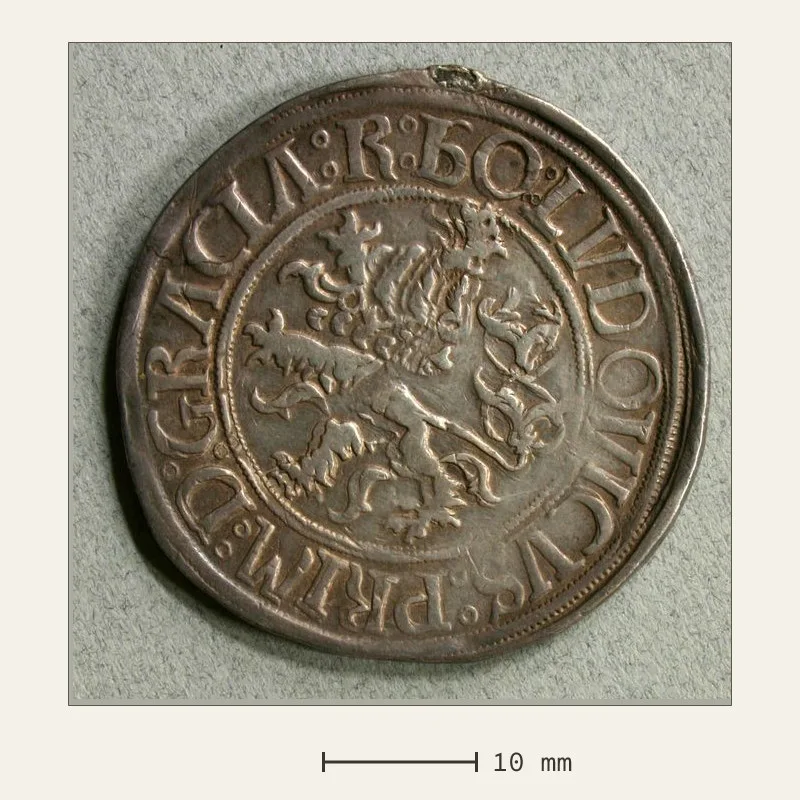
The lion side of the same coin: a crowned lion rampant with a double tail, inside a ring that reads LVDOVICVS PRIM D GRACIA R BO.
Credit and reuse terms
"Tolar Štěpána Šlika bez letopočtu H5-34624 02" by National Museum, Prague, H5-34624 (photo by a museum employee, name not given), color correction by Hubert Kororo — https://commons.wikimedia.org/wiki/File:Tolar_%C5%A0t%C4%9Bp%C3%A1na_%C5%A0lika_bez_letopo%C4%8Dtu_H5-34624_02.jpg — CC BY 4.0 (https://creativecommons.org/licenses/by/4.0/); changes: cropped to a square around the coin with the photo's own background, scaled 0.400 times and set on an 800 x 800 paper-colored panel, 10 mm scale bar added from the museum diameter of 40.6 mm

Joachimsthaler, undated (1519–1526), issued by the Schlick counts at Joachimsthal (Jáchymov). National Museum, Prague, H5-34624.
Counted by the five fixed rules of the legend squeeze, the saint's side strikes 20 of the 52 letters in Berlin's expansion, a ratio of 2.60. The COM ligature counts as three letters, and ET, struck in full, is left out. The lion side gets no ratio. Both museums write BO out as BOHEMIE, but the Prague groschen in Schrötter's dictionary of 1930 strikes the word in full as BOEMIE, so the count would depend on the spelling chosen.
The cuts changed from one issue to the next. On Berlin's coin dated 1525 the saint's ring reads AR DOMI SLI ST E7 FRA COM D BA: the legend breaks between ST and E, a sign shaped like 7 stands for ET, and the lion side spells out REX in full. Every cut word, with its Latin and its source, is in the legend CSV provenance and license of joachimsthaler-legends.csv, set out in the same columns as the coin legend decoder.
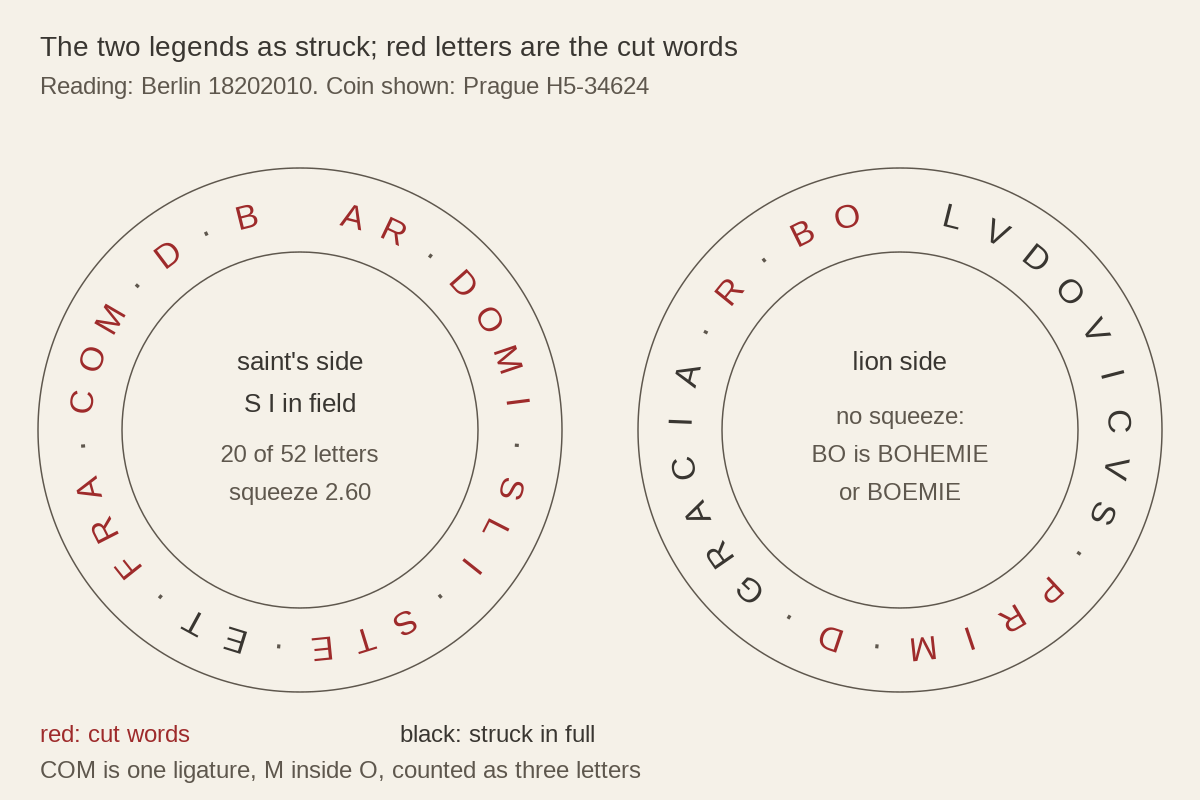
Slide the drawing sideways to read every label, or open it at full size.
Both legends as struck, the saint's side on the left; red marks the cut words, black the words struck in full. Only the saint's side gets a legend squeeze, 2.60 (tincture, not official).
Credit and reuse terms
"The two Joachimsthaler legends as struck" by Banners & Banknotes, https://bannersandbanknotes.com/coins-banknotes/joachimsthaler/, licensed under CC BY 4.0 (https://creativecommons.org/licenses/by/4.0/)
Who struck the Joachimsthaler, and when?
Read the two sides together, the way a portrait is read with its legend. The saint's side carries a family: its arms and its names, around a saint. The lion side carries a crown.
Berlin names the issuer as Stefan, count of Schlick, 1515–1526, and the Prague museum writes that Stefan struck these thalers with his brothers at the Jáchymov mint under the title of Louis. Schrötter's dictionary of 1930 adds that the counts struck them from the silver of their own mine there. Count Stefan fell in 1526, Berlin's record notes, probably at the battle of Mohács.
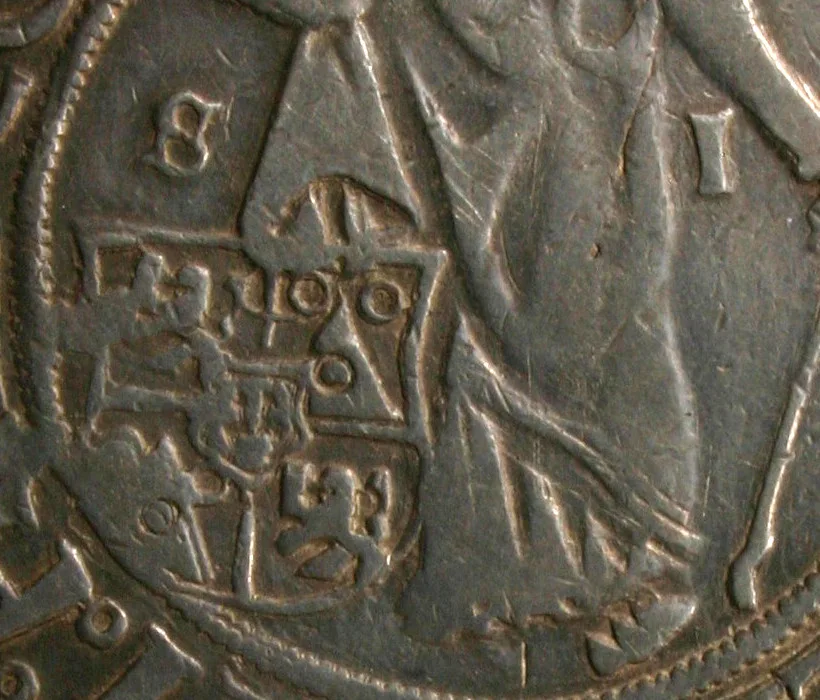
Detail of the saint's side: S and I stand either side of the saint, and the shield at his feet is quartered, with a small shield at its center.
Credit and reuse terms
"Tolar Štěpána Šlika bez letopočtu H5-34624 01" by National Museum, Prague, H5-34624 (photo by a museum employee, name not given), color correction by Hubert Kororo — https://commons.wikimedia.org/wiki/File:Tolar_%C5%A0t%C4%9Bp%C3%A1na_%C5%A0lika_bez_letopo%C4%8Dtu_H5-34624_01.jpg — CC BY 4.0 (https://creativecommons.org/licenses/by/4.0/); changes: detail cropped from the saint's side (820 x 700 pixels from the original), not scaled
Joachimsthaler, undated (1519–1526), issued by the Schlick counts at Joachimsthal (Jáchymov). National Museum, Prague, H5-34624.
Stop on that shield. The two museums describe it differently.
Berlin's catalogue reads the arms of Weiskirchen and Bassano with the Schlick shield in the middle; Prague's reads the Schlick arms, quartered, with the county of Bassano on the small central shield. For another heraldic charge, traced on France's royal arms from many lilies to three, see Fleur-de-lis.
The undated coins leave the first year to the catalogues. The sources read for this page give four different years:
| Source | Year given | What it dates |
|---|---|---|
| J. S. Davenport, European Crowns (1977), as cited by Berlin | about 1517 | this undated type |
| Walter W. Skeat, An Etymological Dictionary of the English Language (1910) | about 1518 | the first Joachimsthalers |
| Friedrich von Schrötter, Wörterbuch der Münzkunde (1930) | 1518 | the first Joachimsthalers |
| A New English Dictionary (1897), citing Kluge | 1519 | the coining at Joachimsthal |
| Münzkabinett Berlin, object 18202010 | 1519 | this undated type |
| National Museum, Prague, H5-34624 | 1519–1526 | this coin |
| Czech 200-koruna coin of 2020 (Berlin 18270335) | 1520 | the start of thaler minting |
The New English Dictionary, citing Kluge, dates the silver mine at Joachimsthal to 1516. The Prague museum records the place as today's Jáchymov, in the Karlovy Vary Region of the Czech Republic; Berlin gives the mint as Jáchymov, Bohemia, Czech Republic.
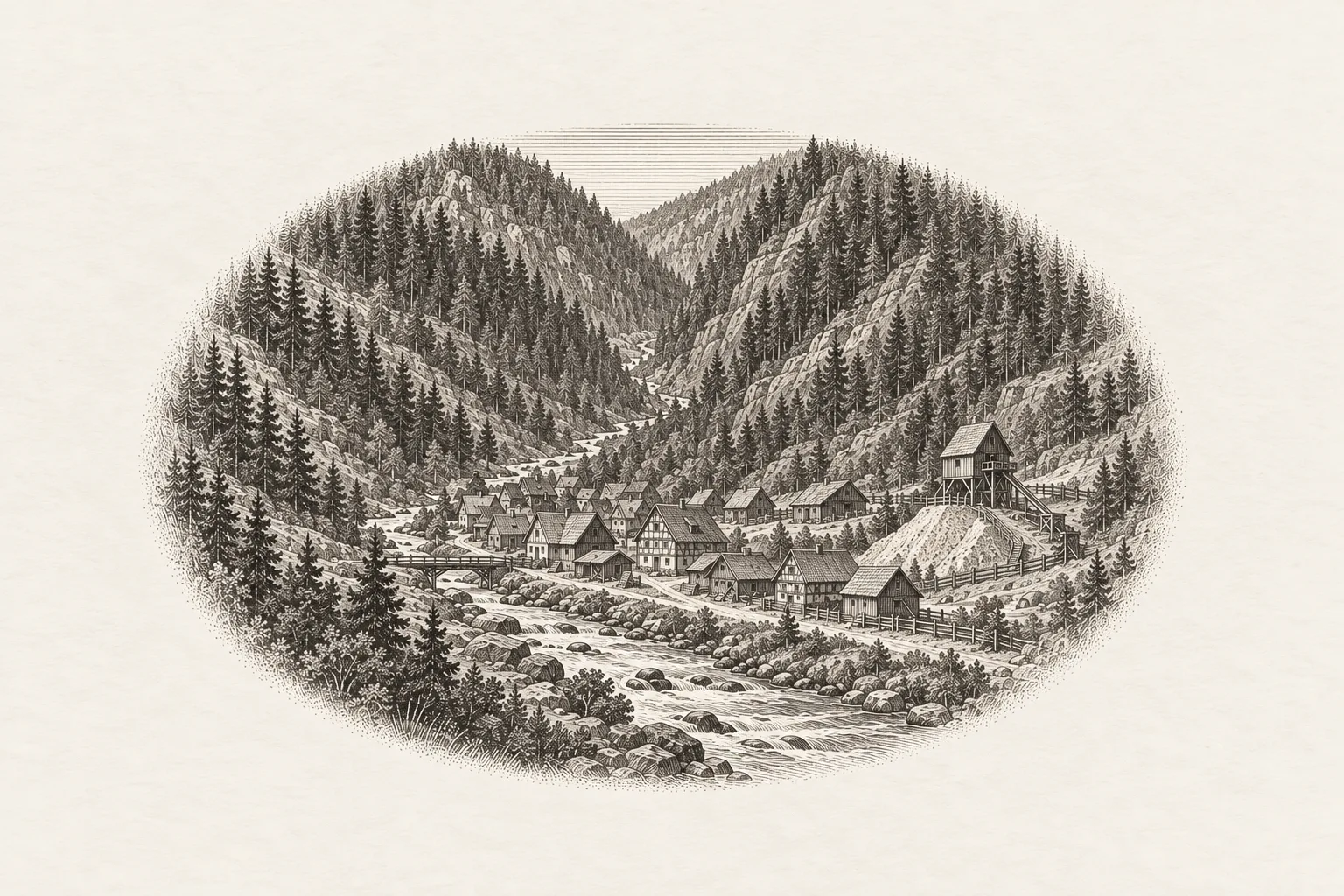
A small mining town in a narrow wooded valley, with a mine house on the slope. The New English Dictionary, citing Kluge, dates the silver mine at Joachimsthal to 1516.
Illustration: Banners & Banknotes. Generated schematic illustration — not a photograph or historical record. © Banners & Banknotes, all rights reserved.
How much silver is in a thaler?
About 27 grams. Schrötter's dictionary of 1930 gives 27.20 g of silver for the first Joachimsthalers and 26.39 g from 1534. The whole coins weigh more than that: 28.73 to 28.93 g for three Berlin coins of the undated type, 28.81 g for Berlin's coin dated 1525 and 29.087 g for Prague's.
Their size was set against gold. Schrötter dates the first coin of this kind to 1484, when Archduke Sigismund of Tyrol struck a large silver piece to represent the value of the gold gulden. Such coins were called Guldengroschen at first and thalers from about 1525. Berlin's coin cabinet describes Sigismund's silver guldiners of 1486 as the equivalent of the gold gulden, at a value ratio of about 11 to 1.
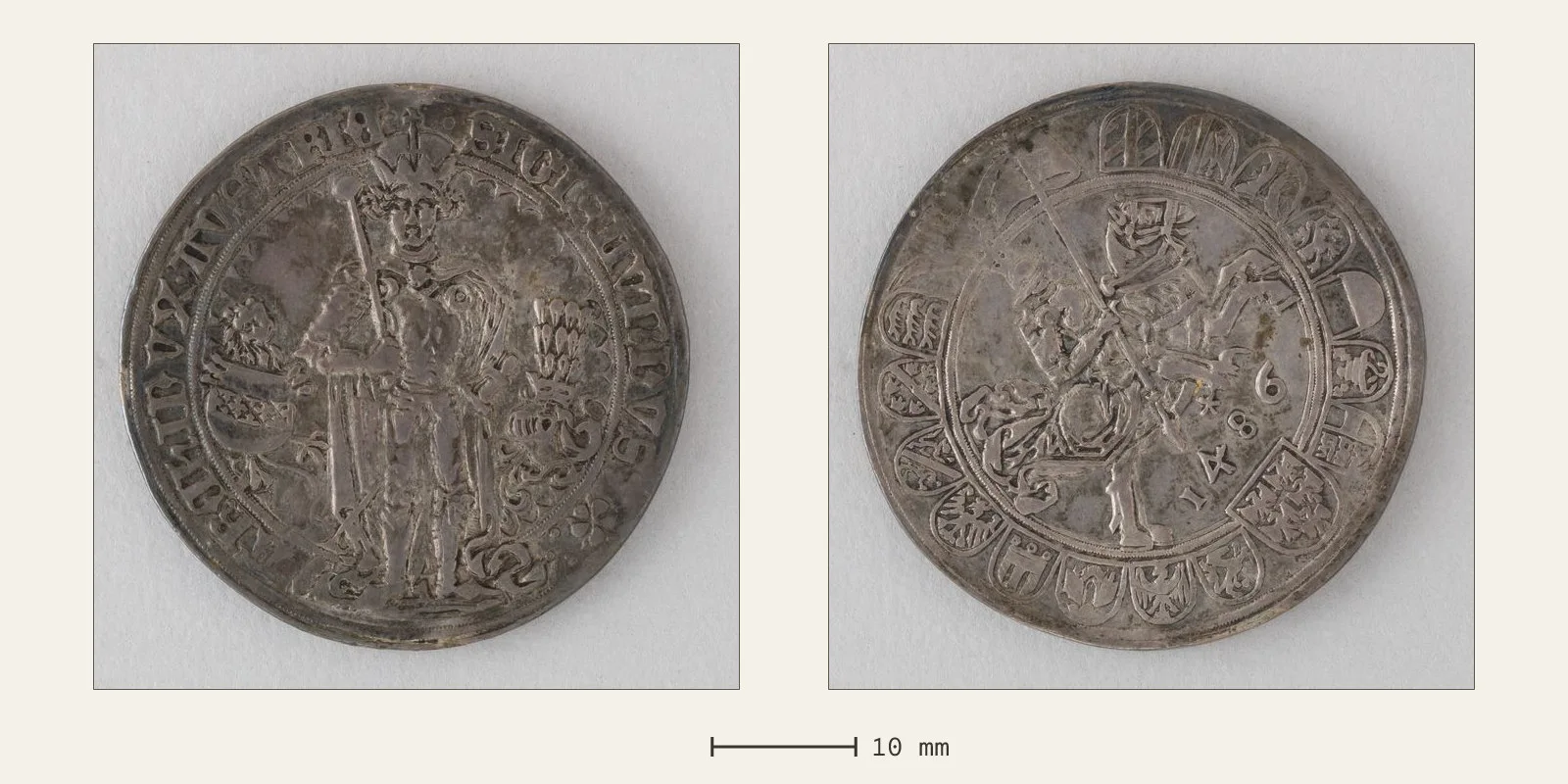
A silver coin of Archduke Sigismund of Tyrol dated 1486, catalogued by the museum as a thaler: the archduke standing on one side, a horseman inside a ring of small shields on the other.
Credit and reuse terms
"Coin (Thaler) Showing Archduke Sigismund MET 22.122.9 001nov2014" by The Metropolitan Museum of Art — https://commons.wikimedia.org/wiki/File:Coin_(Thaler)_Showing_Archduke_Sigismund_MET_22.122.9_001nov2014.jpg — CC0 1.0 (https://creativecommons.org/publicdomain/zero/1.0/); changes: placed beside the other side, File:Coin (Thaler) Showing Archduke Sigismund MET 22.122.9 002nov2014.jpg (CC0 image), each side cropped to a square and scaled to the same coin size on a paper-colored panel, 10 mm scale bar added from the museum diameter of 4.1 cm

Thaler of Archduke Sigismund of Tyrol, 1486, issued under Sigismund. The Metropolitan Museum of Art, 22.122.9.
The Metropolitan Museum of Art records that coin at 31.2 g and 41 mm. Schrötter lists the Joachimsthaler's Latin names as Ioachimicus, Vallensis and Uncialis, the last because the coin weighed an ounce, two Lot. He adds that people took slowly to a silver piece this large, worth 21 groschen.
Two plain discs, large for silver and small for gold, not to scale. Schrötter dates to 1484 the large silver piece Sigismund struck to represent the value of the gold gulden.
Illustration: Banners & Banknotes. Generated schematic illustration — not a photograph or historical record. © Banners & Banknotes, all rights reserved.
When the imperial coinage ordinance of 1524 set a silver gulden holding 27.41 g of silver, the Bohemian coins already held 27.20 g. Reminting them would have cost enormous sums, Schrötter writes, so the new coin was struck only in a few trials. All the weights are in the weights and silver CSV provenance and license of joachimsthaler-silver.csv.
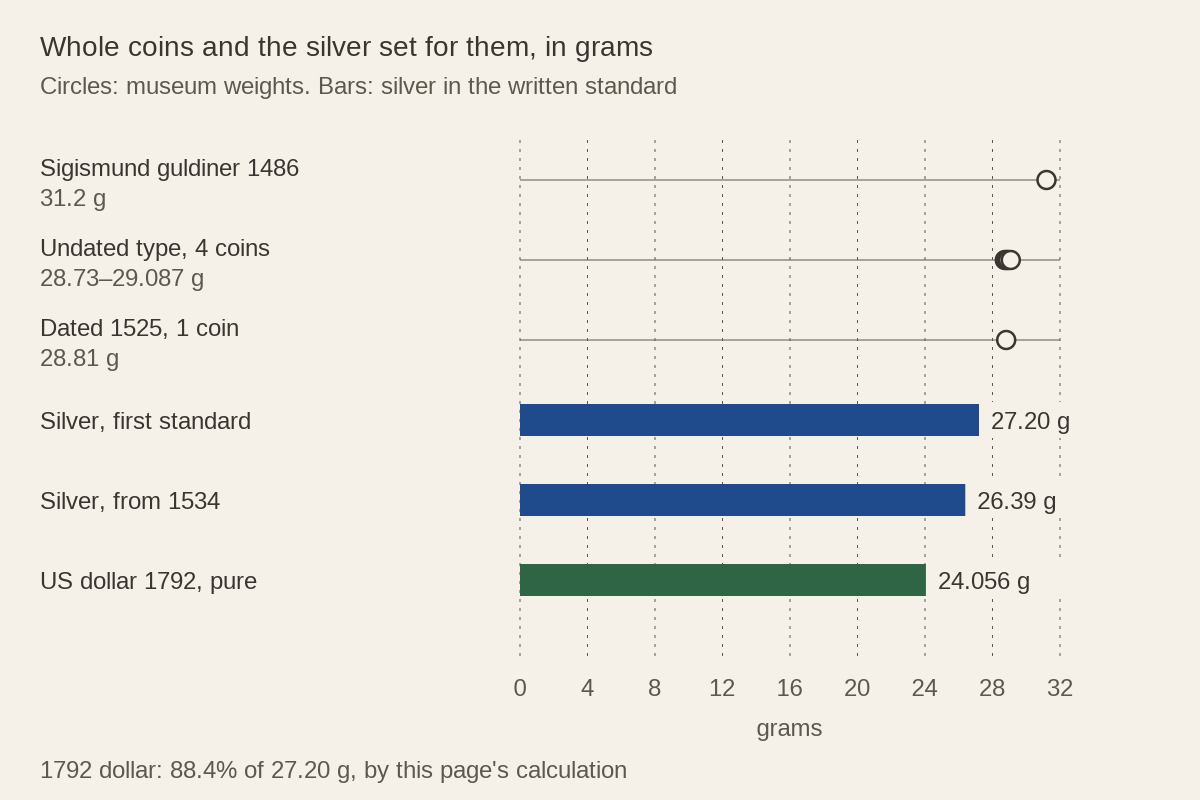
Slide the drawing sideways to read every label, or open it at full size.
Museum weights of whole coins (circles) beside the silver set for each standard (bars), in grams; the 1792 dollar held 88.4% of the first Joachimsthaler's silver, by this page's calculation (tincture, not official).
Credit and reuse terms
"Joachimsthaler weights and silver, in grams" by Banners & Banknotes, https://bannersandbanknotes.com/coins-banknotes/joachimsthaler/, licensed under CC BY 4.0 (https://creativecommons.org/licenses/by/4.0/)
How did Joachimsthaler become dollar?
The name came from the place, not from the first coin of the kind. Saxony's guldengroschen, struck from 1500 with 27.41 g of fine silver, were the first to circulate widely, Schrötter writes, but the coins took their general name from the Schlick pieces: Joachimstaler, or for short Taler. The New English Dictionary glosses Joachimstaler as "(gulden) of Joachimsthal" and says Alberus recorded the short taler, or thaler, in 1540 along with the full form.
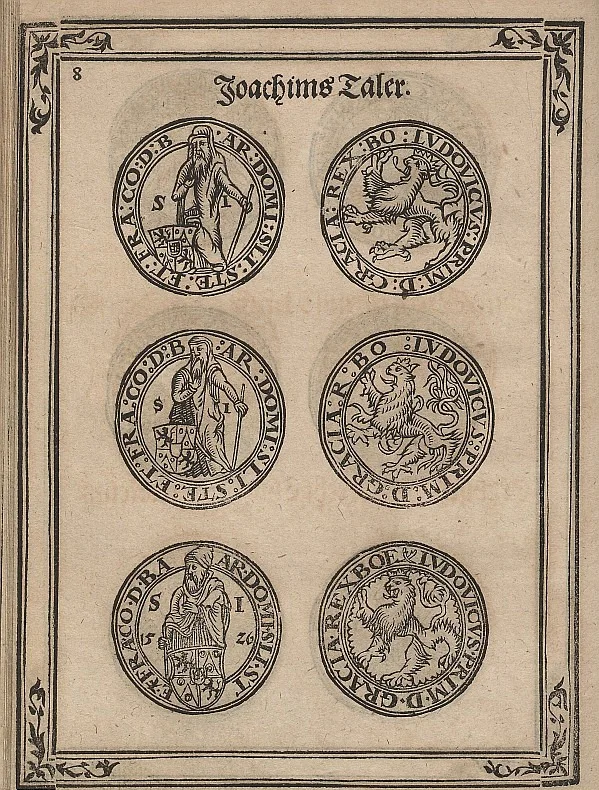
A page of Wolf Stürmer's coin book, printed at Leipzig in 1573 under the heading Joachims Taler: woodcuts of both sides of three Schlick coins, one dated 1526.
Credit and reuse terms
"Fotothek df tg 0002230 Geldwesen ^ Münzwesen ^ Münze ^ Taler ^ Joachimstaler" by an unnamed woodcutter (Wolf Stürmer, Leipzig, 1573); scan: Deutsche Fotothek, SLUB Dresden — https://commons.wikimedia.org/wiki/File:Fotothek_df_tg_0002230_Geldwesen_%5E_M%C3%BCnzwesen_%5E_M%C3%BCnze_%5E_Taler_%5E_Joachimstaler.jpg — Public domain (woodcut page printed at Leipzig in 1573 by Johann Rhambau for Wolf Stürmer, its cutter never named, so an anonymous work published in 1573; a faithful scan of a two-dimensional public-domain work, released by the Deutsche Fotothek with the Public Domain Mark); changes: bottom 30 pixels cropped to remove the provider's caption strip

Joachims Taler, page 8 of Wolf Stürmer's coin book, 1573, printed by Johann Rhambau at Leipzig. Saxon State and University Library Dresden, Hist.Sax.M.191,misc.4.
Look at the heading. The printer set the name as two words, the saint's and the coin's.
The pages belong to a section that the Deutsche Fotothek's record gives as "Die guthen Alten und Bewen [Newen] Taler," the good old and new thalers that had passed the assay under the empire's coinage ordinance. Half a century after the first strikes, the Schlick coins were still among them.
The New English Dictionary takes the English word from Low German and early modern Dutch daler, modern Dutch daalder. Its first quotation, a letter of 4 April 1553 by R. Morysin and Sir T. Chamberlayne, says the Duke of Wirtemberg "shall have for his charges 66000 dalers." Later quotations run through dallors in 1560, dalders in 1577 and Dolor in 1588 to dollars in 1601.
Skeat makes the valley plain. German thal, he writes, is cognate with English dale: "Thus dollar = dale-er." He adds that the coins were sometimes called Schlickenthaler, because the counts of Schlick struck them.
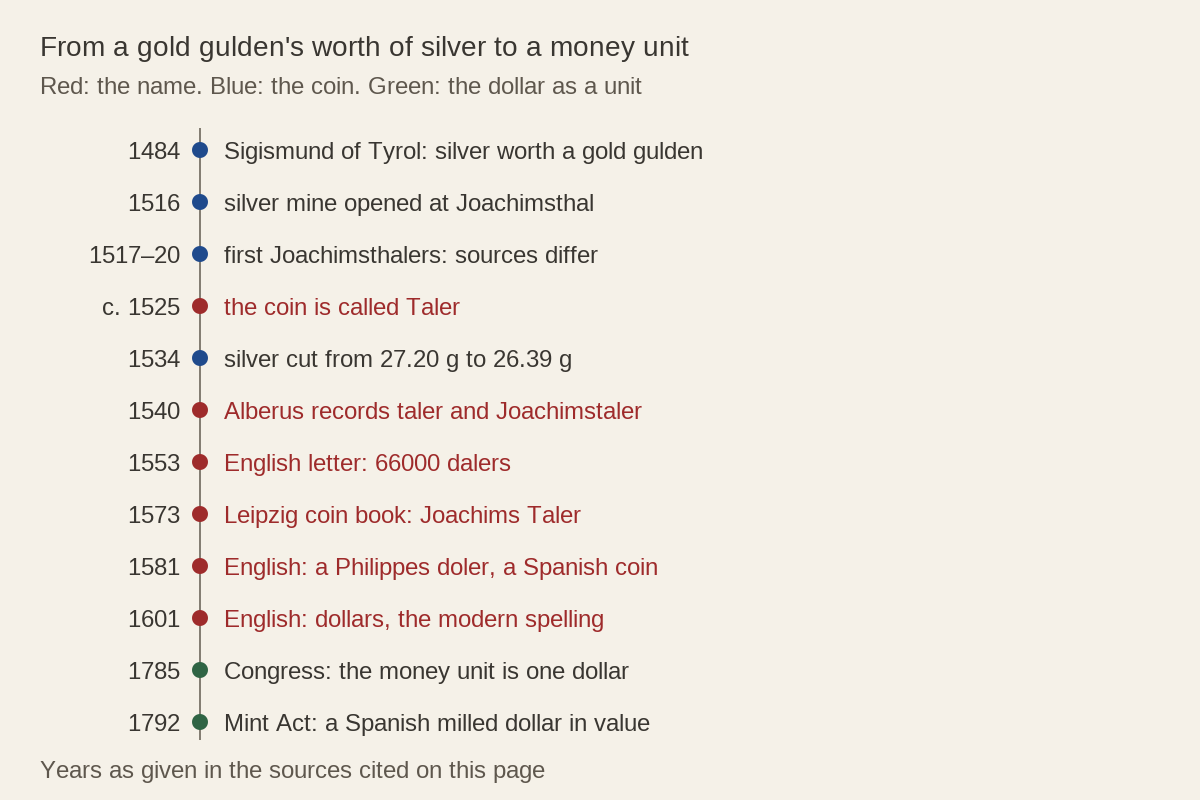
Other languages kept other parts of the name. Schrötter lists the French Jocondale, the Russian Jefimok and the Polish Joachimik, all from Joachimstaler, beside the Italian tallero and the Polish talar. The dates are in the timeline CSV provenance and license of joachimsthaler-timeline.csv.
Slide the drawing sideways to read every label, or open it at full size.
Dated steps from Sigismund's silver equal of the gold gulden in 1484 to the American Mint Act of 1792, as given in the sources cited on this page; red marks the name (tincture, not official).
Credit and reuse terms
"Joachimsthaler to dollar, 1484 to 1792" by Banners & Banknotes, https://bannersandbanknotes.com/coins-banknotes/joachimsthaler/, licensed under CC BY 4.0 (https://creativecommons.org/licenses/by/4.0/)
Was the US dollar based on the thaler or the Spanish dollar?
The US dollar took its name from the thaler and its value from the Spanish milled dollar. By 1581 the English word also named the Spanish peso, or piece of eight: the New English Dictionary quotes "a Philippes doler" from that year and says the coin was "largely used in the British N. American Colonies at the time of their revolt."
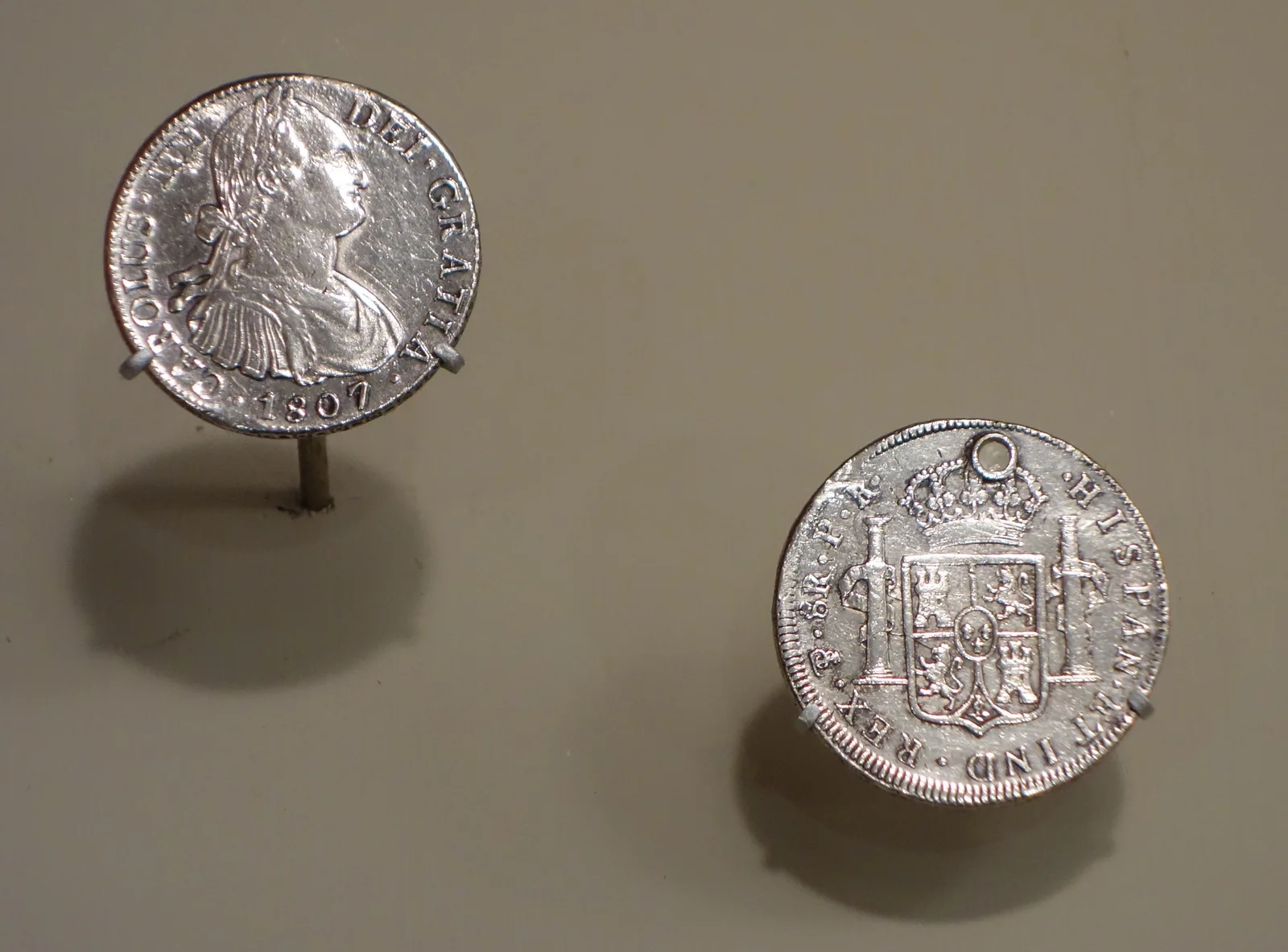
Two silver eight-reales pieces of Charles IV of Spain on display in the Winterthur Museum: the bust side of one, dated 1807, and the arms side of the other, between two pillars.
Credit and reuse terms
"8 reales, Spanish coins, King Charles IV, left 1807 from the Mexico City mint, right 1793 from the Potosi Mint in Bolivia, silver - Winterthur Museum - DSC01592" by Daderot — https://commons.wikimedia.org/wiki/File:8_reales,_Spanish_coins,_King_Charles_IV,_left_1807_from_the_Mexico_City_mint,_right_1793_from_the_Potosi_Mint_in_Bolivia,_silver_-_Winterthur_Museum_-_DSC01592.JPG — CC0 1.0 (https://creativecommons.org/publicdomain/zero/1.0/)

Eight reales of Charles IV, one dated 1807, issued under Charles IV of Spain. Winterthur Museum, no number given.
On 6 July 1785 the Continental Congress resolved, every member answering ay, "That the money unit of the United States of America be one dollar." The Act establishing a Mint, approved on 2 April 1792, then fixed the coin: "Dollars or Units: each to be of the value of a Spanish milled dollar as the same is now current, and to contain three hundred and seventy one grains and four sixteenth parts of a grain of pure, or four hundred and sixteen grains of standard silver."
Schrötter converts that pure silver to 24.056 g, a little below the average of the peso. By this page's calculation it comes to 88.4% of the 27.20 g in the first Joachimsthalers.
Shrink strip
At 16 pixels wide the two legend rings blur into pale hoops. The red and black runs of letters part at 48, and the larger words can be picked out at 160.
Shown at its drawn size. On a narrow screen, scroll sideways to see the whole strip.
The legend diagram at 16, 48 and 160 pixels wide, plus a blurred copy (tincture, not official). Reduction preview, not a legibility test.
Credit and reuse terms
"Shrink strip: the Joachimsthaler legend diagram at 16, 48 and 160 px" by Banners & Banknotes, https://bannersandbanknotes.com/coins-banknotes/joachimsthaler/, licensed under CC BY 4.0 (https://creativecommons.org/licenses/by/4.0/). Derived from "The two Joachimsthaler legends as struck".
Meaning ledger
| Meaning | Earliest we can document | Year | Label | Notes |
|---|---|---|---|---|
| The quartered shield beside St Joachim is the arms of the Schlick counts | The coin's own legend, AR DOMI SLI…, which the Berlin coin cabinet writes out as Arma Dominorum Slickorum…, "arms of the lords Schlick" | 1519–1526 | [first recorded later] | No grant of the Schlick arms was read for this page, so their origin stays open. Berlin and Prague describe the quarters differently (see above). |
| The crowned double-tailed lion stands for the kingdom of Bohemia | Prague groschen of King Wenceslas II, about 1300, as described in Schrötter's Wörterbuch der Münzkunde (1930), pp. 529–530: the Bohemian royal crown on one side, the double-tailed lion on the other, and the legends WENCEZLAVS SECVNDVS DEI GRATIA REX BOEMIE and GROSSI PRAGENSES | about 1300 | [first recorded later] | Schrötter (p. 285) calls the lion on the Joachimsthaler "den böhmischen Löwen," the Bohemian lion. On the Joachimsthaler the lion sits inside the king's Bohemian title, R BO (1519–1526). No document of the lion's adoption as the arms of Bohemia was read for this page. |
How each label is decided: The After-Meaning, the four labels.
Sources
- Münzkabinett der Staatlichen Museen zu Berlin, 18202010: Schlick, county, taler, undated type (catalogued 1519), Joachimsthal (Berlin Münzkabinett Online Catalogue). ikmk.smb.museum Read: catalogue record
- Münzkabinett der Staatlichen Museen zu Berlin, 18202012: Schlick, county, taler, undated type (catalogued 1519), Joachimsthal (Berlin Münzkabinett Online Catalogue). ikmk.smb.museum Read: catalogue record
- Münzkabinett der Staatlichen Museen zu Berlin, 18270798: Schlick, county, taler, undated type (catalogued 1519), Joachimsthal (Berlin Münzkabinett Online Catalogue). ikmk.smb.museum Read: catalogue record
- Münzkabinett der Staatlichen Museen zu Berlin, 18200819: Schlick, county, taler, 1525, Joachimsthal (Berlin Münzkabinett Online Catalogue). ikmk.smb.museum Read: catalogue record
- Národní muzeum (National Museum, Prague), H5-34624: Tolar Štěpána Šlika bez letopočtu (undated thaler of Stephan Schlick), 1519–1526, Jáchymov (eSbírky). esbirky.cz Read: catalogue record
- Journals of the Continental Congress, 1774–1789, vol. 29, July 1–December 30, 1785, ed. John C. Fitzpatrick (Washington: Government Printing Office, 1933), pp. 499–500: proceedings of Wednesday, July 6, 1785. archive.org Read: pages 499–500 (scanned copy)
- "An Act establishing a Mint, and regulating the Coins of the United States," approved April 2, 1792, chapter 16, section 9, in The Laws of the United States of America, vol. 2 (Philadelphia, 1796), pp. 40–41. archive.org Read: pages 40–41 and 46 (scanned copy)
- Wolf Stürmer, Vortzeichnus und Gepräge der groben und kleinen Müntzsorten (Leipzig: Johann Rhambau, 1573), p. 8, "Joachims Taler"; Saxon State and University Library Dresden, Hist.Sax.M.191,misc.4, scan df_tg_0002230 by the Deutsche Fotothek, as reproduced on Wikimedia Commons. commons.wikimedia.org Read: page 8 (scan) and its catalogue record
- The Metropolitan Museum of Art, 22.122.9, Coin (Thaler) Showing Archduke Sigismund, 1486: museum record as mirrored on Wikimedia Commons. commons.wikimedia.org Read: file page
- Daderot, photograph of two eight-reales coins of Charles IV on exhibit in the Winterthur Museum, Delaware, 8 May 2013, Wikimedia Commons file page. commons.wikimedia.org Read: file page
- Münzkabinett der Staatlichen Museen zu Berlin, 18270335: Czech Republic, 200 korun, 2020, 500 years of thaler striking (Berlin Münzkabinett Online Catalogue). ikmk.smb.museum Read: catalogue record
- James A. H. Murray, ed., A New English Dictionary on Historical Principles, vol. 3, D and E (Oxford: Clarendon Press, 1897), s.v. "Dollar," p. 589. archive.org Read: page 589
- Walter W. Skeat, An Etymological Dictionary of the English Language, 4th ed., revised, enlarged and reset (Oxford: Clarendon Press, 1910; impression of 1963), s.v. "Dollar," p. 179. archive.org Read: page 179
- Friedrich Frhr. von Schrötter, ed., Wörterbuch der Münzkunde (Berlin and Leipzig: Walter de Gruyter, 1930), s.v. "Dollar," pp. 150–151; "Joachimstaler," p. 285; "Prager Groschen," pp. 529–530; "Reichsmünzordnungen" and "Reichstaler," pp. 557–558; "Taler," p. 676. archive.org Read: pages 150–151, 285, 529–530, 557–558 and 676
Counter-sign
Counter-sign: The Czech 200-koruna silver coin of 2020, object 18270335 in the Berlin coin cabinet. It sets both sides of the Schlick thaler on one face and gives the other to portraits of Count Stephan Schlick and King Louis, with 1520 – 2020 and JÁCHYMOVSKÉ TOLARY, Jáchymov thalers.
- D G REG F D: A Decoder for the Latin Abbreviations on Coins: the table these two legends join, counted by the same five rules and filed in the same columns.
- Da Ming Tongxing Baochao: a Ming note printed with a picture of strung coins, much as the thaler was struck as the silver equal of a gold gulden.
Cite this page
Banners & Banknotes. “Joachimsthaler: The Valley Coin That Named the Dollar.” Published 14 October 2026. https://bannersandbanknotes.com/coins-banknotes/joachimsthaler/. Accessed [date you read it].
Corrections
No corrections yet.