Object file · No. 0009
US Flag: A 1959 Order Makes It 1.9 Times as Long as Tall
Blazon card
- Field
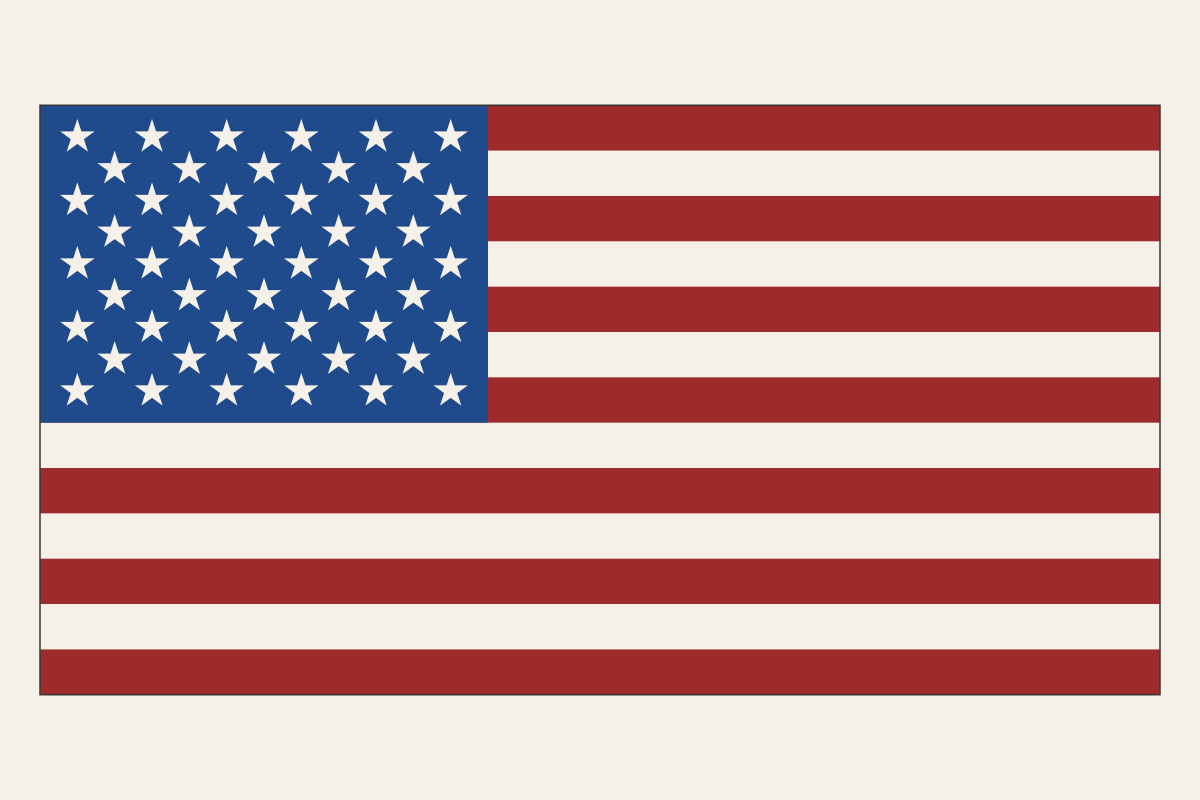
- Thirteen horizontal stripes, alternate red and white, seven red and six white with red at top and bottom, each 1/13 of the hoist; the whole 1.9 times as long as it is tallExecutive Order 10834, Sec. 1 and attachment (A, B, L); red stripes read from the attachment's hatching with Fox-Davies 1909, Fig. 35
- Charge
- A blue union in the upper corner by the pole, 7/13 of the hoist by 0.76, charged with fifty white five-pointed stars in nine rows of six and fiveExecutive Order 10834, Sec. 1–3 and attachment (C, D, E to H, K)
- Tincture
- Gules, argent, azure (red, white, blue), named in Sec. 1 with no shade or color value given; figures here use site tinctures (tincture, not official)Executive Order 10834, Sec. 1
- Difference
- From the 49-star flag of Executive Order 10798 (official July 4, 1959): fifty stars in nine rows of six and five instead of forty-nine in seven staggered rows of seven; hoist 1, fly 1.9 and union .5385 by .76 unchangedExecutive Order 10798, Sec. 1, 6 and attachment, 24 F.R. 79, 81; Executive Order 10834, attachment
- Issued by
- President Dwight D. Eisenhower, Executive Order 10834 of August 21, 1959, under the star rule of 4 U.S.C. §2Executive Order 10834, 24 F.R. 6865–6867; 4 U.S.C. §2
- First documented
- This design: Executive Order 10834, August 21, 1959, official July 4, 1960; a flag of thirteen stripes and thirteen stars: resolution of June 14, 1777; earliest we can documentExecutive Order 10834, Sec. 31; Journals of the Continental Congress, vol. 8, p. 464
- Spec source
- Executive Order 10834, Part I, Sec. 1–3 and attachment Standard proportions, 24 F.R. 6865 (Aug. 25, 1959); 4 U.S.C. §§1–2 (§1 still reads forty-eight stars, US Code 2024 edition)Federal Register, Aug. 25, 1959; US Code 2024 edition
Blazon card as CSV flag-of-the-united-states-blazon.csvprovenance and license of flag-of-the-united-states-blazon.csv
Open the drawing at full size.
The flag of the United States drawn to the Standard proportions of Executive Order 10834, 1.9 times as long as it is tall (tincture, not official).
Credit and reuse terms
"US flag drawn to Executive Order 10834" by Banners & Banknotes, https://bannersandbanknotes.com/flags-heraldry/flag-of-the-united-states/, licensed under CC BY 4.0 (https://creativecommons.org/licenses/by/4.0/). Based on Executive Order 10834, Part I, §§2–3 and its attachment "Standard proportions" (24 F.R. 6865, Aug. 25, 1959), and 4 U.S.C. §§1–2. Design rights: The flag's design is set by federal law (4 U.S.C. §§1–2) and Executive Order 10834 (24 F.R. 6865, 1959), works of the U.S. Government that are not subject to copyright under 17 U.S.C. §105. The issue of the Federal Register that printed the order states, "There are no restrictions on the republication of material appearing in the Federal Register" (24 F.R. 6866, Aug. 25, 1959). Only the parts Banners & Banknotes added (labels, scale bars, layout) are released under CC BY 4.0; no rights are claimed in the original design itself.
TL;DR. The US flag is 1.9 times as long as it is tall because Executive Order 10834, signed in 1959, says so in a lettered table that also sets the blue union at 0.5385 by 0.76 of the height and each stripe at 0.0769. Its fifty stars rest on a statute's rule of one more star for each new state, while the statute's first section, 4 U.S.C. §1, still reads forty-eight stars in the 2024 edition of the US Code.
In this file7 sections
The 1959 order that fixes the US flag's length at 1.9 also authorizes three sizes well short of it. Start at the edge against the pole, which Executive Order 10834 calls the hoist and labels A, with a value of 1.0. Follow the top stripe to the far end, the fly, labeled B: 1.9. In the stranger's read, which names only shapes and colors, the flag is thirteen horizontal stripes, seven red and six white, with a blue canton, the corner panel the order calls the union, holding fifty white five-pointed stars in nine staggered rows.
President Dwight D. Eisenhower signed the order on August 21, 1959, the day Hawaii was admitted to the Union. The Federal Register printed it on August 25, with its table, "Standard proportions," across the top of page 6865. Every part is a fraction of the hoist, so a flag 3 feet tall, size (9) in the order's own list, is 5.70 feet long. The fifty-star design became the official flag on July 4, 1960 (Section 31), and the 2024 edition of the US Code still prints the order in its notes to 4 U.S.C. §1.
What does each letter in the order measure?
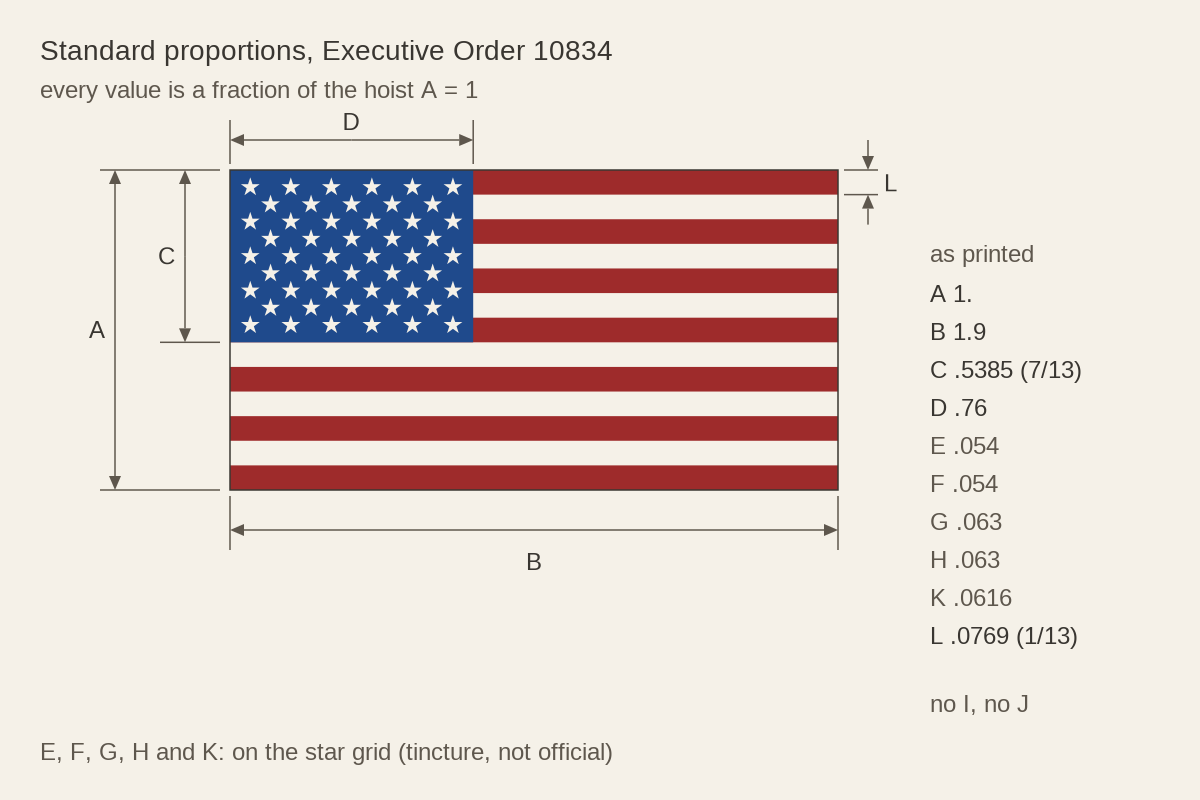
Section 3 makes the table binding: "The dimensions of the constituent parts of the flag shall conform to the proportions set forth in the attachment." The attachment gives ten values, all as fractions of the hoist. The table names six of them, and the other four, E to H, are placed on the drawing above it.
| Letter | Measures | Value |
|---|---|---|
| A | Hoist (width) of flag | 1.0 |
| B | Fly (length) of flag | 1.9 |
| C | Hoist (width) of union | 0.5385 (7/13) |
| D | Fly (length) of union | 0.76 |
| E | Union edge to the top and bottom rows of stars | 0.054 |
| F | Between rows of stars | 0.054 |
| G | Union edge to the first and last columns of stars | 0.063 |
| H | Between columns of stars | 0.063 |
| K | Diameter of star | 0.0616 |
| L | Width of stripe | 0.0769 (1/13) |
The order's own terms need a second look. It calls the edge along the pole the flag's width and the long edge its length, which makes a width of 1.0 the height of a flag on a pole.
Look along the bottom row of the 1959 table. The letters run A to H, then K and L, with no I and no J.
Slide the drawing sideways to read every label, or open it at full size.
The flag with A, B, C, D and L marked, beside all ten values as the 1959 table prints them; E to H and K appear on the star grid below (tincture, not official).
Credit and reuse terms
"US flag: the lettered table of Executive Order 10834" by Banners & Banknotes, https://bannersandbanknotes.com/flags-heraldry/flag-of-the-united-states/, licensed under CC BY 4.0 (https://creativecommons.org/licenses/by/4.0/). Based on Executive Order 10834, Part I, §§2–3 and its attachment "Standard proportions" (24 F.R. 6865, Aug. 25, 1959), and 4 U.S.C. §§1–2. Design rights: The flag's design is set by federal law (4 U.S.C. §§1–2) and Executive Order 10834 (24 F.R. 6865, 1959), works of the U.S. Government that are not subject to copyright under 17 U.S.C. §105. The issue of the Federal Register that printed the order states, "There are no restrictions on the republication of material appearing in the Federal Register" (24 F.R. 6866, Aug. 25, 1959). Only the parts Banners & Banknotes added (labels, scale bars, layout) are released under CC BY 4.0; no rights are claimed in the original design itself.
For a flag 3 feet (36 inches) tall, the letters come to a fly of 68.4 inches, a union 19.4 by 27.4 inches and stripes 2.77 inches wide, by this page's calculation. Every value, as printed and in inches, is in the proportions table (CSV) provenance and license of flag-of-the-united-states-proportions.csv.
Why are the top and bottom stripes red?
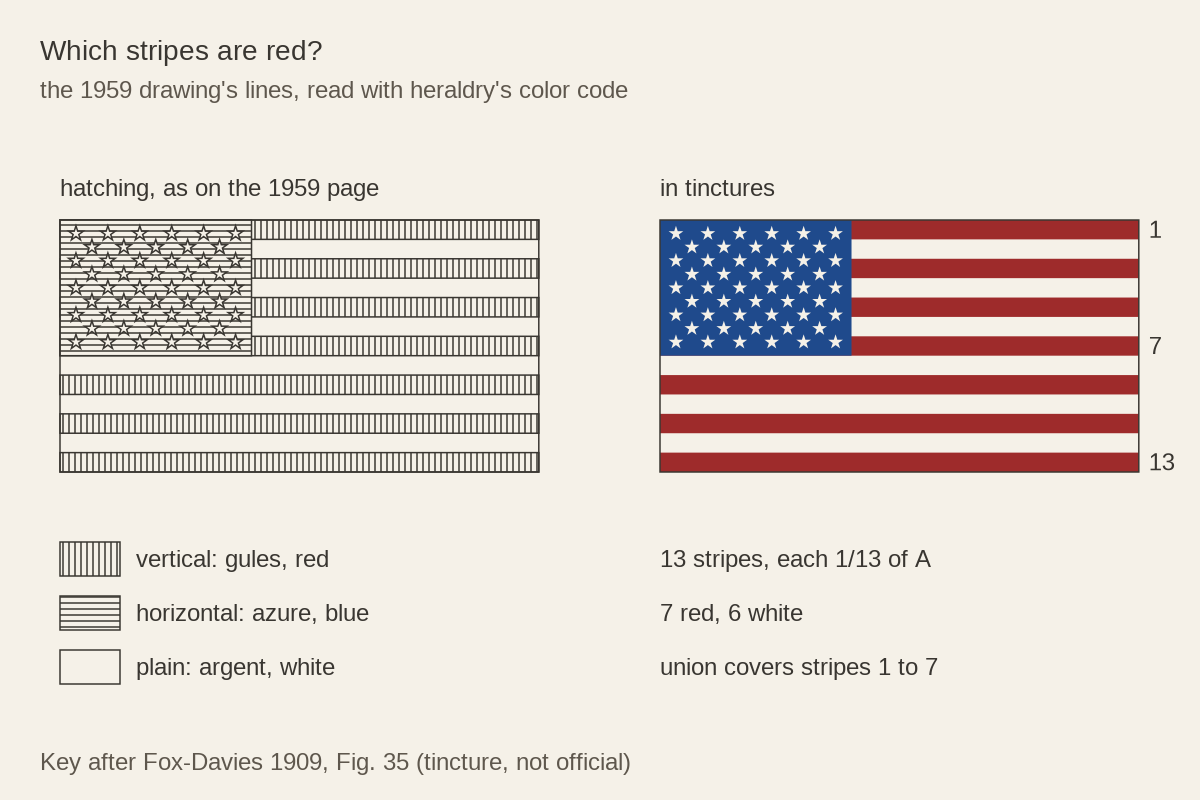
On the stripes, Section 1 of the order says only that the flag "shall have thirteen horizontal stripes, alternate red and white." Neither the order's text nor 4 U.S.C. §1 says which color comes first, so the answer here is read from the drawing printed with the order. That drawing shades the top stripe, and every second stripe below it, with vertical lines. The union gets horizontal lines, and the other six stripes and the stars are left plain.
Those lines match heraldry's black-and-white code for color, though the 1959 page prints no key to them. In A. C. Fox-Davies's A Complete Guide to Heraldry (1909), Figure 35 on page 76 shows vertical lines for gules, or red, and horizontal lines for azure, or blue. Read with that code, the 1959 drawing has seven red stripes, the top and bottom ones included, and six white. The order itself names red, white and blue but gives no shade or color value, so the drawings on this page use the archive's own tinctures.
Slide the drawing sideways to read every label, or open it at full size.
The flag hatched as on the 1959 page, with vertical lines read as red and horizontal as blue, beside the same flag in color, stripes 1, 7 and 13 numbered (tincture, not official).
Credit and reuse terms
"US flag: which stripes are red" by Banners & Banknotes, https://bannersandbanknotes.com/flags-heraldry/flag-of-the-united-states/, licensed under CC BY 4.0 (https://creativecommons.org/licenses/by/4.0/). Based on Executive Order 10834, Part I, §§2–3 and its attachment "Standard proportions" (24 F.R. 6865, Aug. 25, 1959), and 4 U.S.C. §§1–2. Design rights: The flag's design is set by federal law (4 U.S.C. §§1–2) and Executive Order 10834 (24 F.R. 6865, 1959), works of the U.S. Government that are not subject to copyright under 17 U.S.C. §105. The issue of the Federal Register that printed the order states, "There are no restrictions on the republication of material appearing in the Federal Register" (24 F.R. 6866, Aug. 25, 1959). Only the parts Banners & Banknotes added (labels, scale bars, layout) are released under CC BY 4.0; no rights are claimed in the original design itself.
Each stripe is L, which the table prints as 0.0769 and as 1/13; a note beside the drawing divides the hoist into 13 equal parts. Thirteen of the rounded 0.0769 come to 0.9997, by this page's calculation, so the drawings here use the exact thirteenth. Along the right edge of the union, four red stripes meet the blue directly. Whether red may sit against blue is a question for heraldry's rule of tincture, which the fleur-de-lis takes up.
How big is the blue union?
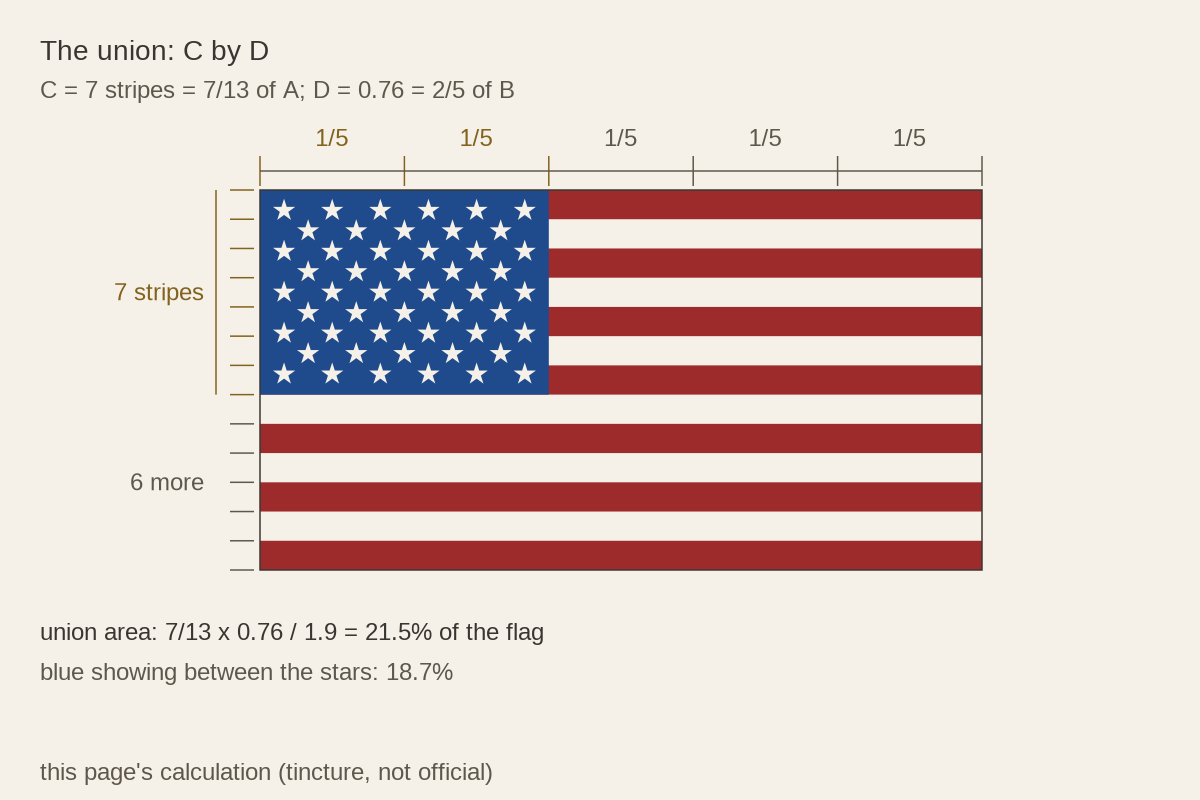
The union is C by D: 0.5385 of the hoist tall and 0.76 long. The table writes C as 7/13, so the union covers stripes 1 to 7 and its lower edge lines up with the bottom of the seventh stripe, a red one. D is two fifths of the fly, since 0.76 divided by 1.9 is 0.4, by this page's calculation.
Slide the drawing sideways to read every label, or open it at full size.
The union covers the top seven of the thirteen stripes and two of five equal parts of the fly (tincture, not official).
Credit and reuse terms
"US flag: the union, 7/13 by 0.76" by Banners & Banknotes, https://bannersandbanknotes.com/flags-heraldry/flag-of-the-united-states/, licensed under CC BY 4.0 (https://creativecommons.org/licenses/by/4.0/). Based on Executive Order 10834, Part I, §§2–3 and its attachment "Standard proportions" (24 F.R. 6865, Aug. 25, 1959), and 4 U.S.C. §§1–2. Design rights: The flag's design is set by federal law (4 U.S.C. §§1–2) and Executive Order 10834 (24 F.R. 6865, 1959), works of the U.S. Government that are not subject to copyright under 17 U.S.C. §105. The issue of the Federal Register that printed the order states, "There are no restrictions on the republication of material appearing in the Federal Register" (24 F.R. 6866, Aug. 25, 1959). Only the parts Banners & Banknotes added (labels, scale bars, layout) are released under CC BY 4.0; no rights are claimed in the original design itself.
By this page's calculation, the union covers 21.5% of the flag and the fifty stars take up 2.8%, which leaves 18.7% of the flag blue. Red is the largest color, at 41.5%. White comes to 39.7%, stripes and stars together. These shares assume regular five-pointed stars whose points touch a circle of diameter K, and they are in the calculation table (CSV) provenance and license of flag-of-the-united-states-calculations.csv.
How are the fifty stars arranged?
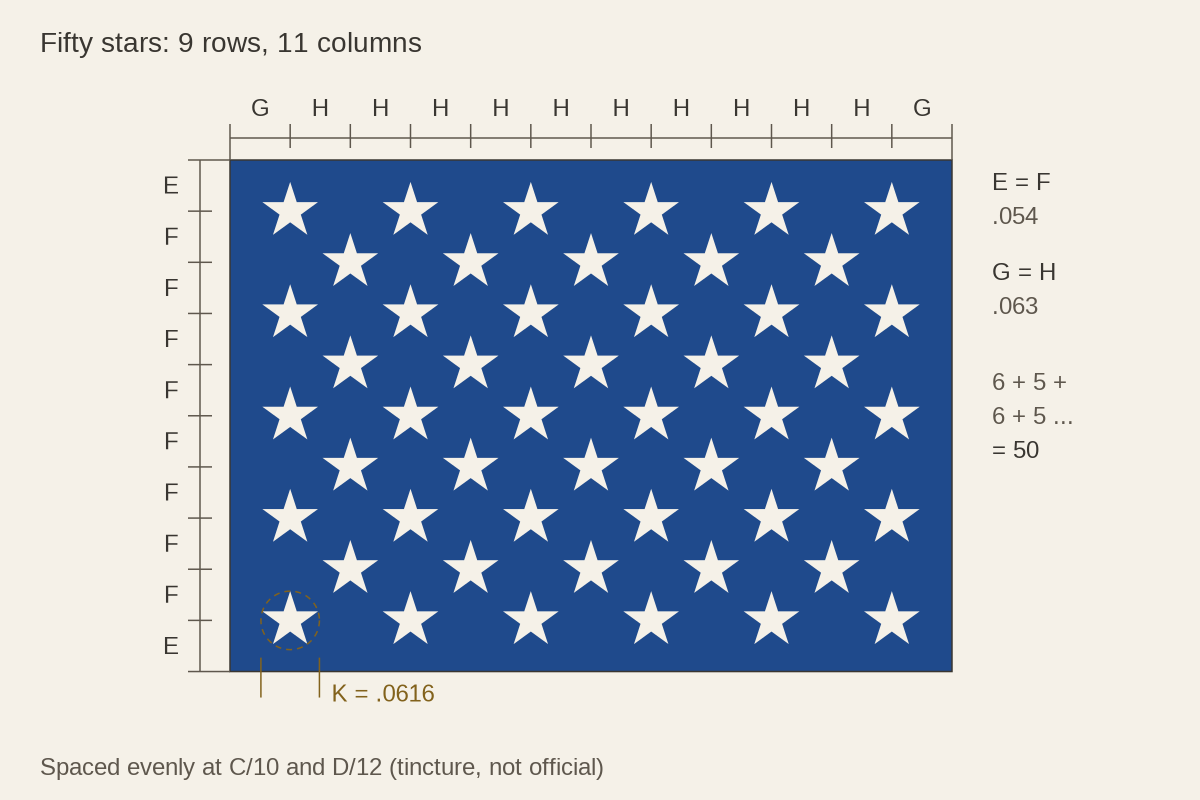
The stars sit in nine rows that alternate six and five, as the attachment draws them. Five rows of six and four rows of five make 50. Section 2 makes the layout part of the order: "The positions of the stars in the union of the flag and in the union jack shall be as indicated on the attachment to this order."
Four letters set the spacing. E and F, both 0.054, are the vertical steps: E from the union's top and bottom edges to the outer rows, F between rows. G and H, both 0.063, are the horizontal steps, from the union's sides to the outer columns and between columns. Each star is K, 0.0616 across, or 0.80 of a stripe by this page's calculation.
Slide the drawing sideways to read every label, or open it at full size.
The union enlarged: nine rows of stars on eleven columns, with the steps E, F, G and H and the star diameter K marked (tincture, not official).
Credit and reuse terms
"US flag: the star grid, E to H and K" by Banners & Banknotes, https://bannersandbanknotes.com/flags-heraldry/flag-of-the-united-states/, licensed under CC BY 4.0 (https://creativecommons.org/licenses/by/4.0/). Based on Executive Order 10834, Part I, §§2–3 and its attachment "Standard proportions" (24 F.R. 6865, Aug. 25, 1959), and 4 U.S.C. §§1–2. Design rights: The flag's design is set by federal law (4 U.S.C. §§1–2) and Executive Order 10834 (24 F.R. 6865, 1959), works of the U.S. Government that are not subject to copyright under 17 U.S.C. §105. The issue of the Federal Register that printed the order states, "There are no restrictions on the republication of material appearing in the Federal Register" (24 F.R. 6866, Aug. 25, 1959). Only the parts Banners & Banknotes added (labels, scale bars, layout) are released under CC BY 4.0; no rights are claimed in the original design itself.
The rounded numbers do not quite add up. Ten vertical steps of 0.054 make 0.540, slightly more than the union's 0.5385, and twelve horizontal steps of 0.063 make 0.756, slightly less than its 0.76, by this page's calculation. The drawings here space the stars evenly instead, at C/10 and D/12, which round to the table's 0.054 and 0.063.
Why does the law still say forty-eight stars?
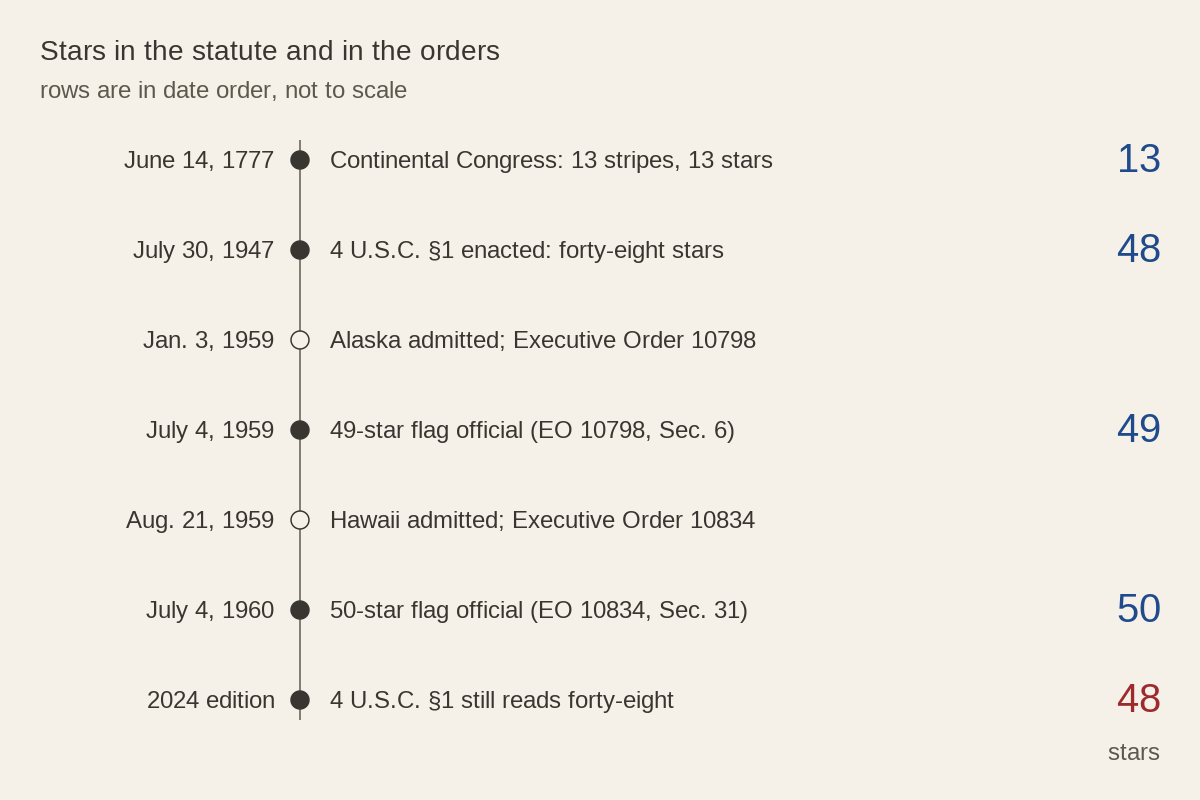
Section 1 of title 4 has not been amended since it was enacted in 1947. The 2024 edition of the US Code prints 4 U.S.C. §1 as "the union of the flag shall be forty-eight stars, white in a blue field," with a single citation, an act of July 30, 1947. The next section supplies the rule for change: "On the admission of a new State into the Union one star shall be added to the union of the flag," taking effect "on the fourth day of July then next succeeding such admission."
Executive orders did the rest. Alaska was admitted on January 3, 1959, and Executive Order 10798, signed that day, made a 49-star flag official from July 4, 1959 (Section 6). Hawaii followed on August 21, 1959. Executive Order 10834 kept the 49-star flag until July 4, 1960, "and on that date the flag prescribed by Part I of this order shall become the official flag of the United States" (Section 31). The dates and star counts in the chart below, each with its source, are in the timeline table (CSV) provenance and license of flag-of-the-united-states-timeline-data.csv.
Slide the drawing sideways to read every label, or open it at full size.
Star counts in date order, from the 1777 resolution to the 2024 edition of the US Code; the rows are not to scale.
Credit and reuse terms
"US flag: stars in the statute and in the orders" by Banners & Banknotes, https://bannersandbanknotes.com/flags-heraldry/flag-of-the-united-states/, licensed under CC BY 4.0 (https://creativecommons.org/licenses/by/4.0/)
The US flag got its fiftieth star on July 4, 1960, under the star rule of 4 U.S.C. §2 and Section 31 of Executive Order 10834, while 4 U.S.C. §1 still reads forty-eight as of the 2024 edition. The 1.9 is older than the fiftieth star. The table attached to Executive Order 10798 already gave the fly as 1.9 and the union as 0.5385 by 0.76, under the same letters with no I or J. What changed in August 1959 was the layout, from seven staggered rows of seven stars to nine rows of six and five.
Does the order allow other shapes?
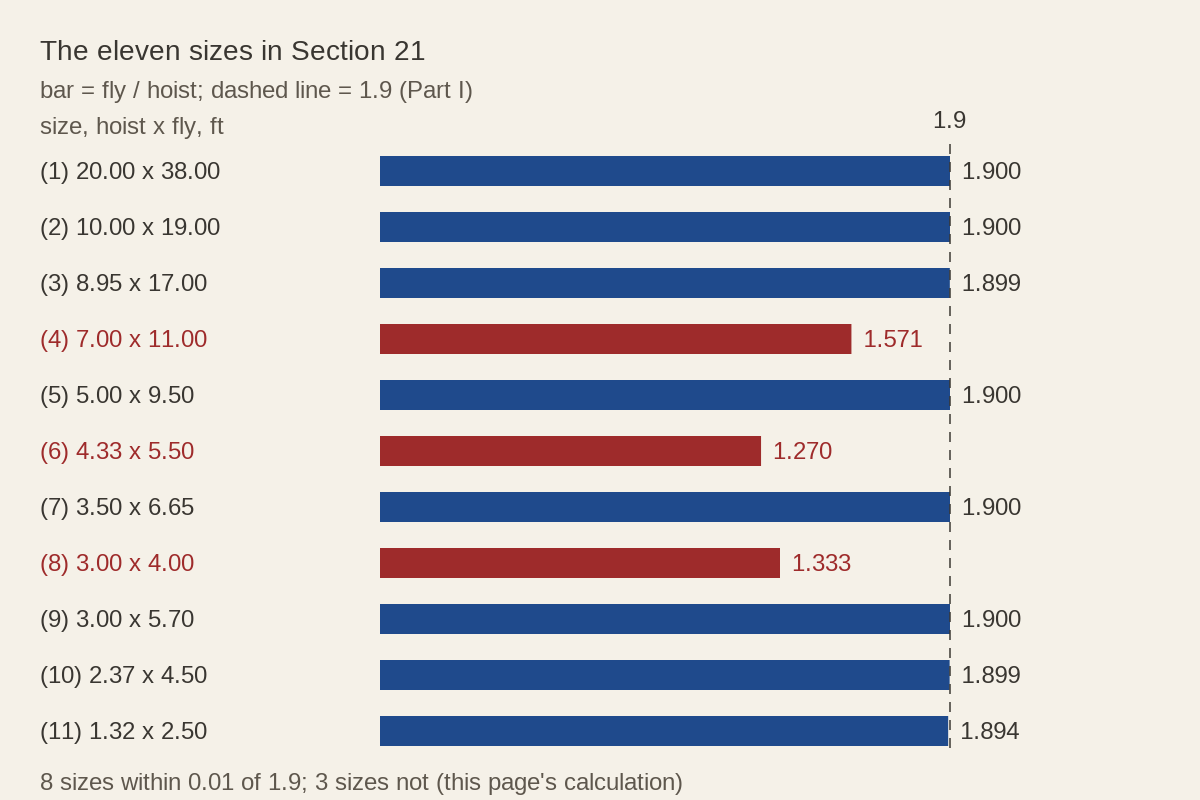
It does, for flags made or bought for executive agencies of the federal government. Section 21 opens, "The following sizes of flags are authorized for executive agencies," and lists eleven, hoist by fly in feet, from 20 by 38 down to 1.32 by 2.5. By this page's calculation, five come out at exactly 1.9 and three more within 0.01 of it. Three of the eleven sizes in Section 21 of Executive Order 10834 miss 1.9 by more than 0.01: 7 by 11 feet is 1.57 times as long as it is tall, 4.33 by 5.5 feet is 1.27 times and 3 by 4 feet is 1.33 times.
The order makes room for the clash. Section 22(a) requires agency flags to follow Part I "except as otherwise authorized by the provisions of section 21." Section 24(a) lets the Secretary of Defense and the Administrator of General Services "authorize proportions or sizes other than those prescribed by section 3 or section 21." Neither section says how the stars and stripes should fit a 3 by 4 flag.
Slide the drawing sideways to read every label, or open it at full size.
The eleven sizes in Section 21 of Executive Order 10834 as length divided by height; three red bars stop more than 0.01 short of the 1.9 set in Part I.
Credit and reuse terms
"US flag: the eleven sizes in Executive Order 10834" by Banners & Banknotes, https://bannersandbanknotes.com/flags-heraldry/flag-of-the-united-states/, licensed under CC BY 4.0 (https://creativecommons.org/licenses/by/4.0/)
Britain's flag has no lettered table in law at all. The Flag Institute, a UK flag charity, recommends a specification for "the world's only national flag that has no basis in law," with 3:5 as "the normal proportions for use on land" and 1:2 at sea. The American 1.9 falls between those two shapes, which the Union Jack page draws side by side. All eleven American sizes are in the sizes table (CSV) provenance and license of flag-of-the-united-states-sizes.csv.
What do the stars, stripes and colors stand for?
The resolution of 1777 gives the flag one meaning, in its last words. On June 14, 1777, the Continental Congress resolved that the flag be "thirteen stripes, alternate red and white: that the union be thirteen stars, white in a blue field, representing a new constellation," according to the Journals of the Continental Congress (vol. 8, p. 464). The resolution says nothing about what the stripes or the colors mean.
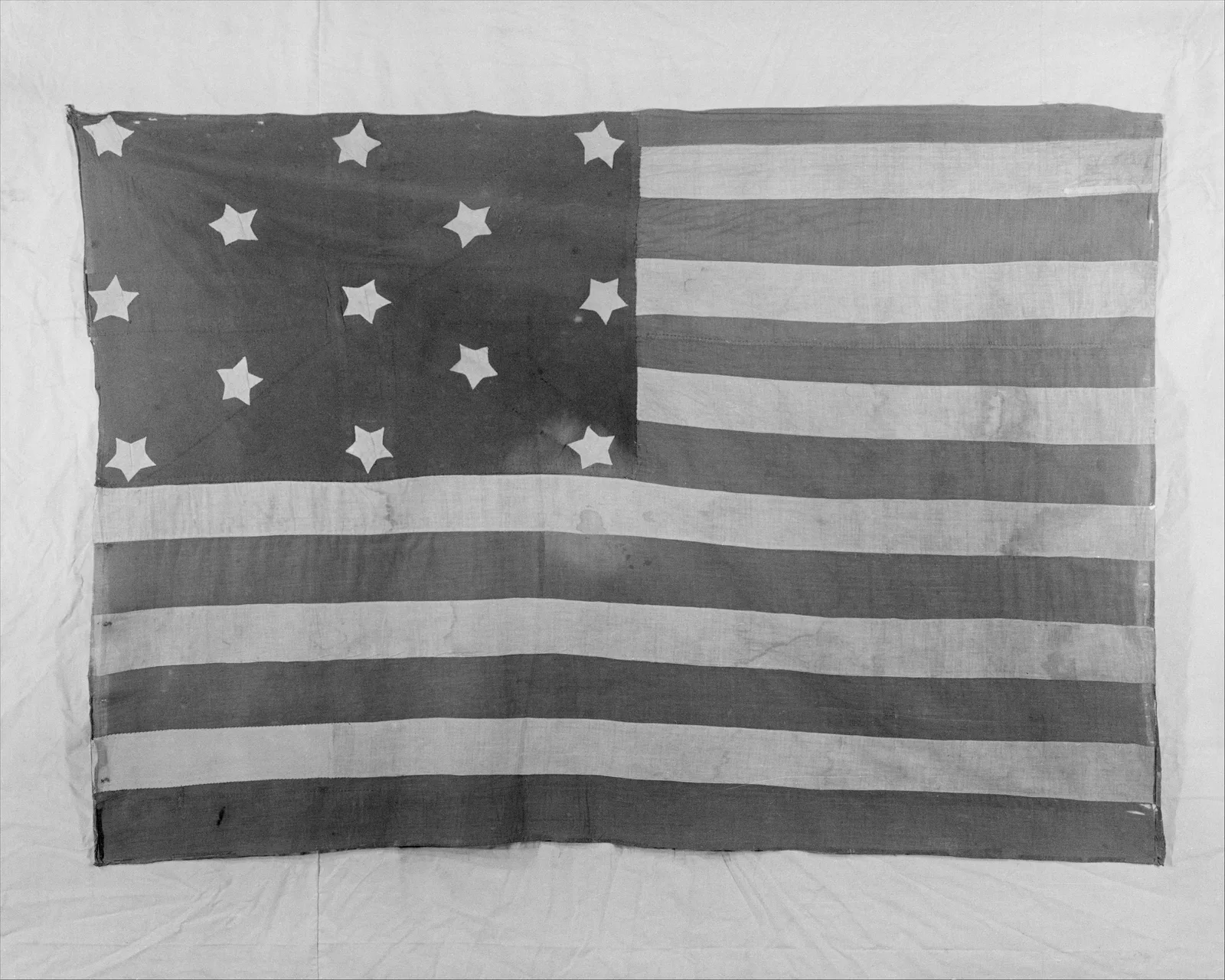
A cotton and wool flag that the Metropolitan Museum of Art dates to about 1777: thirteen stripes, and thirteen stars in rows of three and two. The museum's photograph is black and white.
Credit and reuse terms
"Flag MET 160961" by The Metropolitan Museum of Art — https://commons.wikimedia.org/wiki/File:Flag_MET_160961.jpg — CC0 1.0 (https://creativecommons.org/publicdomain/zero/1.0/)

Flag, dated about 1777 by the museum. The Metropolitan Museum of Art, 56.65.
A reading of the colors comes from another object, the Great Seal. A report on its design, entered in the Journals on June 20, 1782, and written out by Charles Thomson according to the editors, says the colors of the shield's thirteen upright stripes, its pales, "are those used in the flag of the United States of America." There, "White signifies purity and innocence," red stands for "hardiness and valour," and blue, "the colour of the Chief" across the top of the shield, for "vigilance perseverance and justice" (vol. 22, p. 339). That 1782 report is the earliest text we can document for these meanings, and it was written for the seal.
The link between stars and states is written into statute. An act of April 4, 1818, set the union at twenty stars and provided that "on the admission of every new state into the Union, one star be added to the union of the flag." Section 2 of title 4, enacted in 1947, repeats the rule, and Executive Order 10834 opens by quoting it beside Hawaii's admission.
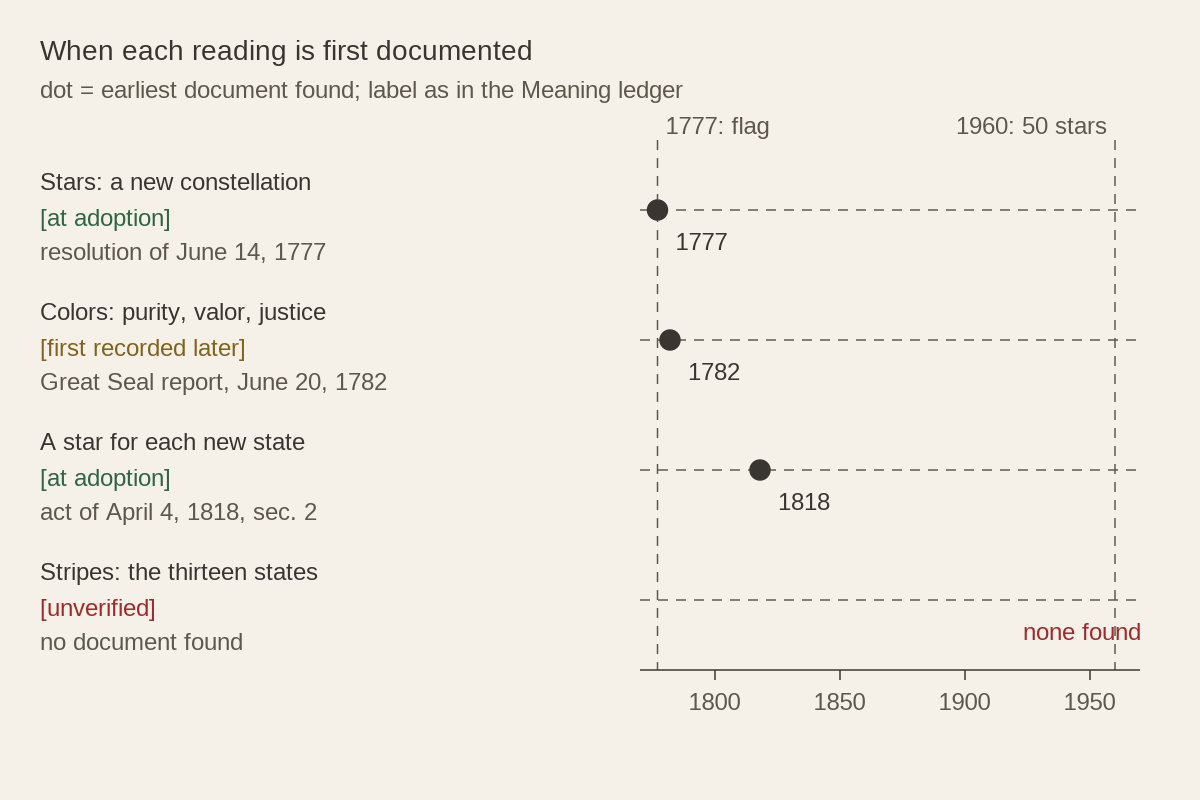
No document read for this page says what the thirteen stripes stand for; the 1782 report says only that the seal's thirteen upright pieces "represent the several States." The ledger below dates each reading.
Slide the drawing sideways to read every label, or open it at full size.
Four readings of the flag set against the year of the earliest document found for each, with the 1777 resolution and the 1960 flag marked.
Credit and reuse terms
"US flag: when each reading is first documented" by Banners & Banknotes, https://bannersandbanknotes.com/flags-heraldry/flag-of-the-united-states/, licensed under CC BY 4.0 (https://creativecommons.org/licenses/by/4.0/)
Shrink strip
At 16 pixels wide, the flag is 8.4 pixels tall, so each stripe is 0.65 of a pixel and each star about half a pixel across, by this page's calculation. At 160 pixels a stripe is 6.5 pixels and a star 5.2.
Shown at its drawn size. On a narrow screen, scroll sideways to see the whole strip.
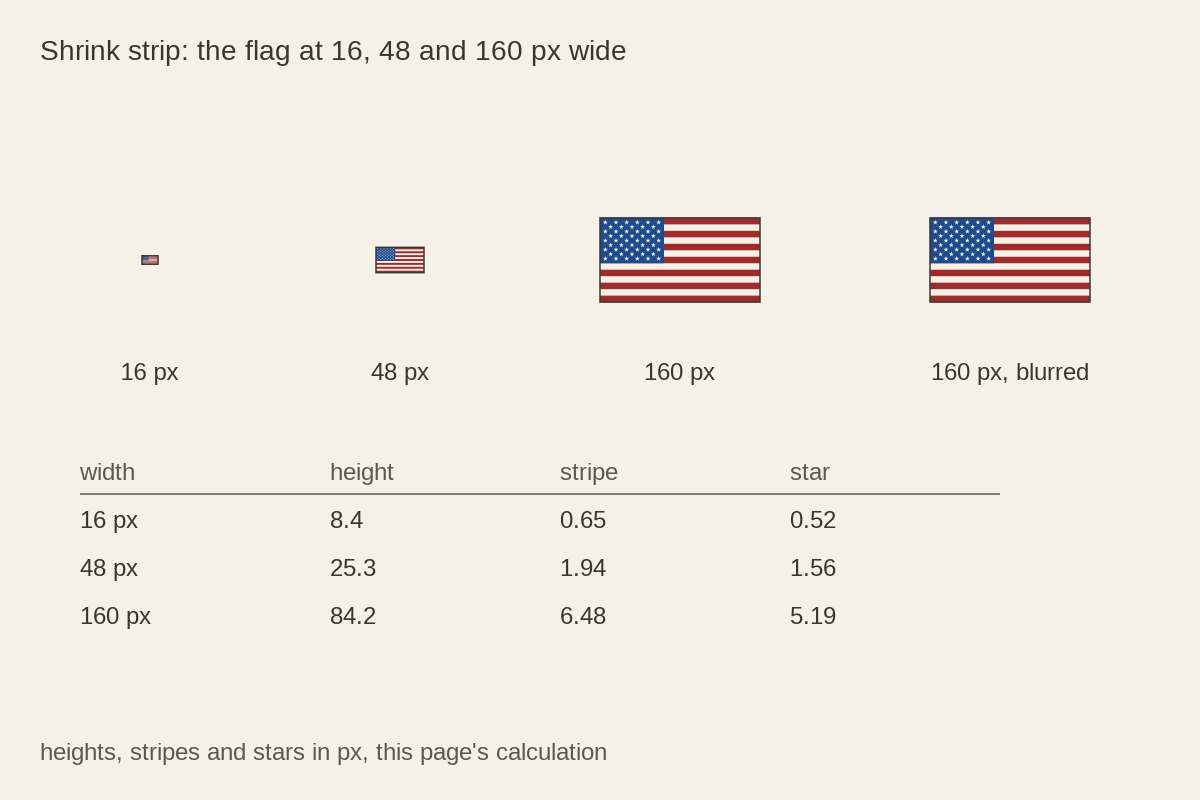
The flag drawn to Executive Order 10834 at 16, 48 and 160 pixels wide, plus a blurred copy (tincture, not official). Reduction preview, not a legibility test.
Credit and reuse terms
"US flag shrink strip" by Banners & Banknotes, https://bannersandbanknotes.com/flags-heraldry/flag-of-the-united-states/, licensed under CC BY 4.0 (https://creativecommons.org/licenses/by/4.0/). Based on Executive Order 10834, Part I, §§2–3 and its attachment "Standard proportions" (24 F.R. 6865, Aug. 25, 1959), and 4 U.S.C. §§1–2. Design rights: The flag's design is set by federal law (4 U.S.C. §§1–2) and Executive Order 10834 (24 F.R. 6865, 1959), works of the U.S. Government that are not subject to copyright under 17 U.S.C. §105. The issue of the Federal Register that printed the order states, "There are no restrictions on the republication of material appearing in the Federal Register" (24 F.R. 6866, Aug. 25, 1959). Only the parts Banners & Banknotes added (labels, scale bars, layout) are released under CC BY 4.0; no rights are claimed in the original design itself. Derived from "US flag drawn to Executive Order 10834".
Meaning ledger
| Meaning | Earliest we can document | Year | Label | Notes |
|---|---|---|---|---|
| The thirteen stars represent "a new constellation" | Resolution of the Continental Congress, June 14, 1777, Journals of the Continental Congress, vol. 8, p. 464 | 1777 | [at adoption] | The same resolution adopted the flag of "thirteen stripes, alternate red and white" and "thirteen stars, white in a blue field." It gives the stripes and colors no meaning. |
| A star is added for each state admitted | Act of April 4, 1818, ch. 34, sec. 2 (3 Stat. 415); repeated in 4 U.S.C. §2 (1947) and quoted in the preamble of Executive Order 10834 (1959) | 1818 | [at adoption] | The 1818 act adopted the twenty-star flag and the rule together, and the order that adopted the fifty-star design quotes the rule and ties the new star to Hawaii's admission "this day." None of these texts uses the word represent. |
| White for purity and innocence, red for hardiness and valor, blue for vigilance, perseverance and justice | Report on the device of the Great Seal, June 20, 1782, Journals of the Continental Congress, vol. 22, p. 339 (in Charles Thomson's handwriting, according to the editors) | 1782 | [first recorded later] | Written for the seal's shield: the report says the colors of its pales, the thirteen upright stripes, "are those used in the flag of the United States of America," and calls blue "the colour of the Chief." No document found that gives these meanings for the flag itself. |
| The thirteen stripes stand for the original thirteen states | No document found | — | [unverified] | The 1777 resolution gives the flag thirteen stripes without saying what they stand for. The 1782 report says the seal's thirteen pieces "represent the several States." |
How each label is decided: The After-Meaning, the four labels.
Sources
- Executive Order 10834, "The Flag of the United States," August 21, 1959, Federal Register vol. 24, no. 166 (August 25, 1959), pp. 6865–6867, with the attachment "Standard proportions." govinfo.gov Read: pages 6865–6867
- 4 U.S.C. §1, "Flag; stripes and stars on," United States Code, 2024 edition, with Executive Orders 10798 and 10834 in its notes. govinfo.gov Read: section 1 and its notes
- 4 U.S.C. §2, "Same; additional stars," United States Code, 2024 edition. govinfo.gov Read: section 2
- An Act to establish the flag of the United States, April 4, 1818, ch. 34, United States Statutes at Large, vol. 3, p. 415. archive.org Read: page 415
- Executive Order 10798, "Flag of the United States," January 3, 1959, Federal Register vol. 24, no. 3 (January 6, 1959), pp. 79 and 81. govinfo.gov Read: pages 79 and 81
- Journals of the Continental Congress, 1774–1789, vol. 8, 1777, May 22–October 2, ed. Worthington Chauncey Ford (Washington: Government Printing Office, 1907), p. 464 (June 14, 1777). archive.org Read: title page; pages 463–464
- Journals of the Continental Congress, 1774–1789, vol. 22, 1782, January 1–August 9, ed. Gaillard Hunt (Washington: Government Printing Office, 1914), pp. 338–340 (June 20, 1782). archive.org Read: title page; pages 338–340
- American Institute of Graphic Arts, Symbol Signs: The Development of Passenger/Pedestrian Oriented Symbols for Use in Transportation-Related Facilities (U.S. Department of Transportation, Office of Facilitation, contract DOT-OS-40192, November 1974; NTIS PB-239 352), abstract. archive.org Read: abstract
- A. C. Fox-Davies, A Complete Guide to Heraldry (London and Edinburgh: T. C. & E. C. Jack, 1909), pp. 75–76 and Fig. 35. archive.org Read: pages 75–76
- The Flag Institute, "Union Flag Specification." flaginstitute.org Read: full text
Counter-sign
Counter-sign: The US union jack. Executive Order 10834 gives it the stars of the union in the same positions (Section 2) and makes it the size of the union of the flag it flies with (Section 23), so one flag is measured by a part of another.
- Union Jack: Britain's flag of that name has two working shapes, 3:5 and 1:2, and no statute behind either.
- DOT/AIGA Symbol Signs: another set of drawings made for a federal agency, in a 1974 report with the US Department of Transportation that created 34 symbols for transportation facilities and gave guidelines for their use.
Cite this page
Banners & Banknotes. “US Flag: A 1959 Order Makes It 1.9 Times as Long as Tall.” Published 14 October 2026. https://bannersandbanknotes.com/flags-heraldry/flag-of-the-united-states/. Accessed [date you read it].
Corrections
No corrections yet.