Lineage · No. 0005
Fleur-de-lis: France's Arms Went From Many Lilies to Three
Blazon card
- Field
- Azure (blue), drawn on this page as a heater-shaped shieldWoodward 1892, vol. 1, p. 112; Fox-Davies 1909, p. 274
- Charge
- Three fleurs-de-lis Or (France Modern); earlier semé-de-lis, gold lilies strewn over the field and cut off by its edge (France Ancient)Woodward 1892, vol. 1, pp. 104 and 112; Fox-Davies 1909, p. 274
- Tincture
- Azure #1F4A8C and Or #82621C; the blazons give no color values (tincture, not official)Banners & Banknotes palette
- Difference
- France Ancient strews the field with lilies; France Modern keeps three. Florence bears Argent, a fleur-de-lis florencée gulesWoodward 1892, vol. 1, pp. 112 and 330; Fox-Davies 1909, p. 275
- Issued by
- The kings of France; quartered in the royal arms of England from 1340 until 1801Fox-Davies 1909, p. 274; London Gazette 15324, p. 2
- First documented
- Earliest we can document: one fleur-de-lis on Philip II's counter-seal, 1180; the strewn shield on a royal official's seal, 1207; a shield of three fleurs-de-lis on a royal counter-seal, 1285; an edict of 1376, quoted in 1892, cuts the arms of France to threeDouët d'Arcq 1863, Nos. 38 and 46; Pastoureau 1979 as summarized in F. Velde, Heraldica; Woodward 1892, vol. 1, p. 329
- Spec source
- Blazons: Azure, semé-de-lis Or (France Ancient); Azure, three fleurs-de-lis Or (France Modern)Woodward 1892, vol. 1, pp. 104 and 112; Fox-Davies 1909, p. 274
Blazon card as CSV fleur-de-lis-blazon.csvprovenance and license of fleur-de-lis-blazon.csv
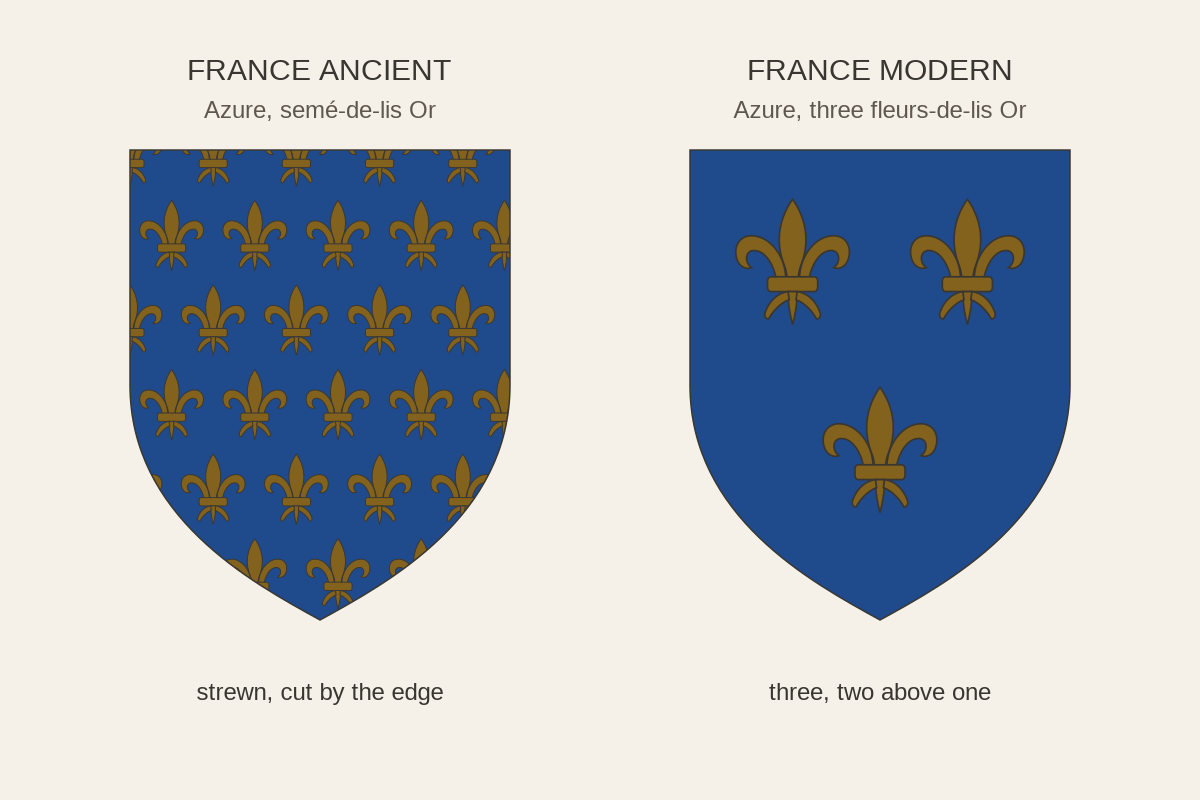
Slide the drawing sideways to read every label, or open it at full size.
France Ancient, a blue shield strewn with gold lilies, beside France Modern, with three, both drawn from their blazons (tincture, not official).
Credit and reuse terms
"France Ancient and France Modern, redrawn from their blazons" by Banners & Banknotes, https://bannersandbanknotes.com/flags-heraldry/fleur-de-lis/, licensed under CC BY 4.0 (https://creativecommons.org/licenses/by/4.0/). Based on the blazons Azure, semé-de-lis Or (France Ancient) and Azure, three fleurs-de-lis Or (France Modern), as given in A. C. Fox-Davies, A Complete Guide to Heraldry (1909), p. 274, and J. Woodward and G. Burnett, A Treatise on Heraldry, British and Foreign (1892), vol. 1, pp. 104 and 112. Design rights: the royal arms of France, recorded on seals by 1211 and reported fixed at three lilies in 1376, have no known author; US copyright in works published before 1931 has expired, and the EU term for anonymous works, 70 years from publication, ended centuries ago. Only the parts Banners & Banknotes added (labels, scale bars, layout) are released under CC BY 4.0; no rights are claimed in the original design itself.
TL;DR. The fleur-de-lis is the stylized gold flower the kings of France bore on a blue shield, first strewn across the whole field and later cut to three, a change two heraldry handbooks tie to an edict of 1376. England quartered those lilies from 1340 to 1801, Florence kept a red lily of its own, and the flag Quebec adopted in 1948 carries four.
In this file6 sections
The early royal arms of France had no fixed number of fleurs-de-lis, because the edge of the shield decided. Look at the rim of the left-hand shield above, where gold lilies run off the sides, the top and the point. John Woodward's Treatise on Heraldry of 1892 says a field strewn this way "appears as if it were cut out of a larger surface." In the stranger's read, which goes by shape, color and position alone, it is a blue shield sown with small gold flowers, each a tall middle petal between two petals that curl outward and down over a band.
Woodward names that version France Ancient, and Fox-Davies gives its blazon as Azure, semé-de-lis Or: blue, strewn with gold lilies. The later version, France Modern, is Azure, three fleurs-de-lis Or. Blazon is heraldry's way of describing arms in words, and these two blazons give no sizes, so the drawing above sets its own; for a flag drawn from numbers instead, see the US flag. Between the two versions runs a trail of seals and coins, and the lily also turns up in the arms of England, Florence and Quebec, each with its own dates.
When did France's arms go from many lilies to three?
The lily reached the king's seal before it covered his shield. Louis Douët d'Arcq's 1863 catalogue of the seals in the French national archives lists Philip II's first seal on a charter given at Sens in 1180, with a single fleur-de-lis on the counter-seal, and François Velde, whose Heraldica site surveys the evidence, also dates the single lily on Philip II's seals to 1180. A passage from the historian Michel Pastoureau's 1979 handbook, in Velde's translation, puts the strewn shield on a seal of 1211, used by the future Louis VIII before he became king. Velde's summary of the same passage adds an official of the royal domain who already bore it on a seal of 1207.
Fox-Davies's Complete Guide to Heraldry of 1909 says that by Louis VIII's reign "Azure, semé-de-lis or" had become "the fixed and determined arms of France." The date of the cut to three rests on one quoted edict. Woodward's Treatise reports "an edict, dated 1376," by which Charles V cut the lilies in his shield to three "pour symboliser la Sainte-Trinité," to stand for the Holy Trinity. Fox-Davies repeats it in 1909 and Velde gives the same year, but none of them says where the edict can be read.
The edict itself was not traced for this page, so the Trinity reading goes into the Meaning ledger below as first recorded later. Three lilies were not new in 1376, either. Douët d'Arcq's catalogue gives the counter-seal of Philip the Bold's regency seal, on letters of July 1285, as a shield bearing three fleurs-de-lis. Woodward describes Edward III's Great Seal of 1340, where the shields on the canopy "have but three fleurs-de-lis" while the king's own shield is strewn, and Herbert Grueber's 1899 handbook to the coins in the British Museum finds that on Henry IV's gold "the number of lis in the French arms varies; being either three, or more than three."
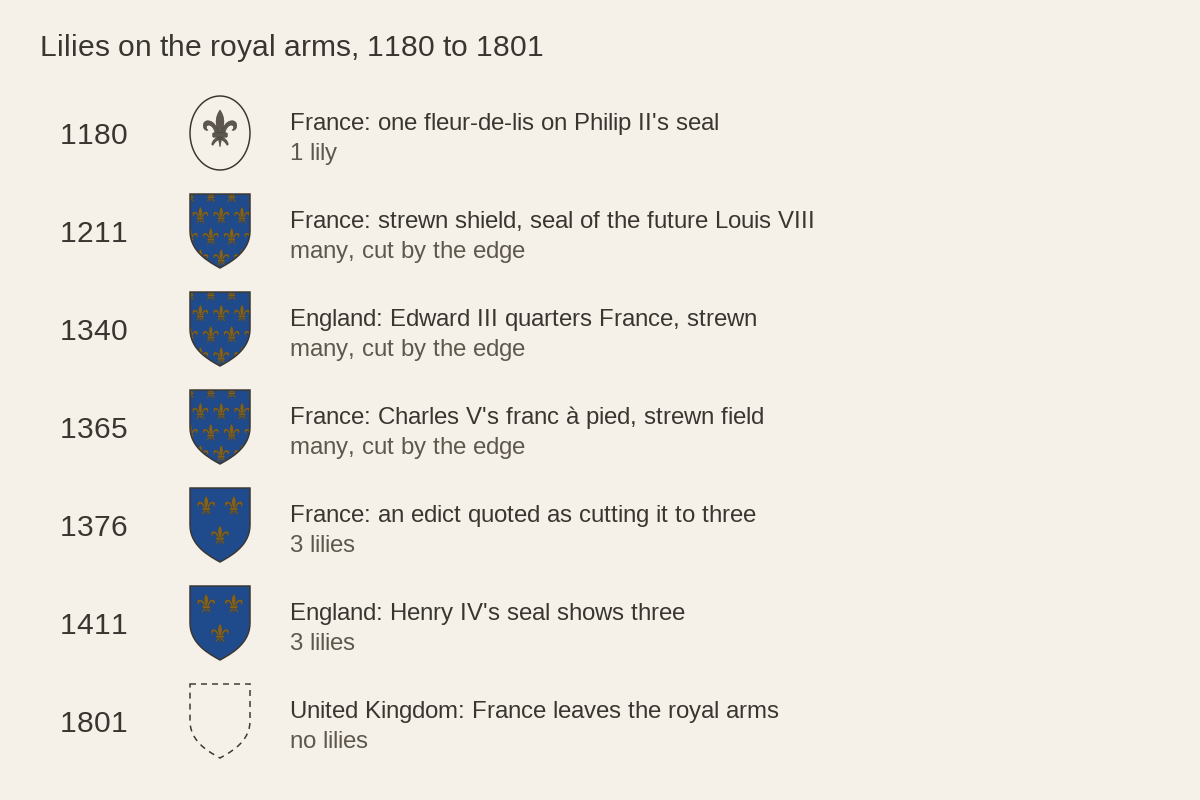
Slide the drawing sideways to read every label, or open it at full size.
Seven dated records of the lilies on the French and English royal arms, from Philip II's seal of 1180 to the arms of 1801 (tincture, not official).
Credit and reuse terms
"Lilies on the royal arms of France and England, 1180 to 1801" by Banners & Banknotes, https://bannersandbanknotes.com/flags-heraldry/fleur-de-lis/, licensed under CC BY 4.0 (https://creativecommons.org/licenses/by/4.0/). Based on the blazons Azure, semé-de-lis Or (France Ancient) and Azure, three fleurs-de-lis Or (France Modern), as given in A. C. Fox-Davies, A Complete Guide to Heraldry (1909), p. 274, and J. Woodward and G. Burnett, A Treatise on Heraldry, British and Foreign (1892), vol. 1, pp. 104 and 112. Design rights: the royal arms of France, recorded on seals by 1211 and reported fixed at three lilies in 1376, have no known author; US copyright in works published before 1931 has expired, and the EU term for anonymous works, 70 years from publication, ended centuries ago. Only the parts Banners & Banknotes added (labels, scale bars, layout) are released under CC BY 4.0; no rights are claimed in the original design itself.
Charles V's own gold still shows the strewn field about a decade before the edict. Arthur Engel and Raymond Serrure's treatise on medieval coins dates the franc à pied, the gold coin on which the king stands under a Gothic canopy, to 1365. They describe the canopy as set "dans un champ semé de lis," in a field strewn with lilies, and the cross on the reverse with two lilies and two crowns in its angles.
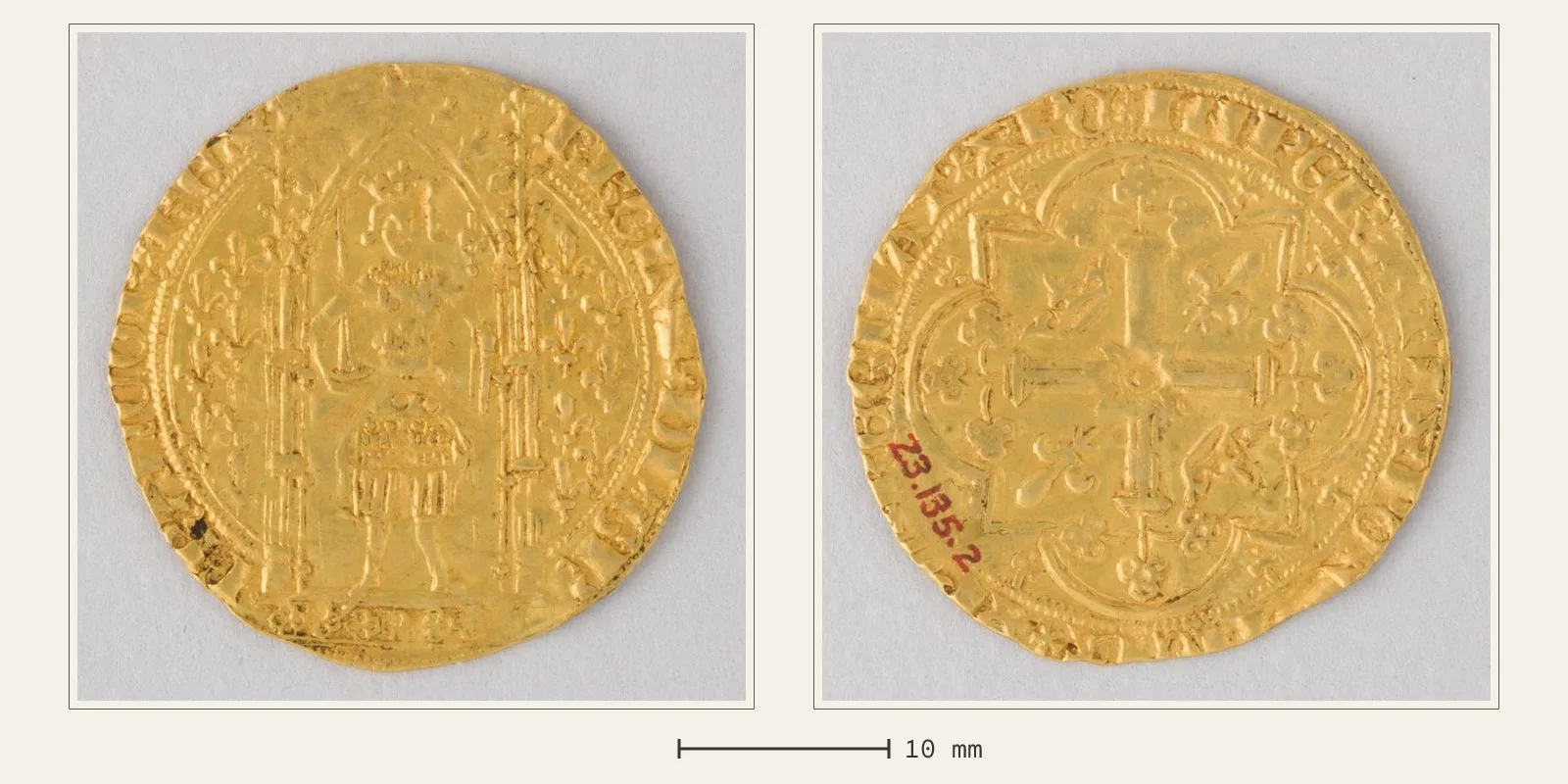
Charles V's franc à pied. The king stands under a Gothic canopy with rows of small lilies on either side; the reverse cross has two lilies and two crowns in its angles.
Credit and reuse terms
"Coin (Franc) Showing Charles V MET 23.135.2 001nov2014" by The Metropolitan Museum of Art — https://commons.wikimedia.org/wiki/File:Coin_(Franc)_Showing_Charles_V_MET_23.135.2_001nov2014.jpg — CC0 1.0 (https://creativecommons.org/publicdomain/zero/1.0/); changes: obverse placed beside the reverse, File:Coin (Franc) Showing Charles V MET 23.135.2 002nov2014.jpg (CC0 image), each side cropped to a square around the coin and scaled to the same coin size on a #F5F1E8 panel, 10 mm scale bar added from the museum diameter of 2.9 cm

Franc à pied of Charles V, 1365–1380, kingdom of France. The Metropolitan Museum of Art, 23.135.2.
Count the small lilies to the left of the king. They are stacked in rows from his feet to the top of the canopy.
Is the fleur-de-lis a lily or an iris?
The name says lily: fleur de lis is French for "lily flower." Velde dates lis, from Latin lilium, to about 1150 for the flower, and the first clear heraldic use of fleur de lis to 1225, in Durmart le Gallois.
The heraldry handbooks lean toward the iris. Woodward wrote in 1892 that the fleur-de-lis is "now generally identified with the iris," and Fox-Davies noted in 1909 that "the iris was known by the name of a lily until comparatively modern times." Pastoureau, in Velde's translation, says that the many writers on the subject agree it has "little to do graphically with the lily" but disagree on what it does come from.
Velde argues from color, writing that lilies are never yellow in the wild while some irises are. Gray's New Manual of Botany of 1908 does list a wild yellow lily, Lilium canadense, with flowers "yellow or orange," in moist meadows and bogs from eastern Quebec to Georgia. Velde leans to a 17th-century idea that he credits to the Flemish Jesuit Godefridus Henschenius: the model was the yellow flag, Iris pseudacorus, a marsh iris. Fox-Davies looked instead at the seal of Louis VIII, where the flower in the king's hand has "a marked resemblance both to the iris and to the conventional fleur-de-lis."
Quebec's floral emblem has been each flower in turn. Canadian Heritage's page on the province's symbols, last updated in 2017, says the emblem was the white garden lily from 1963 to 1999 and has been the blue flag, Iris versicolor, since 5 November 1999. The page does not link either choice to the fleur-de-lis.
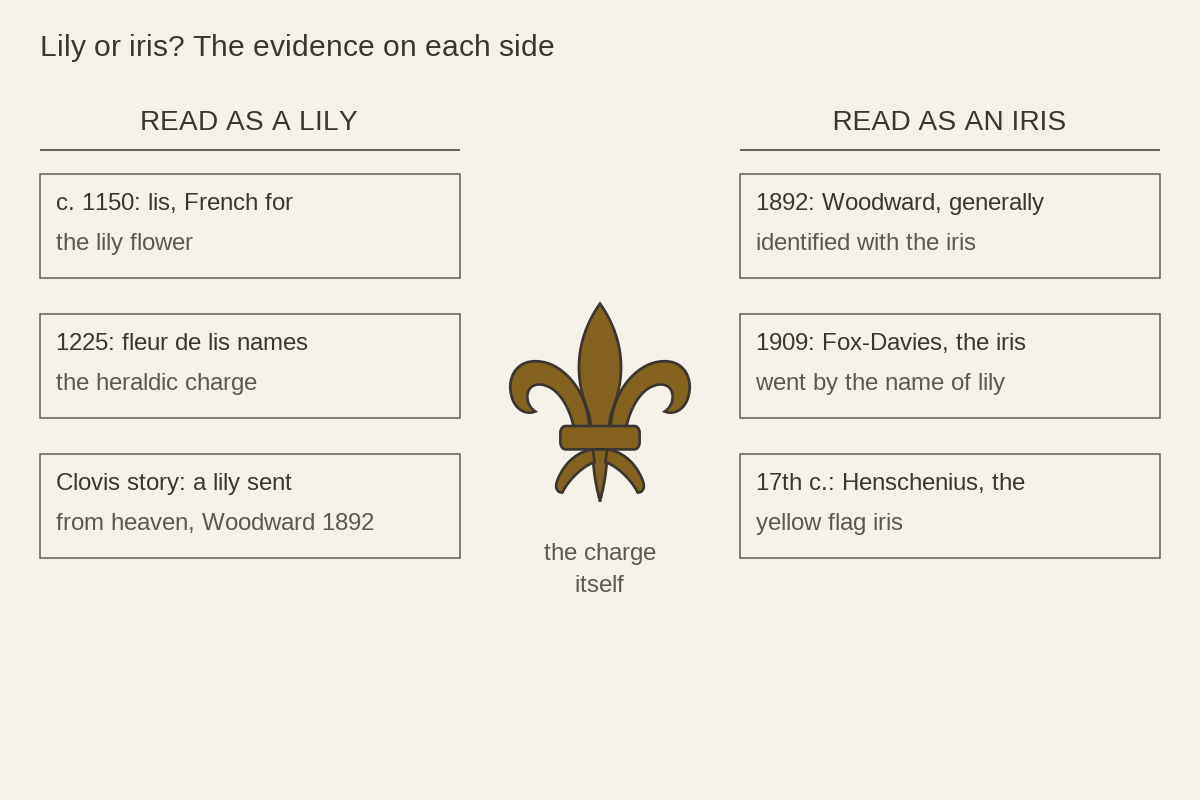
Slide the drawing sideways to read every label, or open it at full size.
The evidence for each reading, with its date: the French word lis and the Clovis story on one side, the handbooks of 1892 and 1909 and the yellow flag iris on the other.
Credit and reuse terms
"Lily or iris? The evidence on each side" by Banners & Banknotes, https://bannersandbanknotes.com/flags-heraldry/fleur-de-lis/, licensed under CC BY 4.0 (https://creativecommons.org/licenses/by/4.0/)
Why did England's kings bear French lilies from 1340 to 1801?
Edward III claimed the crown of France. Fox-Davies writes that after Charles IV of France died in 1328, Edward apparently accepted the decision against him at first, then renewed his claim, "assumed the arms and the title of king of that country, and prepared for war." His new Great Seal of early 1340 shows "Quarterly, 1 and 4, azure, semé-de-lis or (for France); 2 and 3, gules, three lions passant guardant in pale or (for England)." Quarterly means the shield is split into four, and gules is red.
The claim went onto his gold as well. Grueber dates the noble, a gold coin with the king standing in a ship holding a sword and a shield, to 1344 and reads its legend as EDWAR' D' GRA' REX ANGL' Z FRANC' DNS HYB' (No. 259); FRANC, for Francie, "of France," is one of the cuts expanded in the D G REG F D decoder. On the noble below, the shield repeats the claim in heraldry, with strewn lilies in the first and fourth quarters and lions in the second and third. Grueber notes that the title of France was left off the nobles from 1360 to 1369, under the treaty of Brétigny, and came back when the treaty broke down.
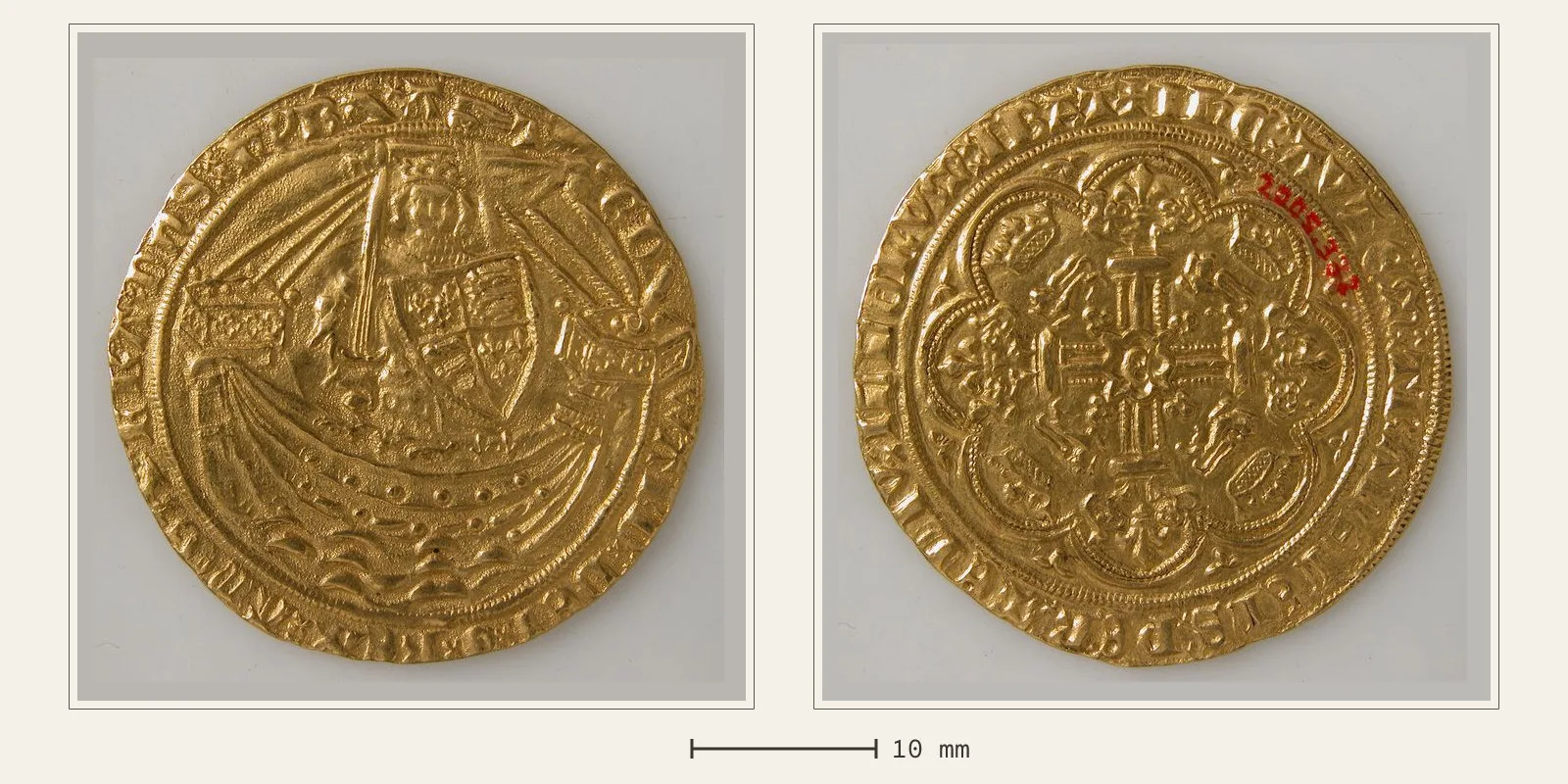
Edward III's noble. The king stands in a ship, his shield quartered with strewn lilies for France and lions for England; the reverse has a floriated cross with a lion in each angle.
Credit and reuse terms
"Noble of Edward III MET sf2005-332s1" by The Metropolitan Museum of Art — https://commons.wikimedia.org/wiki/File:Noble_of_Edward_III_MET_sf2005-332s1.jpg — CC0 1.0 (https://creativecommons.org/publicdomain/zero/1.0/); changes: obverse placed beside the reverse, File:Noble of Edward III MET sf2005-332s2.jpg (CC0 image), each side cropped to a square around the coin and scaled to the same coin size on a #F5F1E8 panel, 10 mm scale bar added from the museum size of 3.3 cm

Noble of Edward III, about 1350, kingdom of England. The Metropolitan Museum of Art, 2005.332.
England's quarters followed France to three, though late. Woodward and Fox-Davies both date the change on the English royal arms to Henry IV's second Great Seal, of 1411. The lilies then stayed until the union with Ireland.
The royal proclamation of 1 January 1801, printed in the London Gazette, set out the new arms as "Quarterly; First and Fourth, England; Second, Scotland; Third, Ireland," and the king's Latin style as "Dei Gratia Britanniarum Rex, Fidei Defensor," with no French title in either. By this page's count, the lilies sat in the English royal arms for 461 years. The same proclamation defined the flag on the Union Jack page.
How did Florence's lily turn red?
Florence's lily has an origin story of its own. The Florentine chronicler Giovanni Villani, who says he began his chronicle in 1300, writes that on their red field the Florentines, "because of the name of Fiorinus and of the city, charged it with the white lily." In July 1251, after the Ghibelline families were banished, the people and the Guelfs who stayed "changed the arms of the commonwealth," Villani writes: "whereas of old they bore the field red and the lily white, they now made on the contrary the field white and the lily red."
The Ghibellines kept the former standard, he adds. A year later the lily went onto gold. In November 1252, Villani writes, Florence began to strike florins of 24-carat gold, eight to the ounce, with "the stamp of the lily" on one side and St John on the other.
Florence draws its flower differently from France. Woodward blazons the city's arms "Argent, a fleur-de-lis florencée gules," and in a fleur-de-lis florencée, Fox-Davies explains, "the natural flower of a lily issues" between the upper petals in place of a seeded stalk.
The Münzkabinett in Berlin, which holds the florin below, dates it to 1507, more than two and a half centuries after the first. The florin's legend still reads FLOR ENTIA around the lily. The museum records 22 mm and 3.48 g and says the florin was issued in Florence from 1252 to 1533. It reads the small shield beside St John as the arms of Paolo Cerretani, master of the gold coinage in the first half of 1507.
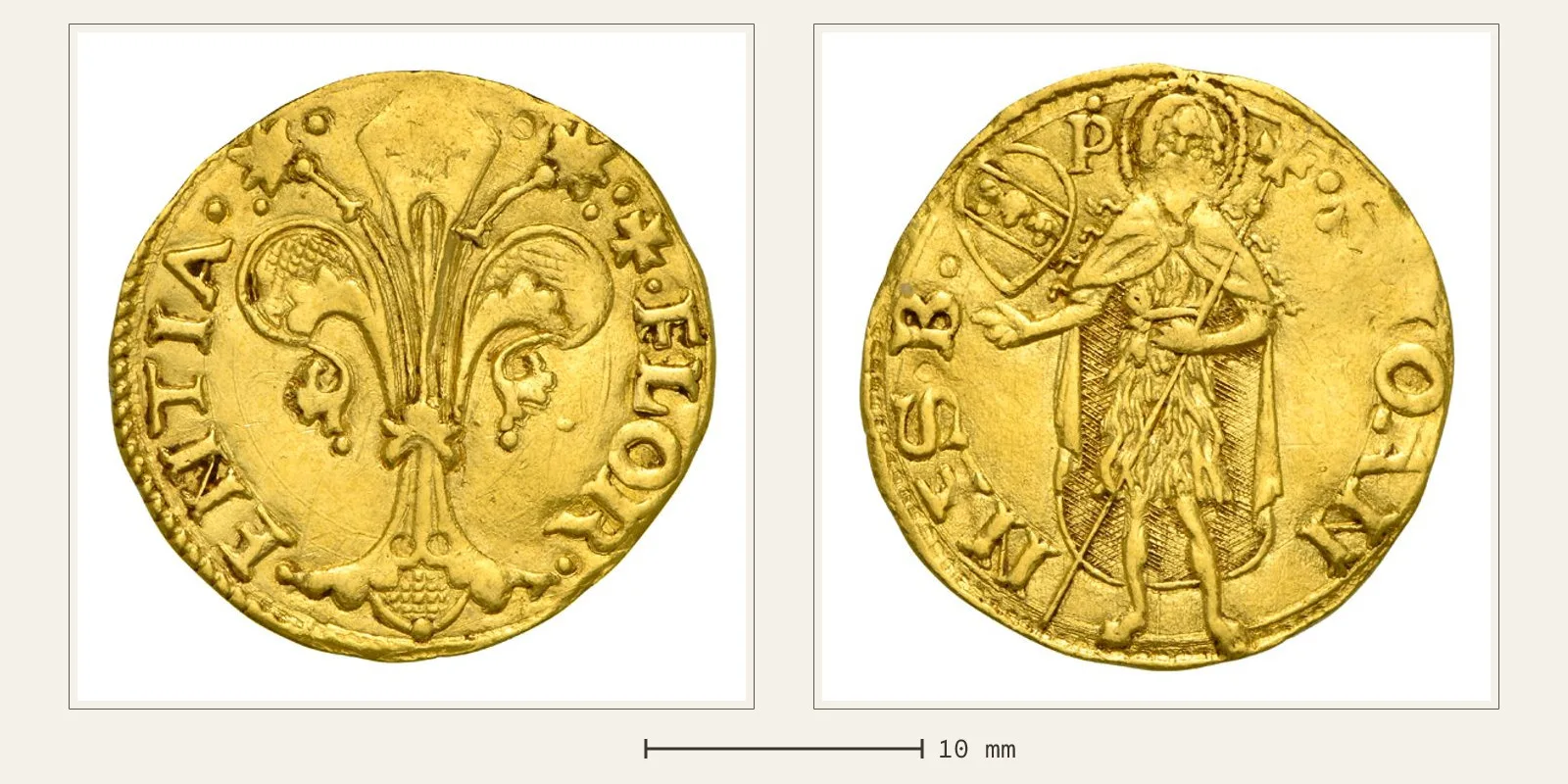
A gold florin of Florence, dated by the Berlin museum to 1507: the city's lily, with flowered stalks rising between its petals, and St John the Baptist on the reverse.
Credit and reuse terms
"Florenz- Stadt - Münzkabinett, Berlin - 5541708" by Münzkabinett der Staatlichen Museen zu Berlin, 18242834, photo by Reinhard Saczewski — https://commons.wikimedia.org/wiki/File:Florenz-_Stadt_-_M%C3%BCnzkabinett,_Berlin_-_5541708.jpg — Public Domain Mark 1.0 (https://creativecommons.org/publicdomain/mark/1.0/); changes: the two faces in the source photo cropped to squares and scaled to the same coin size on a #F5F1E8 panel, 10 mm scale bar added from the museum diameter of 22 mm

Florin of Florence, dated 1507 by the museum, city of Florence. Münzkabinett, Staatliche Museen zu Berlin, 18242834.
What is the rule of tincture, and can red go on blue?
Heraldry sorts its colors into two groups. Fox-Davies lists the metals as or (gold) and argent (silver), and the colors as gules (red), azure (blue), vert (green), purpure (purple) and sable (black).
The rule of tincture keeps the two apart. Woodward calls it "a primary fundamental canon of Heraldry that metal is not to be placed upon metal, or colour on colour," and quotes the saying "Metal on metal is false heraldry." He thought the rule "no doubt originated" in the days when arms were carried on shields and banners and had to be told apart "from afar off."
Both French versions pass, because gold on blue is metal on color. Florence passes in both colorings, white on red before 1251 and red on white after.
Red on blue is color on color, so a red charge on a blue field breaks the plain rule. Red can still meet blue in cases the handbooks accept. Woodward cites the Dukes of Anjou, who marked their branch of the royal house with a red border round the arms of France, and says that "though the red colour impinges on the blue, the law is not considered to be broken thereby." A lion's red tongue on a blue field is no breach either, he adds, and Fox-Davies notes that a field divided into equal pieces "may be composed of two metals or two colours," because the pieces lie in one plane and none is a charge.
The rule also has famous breaks. The arms of the Kingdom of Jerusalem, "Argent, a cross potent between four crosses or," put gold on silver, and Woodward says such arms are called armes pour enquérir, said to be made to prompt the viewer to ask why. He counted the exceptions in Continental heraldry "by the hundred rather than by the dozen."
Flags get more room still. The Rev. J. R. Crawford, who wrote the Union Jack chapter of Fox-Davies's Complete Guide to Heraldry, granted that "the laws of armory are not always nor all of them applied to flags." The 1801 blazon of the Union Jack edges its red crosses in white, and the geometry on that page finds no edge where red touches blue.
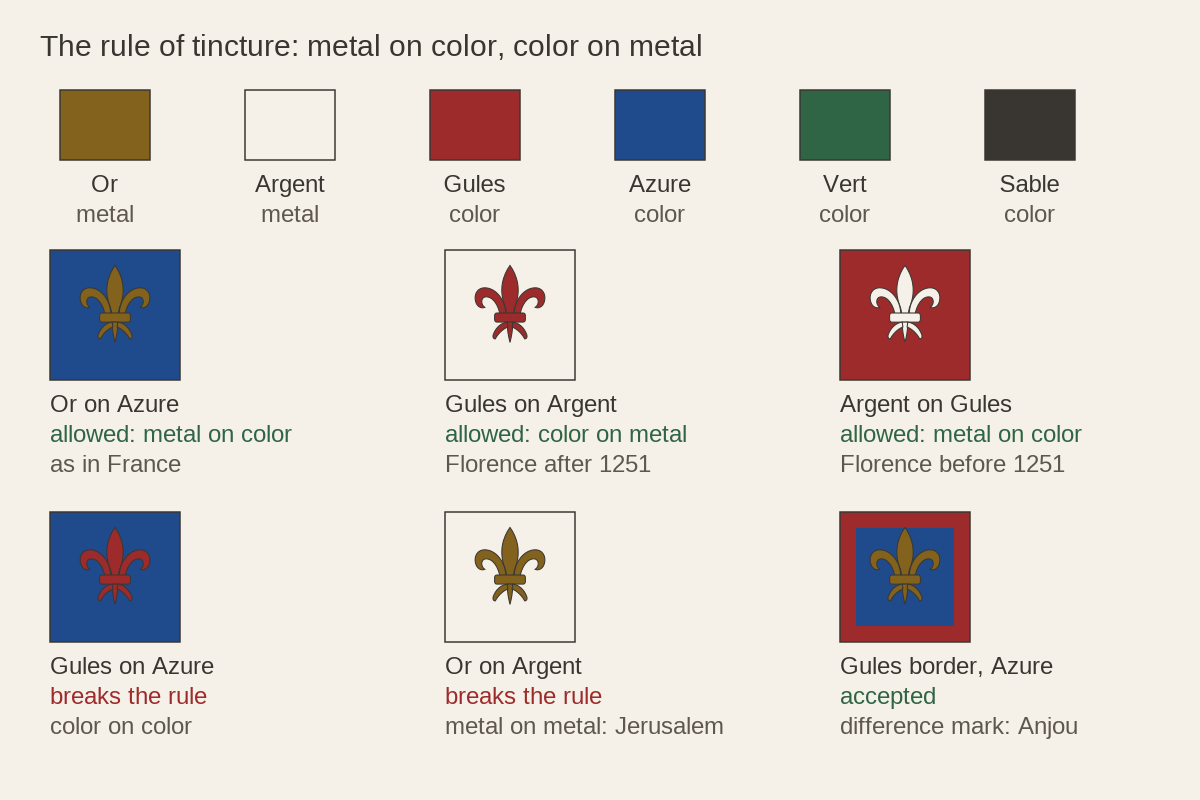
Slide the drawing sideways to read every label, or open it at full size.
Or and argent are metals; gules, azure, vert and sable are colors. Six pairings with a lily: three allowed, two that break the rule, and the red border the rule accepts (tincture, not official).
Credit and reuse terms
"The rule of tincture with six examples" by Banners & Banknotes, https://bannersandbanknotes.com/flags-heraldry/fleur-de-lis/, licensed under CC BY 4.0 (https://creativecommons.org/licenses/by/4.0/)
Why is the fleur-de-lis on the flag of Quebec?
Canadian Heritage's answer is France. Its page on Quebec's symbols says that Jacques Cartier claimed the land "for the King of France" in 1534, and that on the provincial flag "the four fleurs-de-lis are symbolic of France" while the white cross on blue "recalls an ancient French military banner."
The same page dates the flag. It was adopted by order of the Lieutenant Governor in Council in 1948 and confirmed by the legislature in 1950, it is three units long for every two units high, and it is often called the Fleurdelisé.
The lilies reached Quebec's arms first. Queen Victoria granted arms in 1868 with two blue fleurs-de-lis on gold, and an order of 1939 changed them to three gold fleurs-de-lis on blue, which the page calls "a reminder of Royal France, which once ruled Quebec."
This page describes the flag in words: a white cross on a blue field, with four fleurs-de-lis. The flag is not redrawn, because the rights in its 1948 design were not confirmed. The dates on the chart below and on the lily chart in the first section are collected in the timeline CSV provenance and license of fleur-de-lis-timeline.csv.
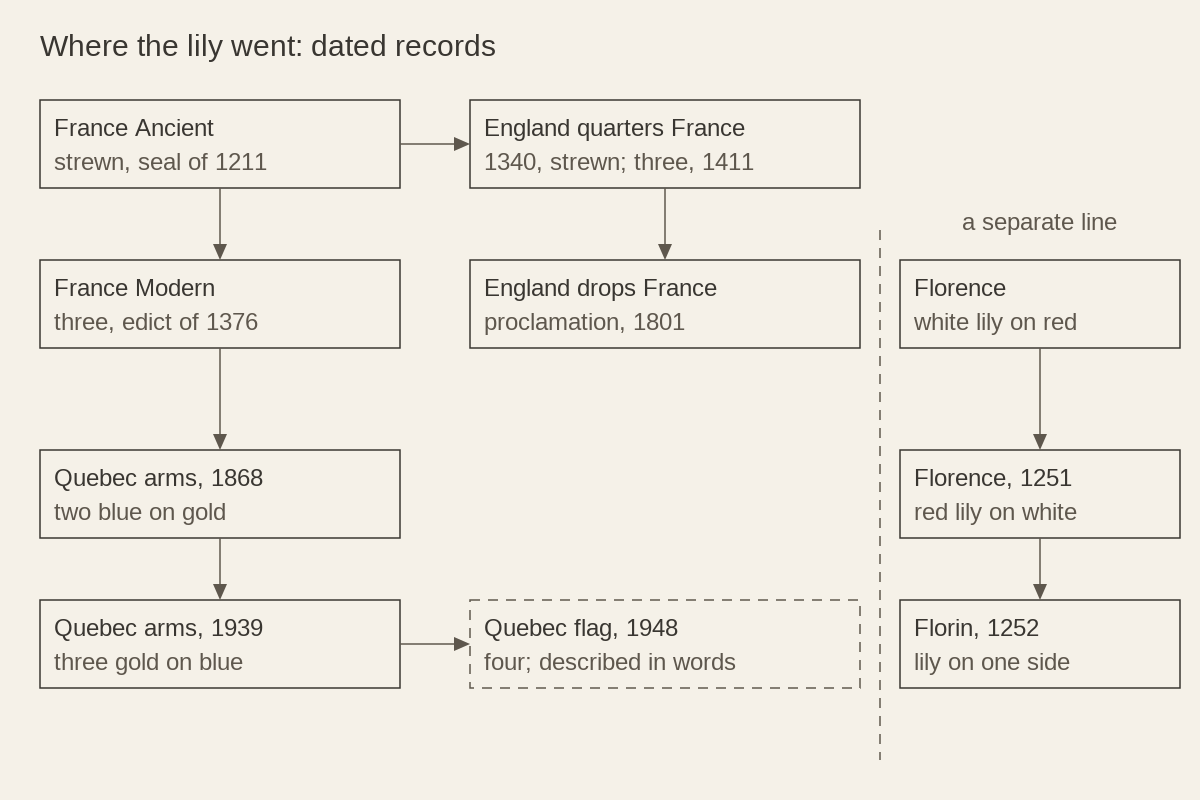
Slide the drawing sideways to read every label, or open it at full size.
Where the lily went, with a dated record for each step. Florence stands apart, and the Quebec flag is a dashed box because it is described here in words only.
Credit and reuse terms
"Where the lily went: dated records" by Banners & Banknotes, https://bannersandbanknotes.com/flags-heraldry/fleur-de-lis/, licensed under CC BY 4.0 (https://creativecommons.org/licenses/by/4.0/)
Shrink strip
At 16 pixels wide, each of France Modern's three lilies is about 5 pixels across in this drawing and reads as a gold speck. At 48 pixels the three are still three. Only at 160 do their bands and feet show clearly.
Shown at its drawn size. On a narrow screen, scroll sideways to see the whole strip.
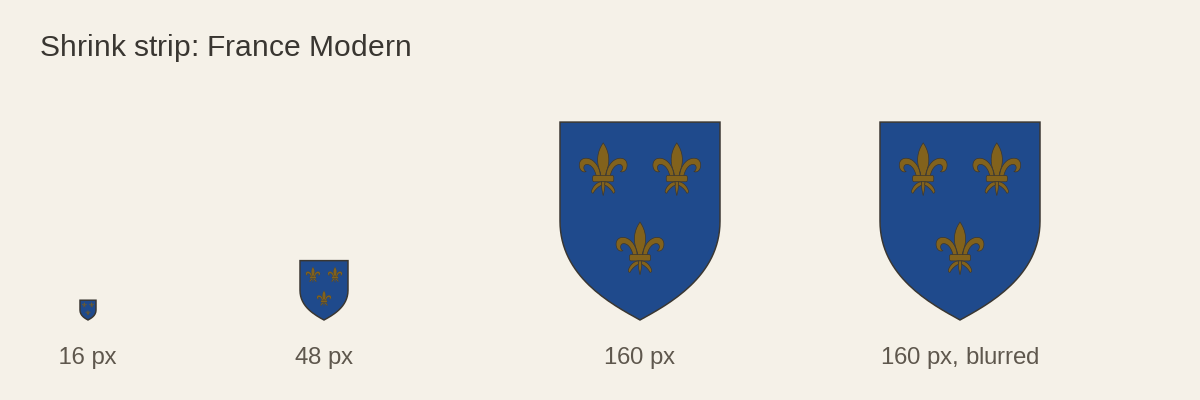
France Modern from the opening figure at 16, 48 and 160 pixels wide, plus a blurred copy (tincture, not official). Reduction preview, not a legibility test.
Credit and reuse terms
"Shrink strip: France Modern at 16, 48 and 160 pixels" by Banners & Banknotes, https://bannersandbanknotes.com/flags-heraldry/fleur-de-lis/, licensed under CC BY 4.0 (https://creativecommons.org/licenses/by/4.0/). Based on the blazons Azure, semé-de-lis Or (France Ancient) and Azure, three fleurs-de-lis Or (France Modern), as given in A. C. Fox-Davies, A Complete Guide to Heraldry (1909), p. 274, and J. Woodward and G. Burnett, A Treatise on Heraldry, British and Foreign (1892), vol. 1, pp. 104 and 112. Design rights: the royal arms of France, recorded on seals by 1211 and reported fixed at three lilies in 1376, have no known author; US copyright in works published before 1931 has expired, and the EU term for anonymous works, 70 years from publication, ended centuries ago. Only the parts Banners & Banknotes added (labels, scale bars, layout) are released under CC BY 4.0; no rights are claimed in the original design itself. Derived from "France Ancient and France Modern, redrawn from their blazons".
Meaning ledger
| Meaning | Earliest we can document | Year | Label | Notes |
|---|---|---|---|---|
| The fleur-de-lis is the emblem of the French king | Philip II's first seal, on a charter given at Sens in 1180: a single fleur-de-lis on the counter-seal, with the legend Philippus Dei gratia Francorum rex on the seal (Douët d'Arcq 1863, No. 38; also F. Velde, Heraldica) | 1180 | [first recorded later] | A seal shows the king using the flower but states no meaning, and no document adopting the emblem was found. Pastoureau, in Velde's translation, thinks Louis VII adopted it. Woodward (1892) and Fox-Davies (1909) trace the flower further back, to fleurons on royal scepters and crowns. |
| Three fleurs-de-lis stand for the Holy Trinity | Works from the middle of the 14th century, as described by Pastoureau (1979, in Velde's translation), in which the king bears three fleurs-de-lis "as sign of the blessed Trinity"; an edict of Charles V of 1376, "pour symboliser la Sainte-Trinité," as quoted by Woodward (1892, p. 329) and Fox-Davies (1909, p. 274) | Mid-14th century | [first recorded later] | Neither handbook says where the edict is kept, and it was not traced here. A shield of three fleurs-de-lis is already on a French royal counter-seal of 1285 (Douët d'Arcq, No. 46) and on Edward III's seal of 1340 (Woodward, p. 330), so 1376 is not the first three. |
| The lilies were sent from heaven to Clovis, king of the Franks | Works from the middle of the 14th century, as described by Pastoureau (1979, in Velde's translation) | Mid-14th century | [first recorded later] | Pastoureau writes that there are no coats of arms before 1130 to 1140, so the story cannot describe how the arms began. Fox-Davies (1909) calls the date of the tradition hard to fix; Canadian Heritage (2017) places the legend at Clovis's baptism in 496. |
| The lily of the French arms honors the Virgin Mary | No document stating that the royal arms honor Mary was traced | None found | [unverified] | Woodward (1892) and Fox-Davies (1909) retell a version of the Clovis story in which the Virgin, whose emblem they call the lily, sent it as a mark of her favor; Pastoureau describes a Marian meaning of the lily growing in the high Middle Ages. Unverified does not mean false. |
| Florence's lily alludes to the city's name | Giovanni Villani's chronicle, Book I §40: chosen "because of the name of Fiorinus and of the city" (Selfe translation, 1906, p. 31) | After 1300 | [first recorded later] | Villani says he began the chronicle in 1300 (Book VIII §36). He traces the city's red field to a shield that, he writes, fell from heaven into Rome under Numa Pompilius; when Florence adopted the lily is not documented here. |
| The four fleurs-de-lis on Quebec's flag are symbolic of France | Canadian Heritage, "Quebec" (provincial symbols page) | 2017 | [first recorded later] | The flag was adopted in 1948; the 1948 order in council was not read for this page. |
| The three gold fleurs-de-lis in Quebec's arms recall Royal France | Canadian Heritage, "Quebec": "a reminder of Royal France, which once ruled Quebec" | 2017 | [first recorded later] | The arms were revised in 1939; the 1939 order was not read for this page. |
How each label is decided: The After-Meaning, the four labels.
Sources
- The London Gazette, issue 15324, pages 2–3: royal proclamation given at St James's on 1 January 1801, declaring the royal style and titles, the arms of the United Kingdom and the Union Flag. Page 3: https://www.thegazette.co.uk/London/issue/15324/page/3 thegazette.co.uk Read: pages 2–3
- Canadian Heritage, "Quebec," Provincial and territorial symbols, Government of Canada (page dated 2017-08-15). canada.ca Read: full page
- Villani's Chronicle: Being Selections from the First Nine Books of the Croniche Fiorentine of Giovanni Villani, translated by Rose E. Selfe, edited by Philip H. Wicksteed (London: Constable, 1906), Book I §40 (p. 31), Book VI §§43 and 53 (pp. 154 and 161), Book VIII §36 (pp. 320–321). archive.org Read: pages 31, 154, 161 and 320–321
- Louis Douët d'Arcq, Collection de sceaux, vol. 1 (Paris: Plon, 1863), pp. 271–272: No. 38, first seal of Philippe-Auguste (1180), and No. 46, regency seal of Philippe le Hardi (1285). archive.org Read: pages 271–272
- The Metropolitan Museum of Art, 23.135.2, Coin (Franc) Showing Charles V, 14th century: museum record as mirrored on Wikimedia Commons. commons.wikimedia.org Read: file page
- The Metropolitan Museum of Art, 2005.332, Noble of Edward III, ca. 1350: museum record as mirrored on Wikimedia Commons. commons.wikimedia.org Read: file page
- Münzkabinett der Staatlichen Museen zu Berlin, 18242834, Florenz: Stadt, 1507 (gold florin), Interaktiver Katalog des Münzkabinetts. ikmk.smb.museum Read: catalogue record
- Herbert A. Grueber, Handbook of the Coins of Great Britain and Ireland in the British Museum (London: British Museum, 1899), pp. xxix–xxx, 48 (No. 259), 57 (No. 308) and 147 (No. 850). archive.org Read: pages xxix–xxx, 48, 57 and 147
- Arthur Engel and Raymond Serrure, Traité de numismatique du moyen âge, vol. 3 (Paris: E. Leroux; facsimile reprint, Bologna: Arnaldo Forni), p. 972. archive.org Read: page 972
- John Woodward and George Burnett, A Treatise on Heraldry, British and Foreign, vol. 1 (Edinburgh and London: W. & A. K. Johnston, 1892), pp. 102–104, 112 and 326–330. archive.org Read: pages 102–104, 112 and 326–330
- A. C. Fox-Davies, A Complete Guide to Heraldry (London and Edinburgh: T. C. & E. C. Jack, 1909), pp. 70, 85–87 and 272–275; chapter XLI, "The Union Jack," by the Rev. J. R. Crawford, p. 616. archive.org Read: pages 70, 85–87, 272–275, 611 and 614–616
- François R. Velde, "The Fleur-de-lis," Heraldica (page last modified 7 October 2014), including his translation of a passage from Michel Pastoureau, Traité d'Héraldique (Paris, 1979). heraldica.org Read: full page
- Asa Gray, Gray's New Manual of Botany: A Handbook of the Flowering Plants and Ferns of the Central and Northeastern United States and Adjacent Canada, 7th ed., rearranged and revised by Benjamin Lincoln Robinson and Merritt Lyndon Fernald (New York: American Book Company, 1908), p. 288. archive.org Read: page 288
Counter-sign
Counter-sign: The royal arms of the United Kingdom set on 1 January 1801. They answer France Modern by leaving it out: the proclamation gives the four quarters to England, Scotland and Ireland, and the French lilies that England had borne since 1340 are gone.
- Union Jack: the same proclamation of 1 January 1801 that took the lilies off the royal arms gave the Union Flag its blazon, red crosses edged white on blue.
- D G REG F D: A Decoder for the Latin Abbreviations on Coins: Grueber's 1899 handbook notes that the French arms and the French title were dropped from the coins together in 1801; Edward III's noble of 1344 already reads FRANC.
Cite this page
Banners & Banknotes. “Fleur-de-lis: France's Arms Went From Many Lilies to Three.” Published 14 October 2026. https://bannersandbanknotes.com/flags-heraldry/fleur-de-lis/. Accessed [date you read it].
Corrections
No corrections yet.