Object file · No. 0001
Union Jack: Off-Center Red Diagonals Give It an Upside Down
Blazon card
- Field
- Azure (blue); a rectangle, 3:5 on land or 1:2 at sea in the Flag Institute's specification.London Gazette 15324, p. 3; Flag Institute, Union Flag Specification
- Charge
- The saltires (diagonal crosses) of St Andrew in white and St Patrick in red, counterchanged, the red edged white; over all, the red cross of St George edged white.London Gazette 15324, p. 3
- Tincture
- Blue, red, white. The Flag Institute recommends Pantone 280 C and 186 C and sets no value for white; figures here use site tinctures (tincture, not official).Flag Institute, Union Flag Specification
- Difference
- From the 1606 Union Flag: adds St Patrick's red saltire, counterchanged with St Andrew's white (1801).London Gazette 15324, p. 3; Flag Institute, History of the Union Flag
- Issued by
- George III and his Privy Council, royal proclamation of 1 January 1801.London Gazette 15324, pp. 2–3
- First documented
- 1 January 1801 (this pattern); 12 April 1606 (first Union Flag); earliest we can document.London Gazette 15324; 1606 proclamation as transcribed by the Flag Institute
- Spec source
- Blazon: London Gazette 15324, p. 3. Construction: Flag Institute Union Flag Specification, a recommendation; no statute fixes the design.London Gazette 15324, p. 3; Flag Institute, Union Flag Specification
Blazon card as CSV union-jack-blazon.csvprovenance and license of union-jack-blazon.csv
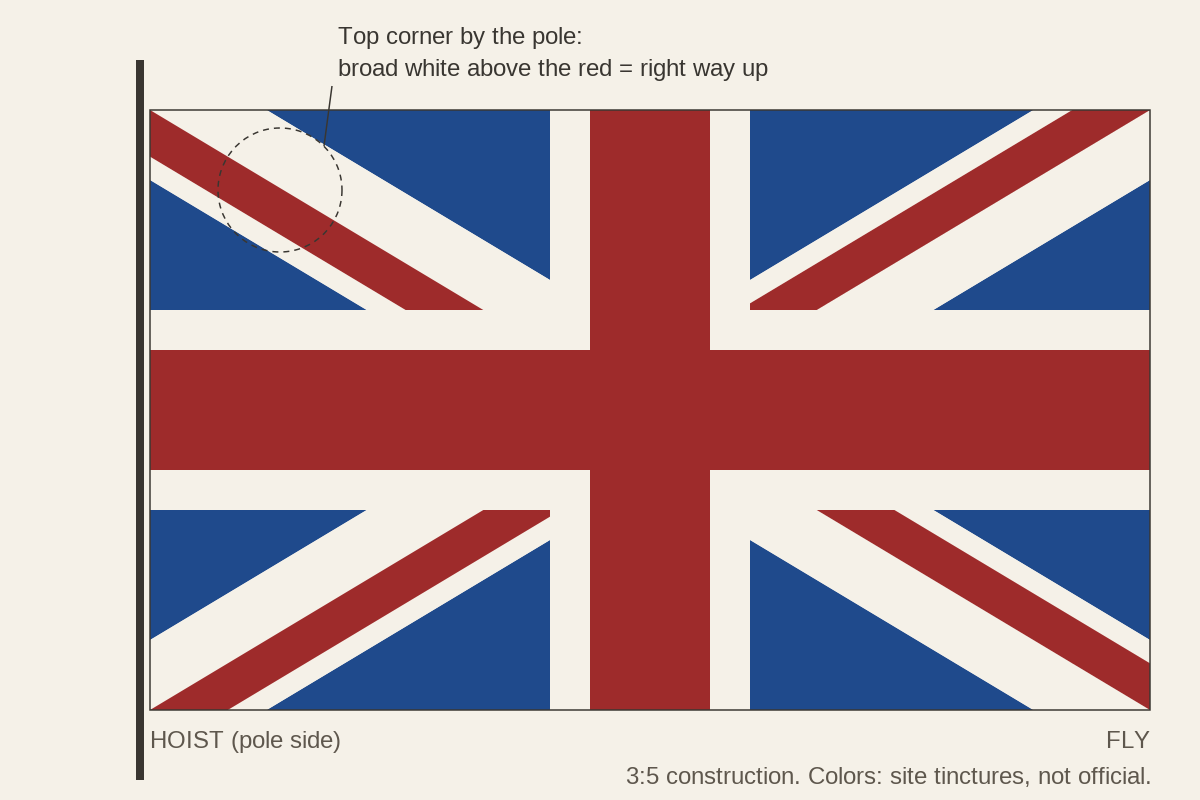
Slide the drawing sideways to read every label, or open it at full size.
The Union Jack in 3:5, pole on the left, flown the right way up (tincture, not official).
Credit and reuse terms
"Union Jack, 3:5, right way up" by Banners & Banknotes, https://bannersandbanknotes.com/flags-heraldry/union-jack/, licensed under CC BY 4.0 (https://creativecommons.org/licenses/by/4.0/). Based on the blazon in the royal proclamation of 1 January 1801 (London Gazette 15324, p. 3) and the Flag Institute Union Flag Specification. Design rights: design adopted by royal proclamation of 1 January 1801; the longest Crown copyright term in CDPA 1988 s.163(3)(a), 125 years from the end of the year of making, ran out for the 1801 design by the end of 1926. Only the parts Banners & Banknotes added (labels, scale bars, layout) are released under CC BY 4.0; no rights are claimed in the original design itself.
TL;DR. The Union Jack has a right way up because the red diagonals of St Patrick sit off-center inside the white diagonals of St Andrew, an arrangement that arrived in 1801. Fly it with the broad white above the red in the top corner by the pole; a half turn changes nothing, but a flip puts the red on top.
In this file6 sections
The Union Jack, the United Kingdom's national flag, has an upside down that its 1801 proclamation never mentions. Look at the top corner nearest the flagpole. The red diagonal there does not run down the middle of its white diagonal: a broad band of white sits above it and a thin band below. Start with the stranger's read, our habit of describing only shapes, colors and positions before any official meaning: a blue field, a white diagonal cross with a narrower red one set off-center inside it, and a red upright cross edged white over everything.
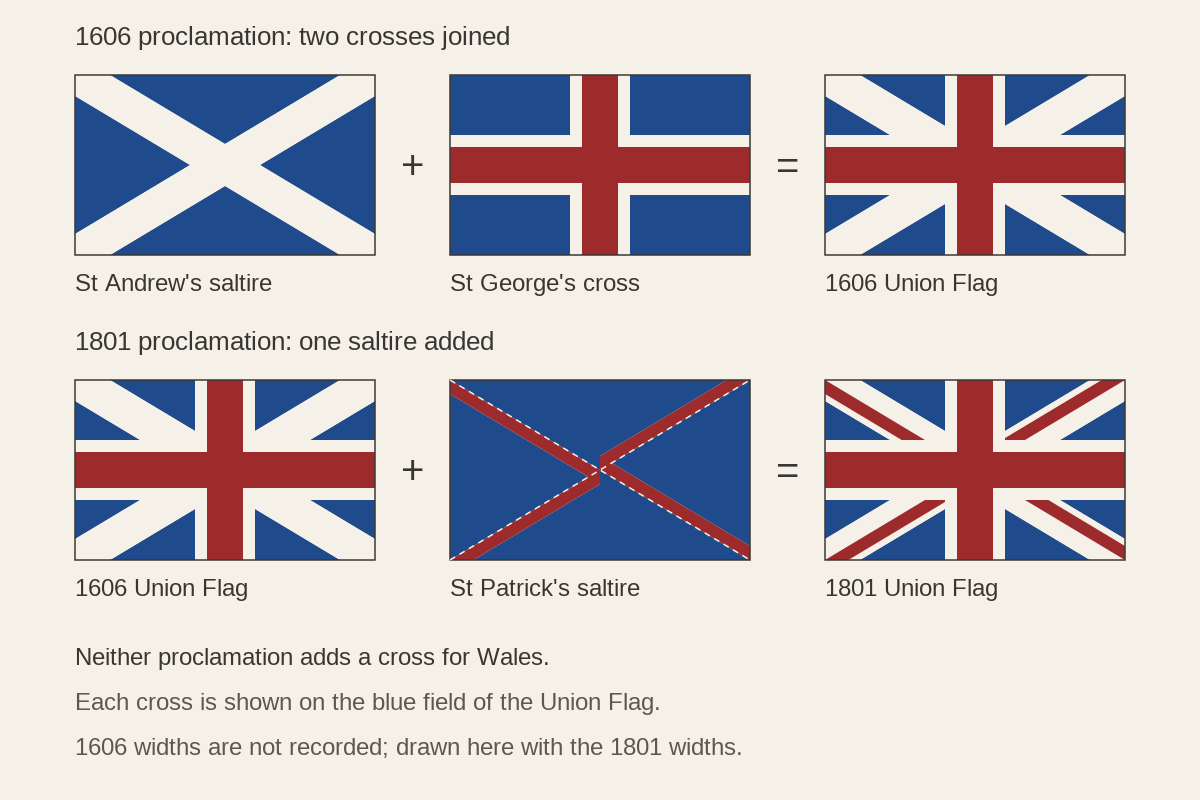
According to the Flag Institute, a UK flag charity, the Union Flag is the national flag "by long-established custom and practice rather than by statute." Its crosses come from two dated documents. For the ships of "South and North Britain," a proclamation of 12 April 1606 joined the red cross of St George and the white cross of St Andrew. A proclamation of 1 January 1801 added the red saltire of St Patrick when Great Britain and Ireland became one kingdom.
Which way up does the Union Jack go?
Fly the Union Jack so that, in the half nearest the pole, the broad white diagonal sits above the red one. The Flag Institute's protocol states the rule that way and calls flying the flag upside down "most improper." For a flag hung flat on a wall, horizontally or vertically, the protocol puts the broad white uppermost in the top-left corner.
The rule is tied to the pole. Seen from behind, the pole is on your right, but the broad white still rides above the red beside it, because a mirror image keeps up and down where they were.
We drew the flag from the specification and compared it with copies of itself in the drawing below. A half turn leaves every patch of color where it was. But a flip from top to bottom changes the color of 19.5% of the cloth on a 3:5 flag and 18.8% on a 1:2 flag. An upside-down flag therefore cannot be fixed by spinning it flat; it has to be turned over.
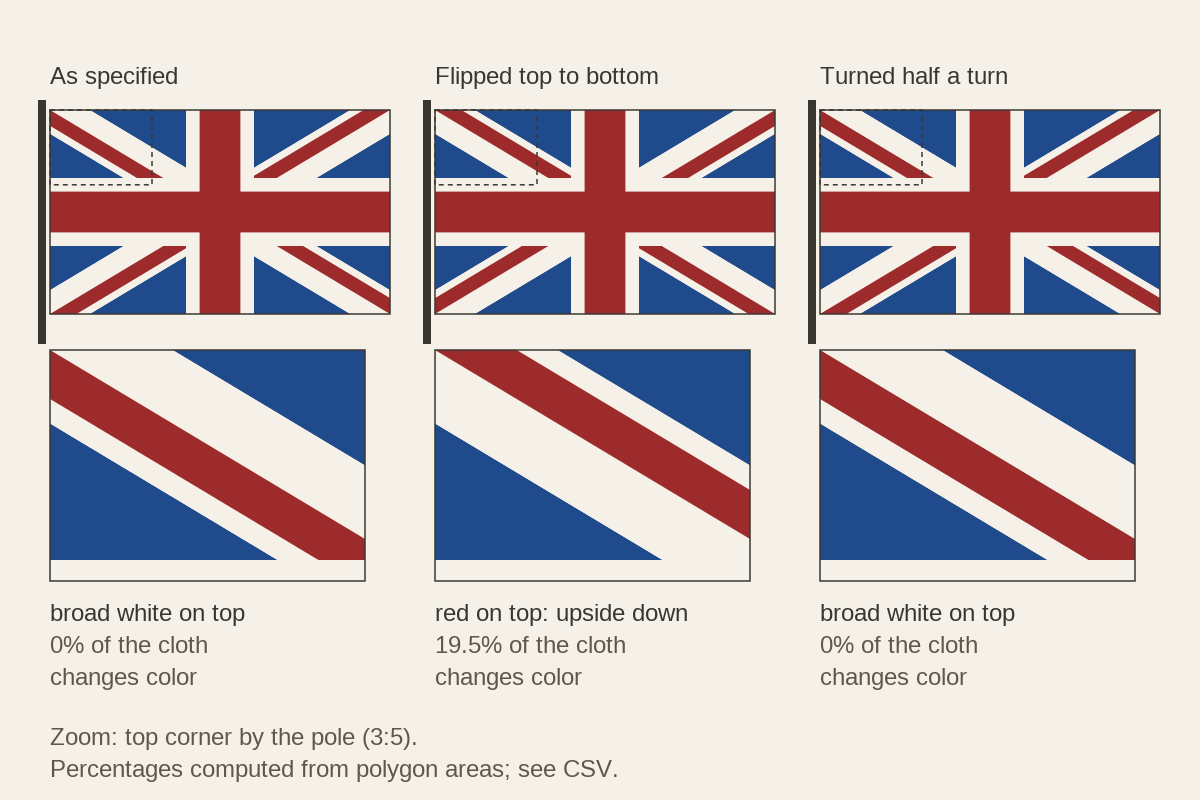
Slide the drawing sideways to read every label, or open it at full size.
As specified, flipped, and turned half a turn, with the top corner by the pole enlarged (tincture, not official).
Credit and reuse terms
"Union Jack: flipped versus turned" by Banners & Banknotes, https://bannersandbanknotes.com/flags-heraldry/union-jack/, licensed under CC BY 4.0 (https://creativecommons.org/licenses/by/4.0/). Based on the blazon in the royal proclamation of 1 January 1801 (London Gazette 15324, p. 3) and the Flag Institute Union Flag Specification. Design rights: design adopted by royal proclamation of 1 January 1801; the longest Crown copyright term in CDPA 1988 s.163(3)(a), 125 years from the end of the year of making, ran out for the 1801 design by the end of 1926. Only the parts Banners & Banknotes added (labels, scale bars, layout) are released under CC BY 4.0; no rights are claimed in the original design itself.
Why does the Union Jack have a right way up?
Because of one word in its blazon, the formal description heraldry uses in place of a drawing. The proclamation, as printed in the London Gazette, reads:
"And that the Union Flag shall be Azure, the Crosses Saltires of St. Andrew and St. Patrick Quarterly per Saltire, counterchanged Argent and Gules; the latter fimbriated of the Second, surmounted by the Cross of St. George of the Third, fimbriated as the Saltire."
In this blazon azure means blue, while argent and gules are white and red. A saltire is a diagonal cross, fimbriated means edged with a narrow border, and counterchanged means that two colors exchange places across a dividing line. On the flag, each diagonal arm is white on one side of its center line and red on the other, and the sides swap from arm to arm.
That exchange produces a pinwheel. A pinwheel has a handedness, so its mirror copy is a different flag. The printed text gives no picture and no measurements, and it does not say which side of each arm is white.
The first Union Flag had no such problem. The 1606 proclamation joined "the Red Cross, commonly called St George's Cross, and the White Cross, commonly called St Andrew's Cross" according to "a form made by our Heralds," a drawing the Flag Institute says has not survived. A centered cross laid over a centered saltire looks the same after a flip either way, and the Institute's protocol dates the possibility of an upside-down flag to the 1801 addition of St Patrick's cross.
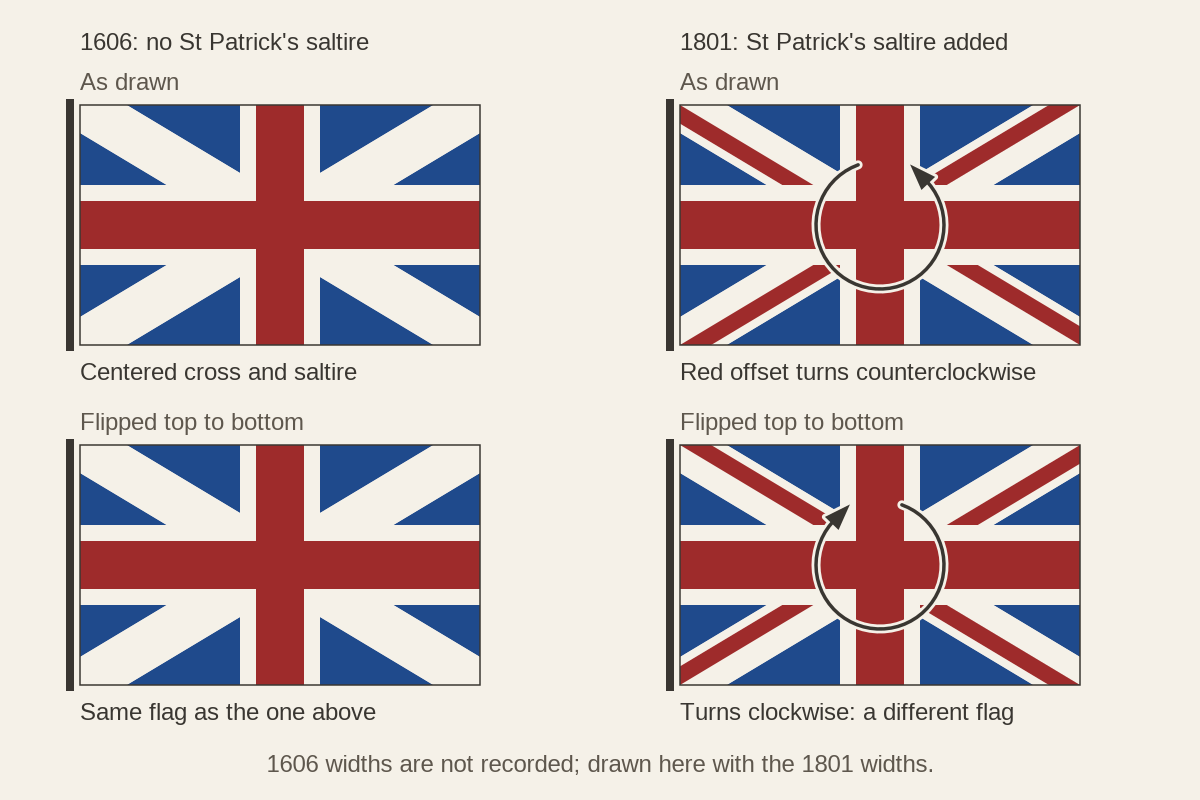
Slide the drawing sideways to read every label, or open it at full size.
The 1606 and 1801 patterns, each above its top-to-bottom flip; only the 1801 flag, with its off-center red, comes out different. The 1606 pattern uses the 1801 widths (tincture, not official).
Credit and reuse terms
"Union Flag 1606 and 1801: why only one has a wrong way up" by Banners & Banknotes, https://bannersandbanknotes.com/flags-heraldry/union-jack/, licensed under CC BY 4.0 (https://creativecommons.org/licenses/by/4.0/). Based on the proclamation of 12 April 1606 as transcribed by the Flag Institute, the blazon in the royal proclamation of 1 January 1801 (London Gazette 15324, p. 3) and the Flag Institute Union Flag Specification. Design rights: designs adopted by royal proclamations of 12 April 1606 and 1 January 1801; the longest Crown copyright term in CDPA 1988 s.163(3)(a), 125 years from the end of the year of making, ran out for the 1606 design by the end of 1731 and for the 1801 design by the end of 1926. Only the parts Banners & Banknotes added (labels, scale bars, layout) are released under CC BY 4.0; no rights are claimed in the original design itself.
The explanation offered today for the broad white on top is precedence: the protocol says Scotland's St Andrew's Cross "takes precedence over Ireland's St Patrick's Cross." The earliest statement of that reason we can document is from 1909, when the Rev. J. R. Crawford's chapter in A. C. Fox-Davies's A Complete Guide to Heraldry placed St Andrew's cross above St Patrick's as "senior in partnership." Nothing we found shows the reason was added after 1801, so we do not call it an after-meaning, our term for a meaning demonstrably added after adoption; the ledger below marks it as first recorded later.
Is the Union Jack 3:5 or 1:2?
Both, depending on where it flies, and as of 2026 no law settles the question. The Flag Institute calls the Union Flag "the world's only national flag that has no basis in law," and a Union Flag Bill introduced on 5 February 2008 to supply that basis did not get past its first reading. On 14 July 1908, the Earl of Crewe told the House of Lords that "the Union Jack should be regarded as the National flag."
What exists instead is a recommended construction from the Flag Institute, in which the flag is 30 units tall. The upright red cross is 6 units wide, one-fifth of the height, with a white border of 2 units on each side. Each diagonal measures 6 units across, divided into white 3, red 2 and white 1, with the broad white on top at the hoist (the pole edge) and the center lines running exactly corner to corner.
The Institute gives 3:5, 50 units long, as the normal shape on land, and 1:2, 60 units long, as the customary shape for ensigns at sea. Because the diagonals must hit the corners, their angle shifts from 30.96 degrees at 3:5 to 26.57 degrees at 1:2, while every width stays a fixed fraction of the height, as the drawing below shows. For another country's legal shape, see the US flag.
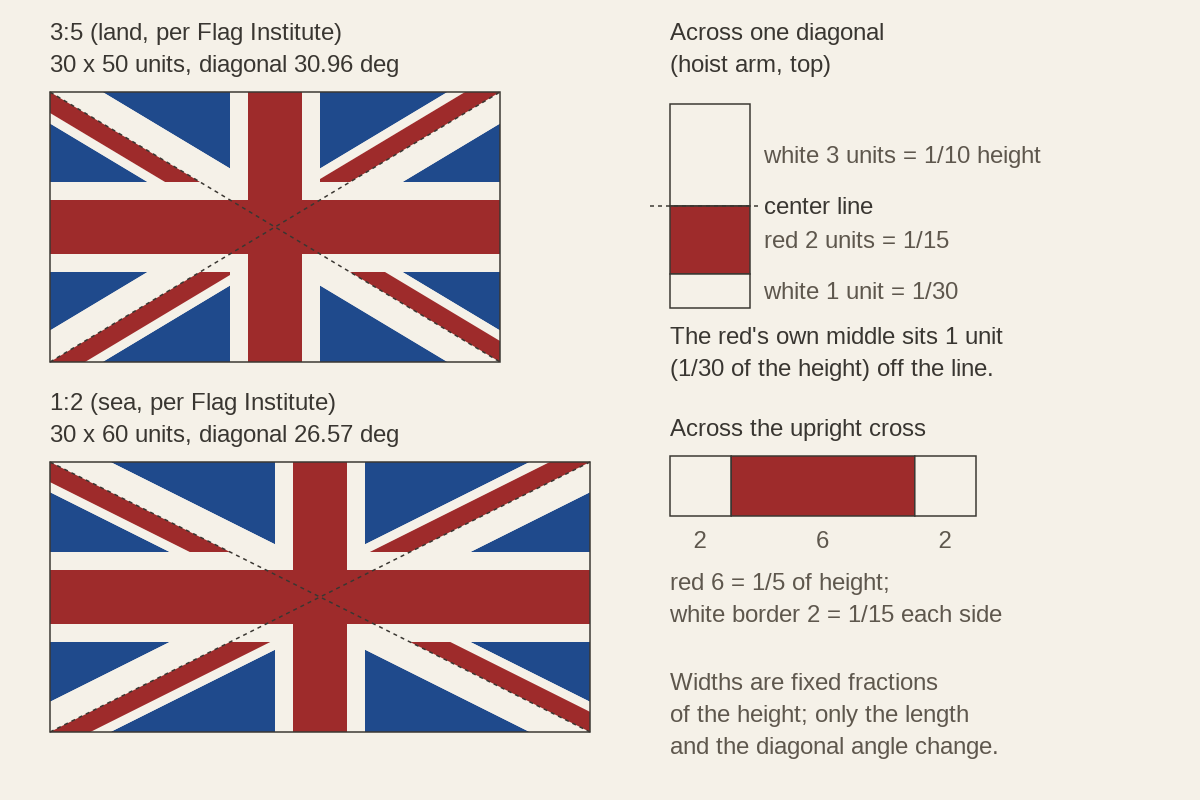
Slide the drawing sideways to read every label, or open it at full size.
The 3:5 and 1:2 constructions at equal height, with cross-sections of one diagonal and of the upright cross (tincture, not official).
Credit and reuse terms
"Union Jack construction in 3:5 and 1:2" by Banners & Banknotes, https://bannersandbanknotes.com/flags-heraldry/union-jack/, licensed under CC BY 4.0 (https://creativecommons.org/licenses/by/4.0/). Based on the Flag Institute Union Flag Specification and the 1801 blazon (London Gazette 15324, p. 3). Design rights: design adopted by royal proclamation of 1 January 1801; the longest Crown copyright term in CDPA 1988 s.163(3)(a), 125 years from the end of the year of making, ran out for the 1801 design by the end of 1926. Only the parts Banners & Banknotes added (labels, scale bars, layout) are released under CC BY 4.0; no rights are claimed in the original design itself.
Where the red diagonal sits
Stop on the red diagonal. Its middle sits 1/30 of the flag's height off the center line, which on a flag 3 feet tall is 1.2 inches.
The two shapes also differ in one small detail. At 1:2, each of the four visible red pieces of St Patrick's saltire has four sides. At 3:5, though, two of them gain a fifth side where they meet the white border of the upright cross, a vertical edge 1/90 of the flag's height. Julian Wiseman reported that sliver in his construction guide, and our polygon model gives the same figure, 1/90.26.
How much of the Union Jack is blue?
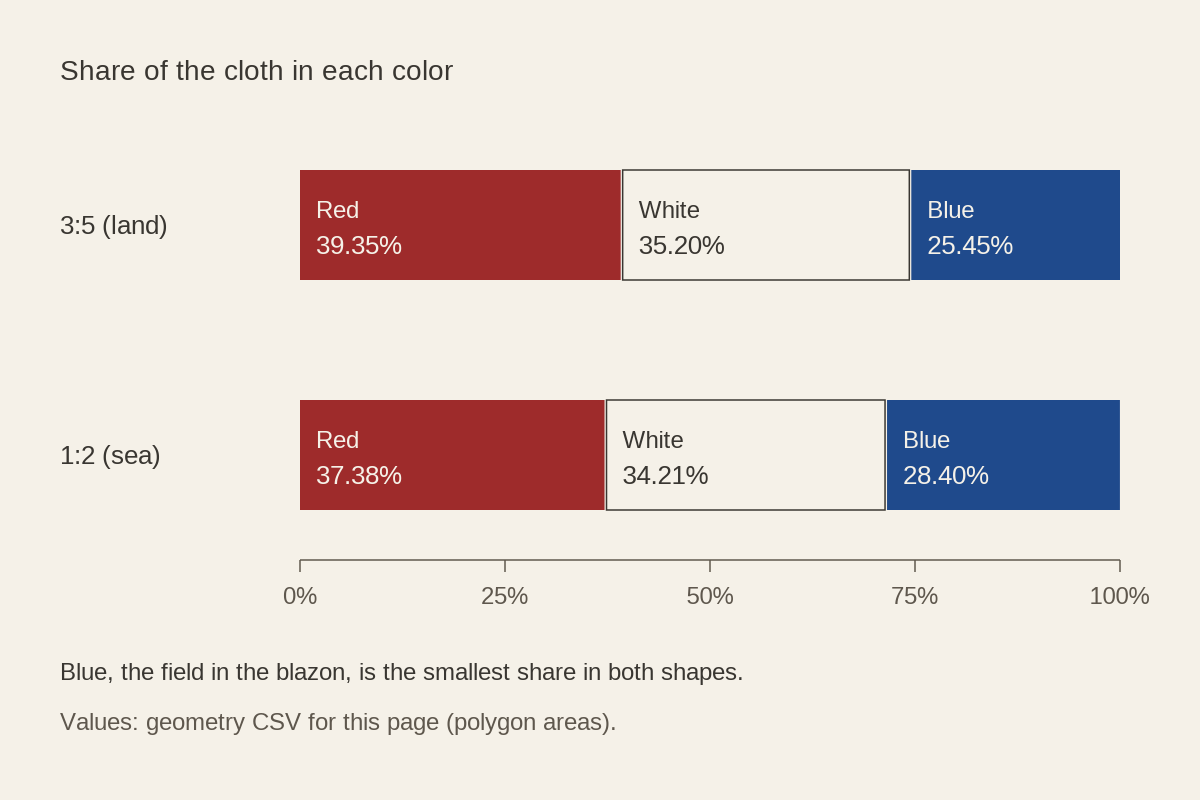
Blue is the field in the blazon, yet it is the smallest of the three colors on the cloth. We computed the exact area of each color from the specification's geometry (results in the geometry CSV provenance and license of union-jack-geometry.csv).
| Share of the flag | 3:5 (land) | 1:2 (sea) |
|---|---|---|
| Red | 39.35% | 37.38% |
| White | 35.20% | 34.21% |
| Blue | 25.45% | 28.40% |
| Changes color when flipped top to bottom | 19.50% | 18.77% |
| Changes color after a half turn | 0% | 0% |
Slide the drawing sideways to read every label, or open it at full size.
Share of the cloth in each color for the 3:5 and 1:2 shapes, from this page's geometry CSV (tincture, not official).
Credit and reuse terms
"Union Jack color areas, 3:5 and 1:2" by Banners & Banknotes, https://bannersandbanknotes.com/flags-heraldry/union-jack/, licensed under CC BY 4.0 (https://creativecommons.org/licenses/by/4.0/)
Wiseman's guide gives 37.38%, 34.21% and 28.4% for the 1:2 flag, matching our figures. The 3:5 figures are our own. Thanks to the white borders, our model finds no edge on either shape where red touches blue. For how heraldry treats red against blue, see the rule of tincture in Fleur-de-lis.
Union Jack or Union Flag?
Either name is valid, according to the Flag Institute. A jack was a small flag flown from a staff rigged on a ship's bowsprit. By 1674, the Institute writes, the Admiralty acknowledged both "His Majesty's Jack" and "Union Jack." The royal family's official website gives a later, less certain date for the name Union Jack, saying the term "possibly dates from Queen Anne's time (r. 1702-14), but its origin is uncertain."
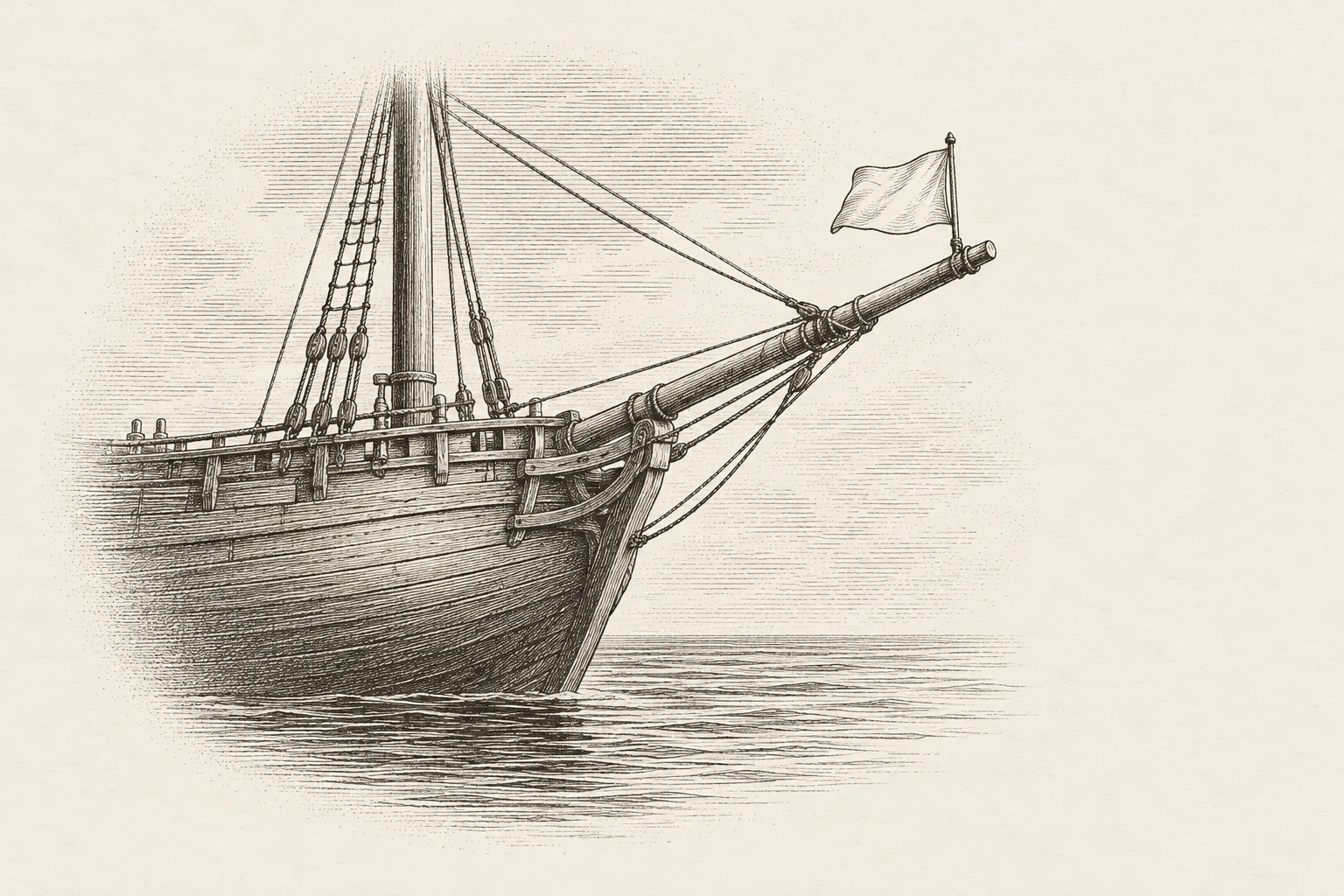
The bow of a ship and its bowsprit, the spar angled forward and up; a small plain flag, a jack, flies from a short staff rigged near the bowsprit's end. Not to scale.
Illustration: Banners & Banknotes. Generated schematic illustration — not a photograph or historical record. © Banners & Banknotes, all rights reserved.
If names were coins, this one had a double issue: in 1902, the Institute says, an Admiralty circular declared either name officially valid, and the 1908 Lords answer used "Union Jack."
Why isn't Wales on the Union Jack?
Wales has no cross or dragon of its own in the Union Jack. The 1606 proclamation spoke only of South Britain and North Britain, and an Act of 1535, now known as the Laws in Wales Act, had already declared Wales "incorporated with England." The British royal family's official website gives that as the reason the Welsh dragon is missing: by 1606, it says, Wales "was already united with England and was no longer a separate principality."
Slide the drawing sideways to read every label, or open it at full size.
Which proclamation added which cross: 1606 joined St George's and St Andrew's crosses, and 1801 added St Patrick's saltire (tincture, not official).
Credit and reuse terms
"Union Jack: which proclamation added which cross" by Banners & Banknotes, https://bannersandbanknotes.com/flags-heraldry/union-jack/, licensed under CC BY 4.0 (https://creativecommons.org/licenses/by/4.0/). Based on the proclamation of 12 April 1606 as transcribed by the Flag Institute, the blazon in the royal proclamation of 1 January 1801 (London Gazette 15324, p. 3) and the Flag Institute Union Flag Specification. Design rights: designs adopted by royal proclamations of 12 April 1606 and 1 January 1801; the longest Crown copyright term in CDPA 1988 s.163(3)(a), 125 years from the end of the year of making, ran out for the 1606 design by the end of 1731 and for the 1801 design by the end of 1926. Only the parts Banners & Banknotes added (labels, scale bars, layout) are released under CC BY 4.0; no rights are claimed in the original design itself.
Shrink strip
At 16 pixels wide, the offset that sets the right way up is a third of a pixel. At 160 pixels it is just over three.
Shown at its drawn size. On a narrow screen, scroll sideways to see the whole strip.
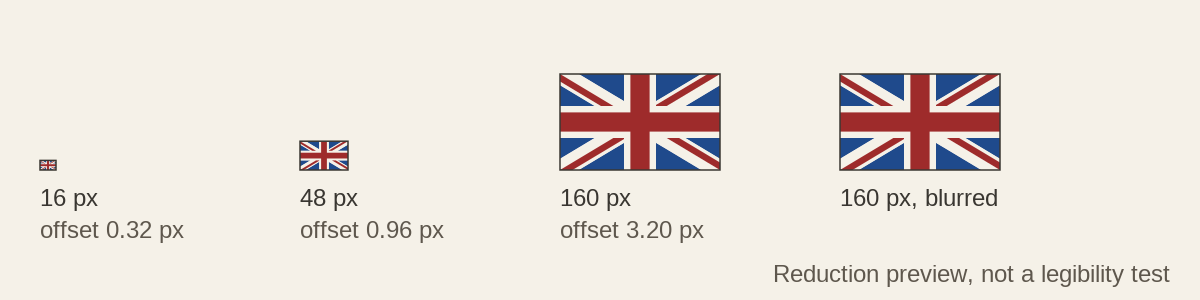
The same 3:5 flag at 16, 48 and 160 pixels wide, plus a blurred copy (tincture, not official). Reduction preview, not a legibility test.
Credit and reuse terms
"Union Jack shrink strip" by Banners & Banknotes, https://bannersandbanknotes.com/flags-heraldry/union-jack/, licensed under CC BY 4.0 (https://creativecommons.org/licenses/by/4.0/). Based on the blazon in the royal proclamation of 1 January 1801 (London Gazette 15324, p. 3) and the Flag Institute Union Flag Specification. Design rights: design adopted by royal proclamation of 1 January 1801; the longest Crown copyright term in CDPA 1988 s.163(3)(a), 125 years from the end of the year of making, ran out for the 1801 design by the end of 1926. Only the parts Banners & Banknotes added (labels, scale bars, layout) are released under CC BY 4.0; no rights are claimed in the original design itself. Derived from "Union Jack, 3:5, right way up".
Meaning ledger
| Meaning | Earliest we can document | Year | Label | Notes |
|---|---|---|---|---|
| The red cross of St George stands for England ("South Britain") | Proclamation of 12 April 1606, as transcribed by the Flag Institute | 1606 | [at adoption] | Ships of South Britain fly the red cross alone in the foretop; a 1634 proclamation reads "England or South Britain." |
| The white saltire of St Andrew stands for Scotland ("North Britain") | Proclamation of 12 April 1606, as transcribed by the Flag Institute | 1606 | [at adoption] | Ships of North Britain fly the white cross alone in the foretop; the 1634 text reads "Scotland or North Britain." |
| The red saltire is St Patrick's and stands for Ireland | F. Edward Hulme, The Flags of the World (1897), p. 53: "the red cross of Ireland" | 1897 | [first recorded later] | The 1801 flag clause names the saint, not Ireland. The year comes from The English Catalogue of Books, which lists the book under Warne in October 1897; the copy cited here is undated and has a different plate count from that entry, so it may be a later printing. W. G. Perrin's British Flags (1922), p. 51, is more explicit: "the red saltire on white ground which represents Ireland in the Union flag." No evidence found that the reading was added later. |
| The broad white is on top because St Andrew's cross takes precedence over St Patrick's | A. C. Fox-Davies, A Complete Guide to Heraldry (1909), p. 614: "the St. Andrew, as senior in partnership to the St. Patrick, is placed above the St. Patrick" | 1909 | [first recorded later] | The 1801 blazon says only "counterchanged." The book's Union Jack chapter is by the Rev. J. R. Crawford. The Flag Institute's UK flag protocol page, archived 11 August 2013, gives the reason as it is put today: St Andrew's Cross "takes precedence over Ireland's St Patrick's Cross." No evidence found that the reason was added later. |
How each label is decided: The After-Meaning, the four labels.
Sources
- The London Gazette, issue 15324, pages 2–3 (issue listed with publication date 30 December 1800; prints the royal proclamation given at St James's on 1 January 1801, including the royal style, the arms and the Union Flag blazon). Page 3: https://www.thegazette.co.uk/London/issue/15324/page/3 thegazette.co.uk Read: pages 2–3
- The London Gazette, issue 49328 (22 April 1983), page 5509: royal proclamation of 20 April 1983, "Determining the Specification and Design of a One Pound Coin and Determining the Amount for which the Said Coin is to be Legal Tender" (new nickel-brass coin; obverse inscription "ELIZABETH · II D · G · REG · F · D ·"; in force 21 April 1983). thegazette.co.uk Read: page 5509
- UK Parliament, Hansard, HL Deb 14 July 1908 vol 192 cc579–80, "The Flying of the Union Jack." api.parliament.uk Read: full text
- legislation.gov.uk, Laws in Wales Act 1535 (27 Hen. 8 c. 26), contents. legislation.gov.uk Read: contents page
- Executive Order 10834, "The Flag of the United States," Federal Register vol. 24, no. 166 (August 25, 1959), p. 6865, with the attached table "Standard proportions." govinfo.gov Read: page 6865
- legislation.gov.uk, Copyright, Designs and Patents Act 1988, section 163 (Crown copyright). legislation.gov.uk Read: section 163
- W. G. Perrin, British Flags: Their Early History, and Their Development at Sea; with an Account of the Origin of the Flag as a National Device (Cambridge: Cambridge University Press, 1922), p. 51. commons.wikimedia.org Read: page 51
- F. Edward Hulme, The Flags of the World: Their History, Blazonry, and Associations (London: Frederick Warne, undated; listed October 1897 in The English Catalogue of Books), p. 53. commons.wikimedia.org Read: page 53
- The English Catalogue of Books, vol. 5, January 1890 to December 1897 (London: Sampson Low, Marston & Company, 1898), p. 488 (author entry for F. E. Hulme, Flags of the World) and p. 342 (subject entry). archive.org Read: title page; pages 342 and 488
- The Flag Institute, "Union Flag Specification." flaginstitute.org Read: full text
- The Flag Institute (Graham Bartram), "History of the Union Flag." flaginstitute.org Read: full text
- The Flag Institute (Cdr Bruce Nicolls), "Union Jack or Union Flag?" flaginstitute.org Read: full text
- The Flag Institute, "UK Flag Protocol" (page first published 2013, modified 2026). Internet Archive copy of 11 August 2013: https://web.archive.org/web/20130811083437/http://www.flaginstitute.org/wp/british-flags/flying-flags-in-the-united-kingdom/british-flag-protocol/ flaginstitute.org Read: full text; archived copy of 11 August 2013
- The Royal Household, "Union Jack," The Royal Family (official website of the British royal family). royal.uk Read: full text
- Julian D. A. Wiseman, "How to draw the Union Jack — accurately." jdawiseman.com Read: full text
- A. C. Fox-Davies, A Complete Guide to Heraldry (London: T. C. & E. C. Jack, 1909), chapter XLI, "The Union Jack," by the Rev. J. R. Crawford, p. 614. archive.org Read: title page; pages 611 and 614
Counter-sign
Counter-sign: The 1606 Union Flag. Its field started out sky blue, the Flag Institute says, and it carried two of the same crosses but no St Patrick's saltire, so it had no wrong way up.
- US flag: Executive Order 10834 of 1959 does what the 1801 proclamation never did and gives every proportion of the flag a letter, from A for the hoist to L for the width of a stripe.
- D G REG F D: A Decoder for the Latin Abbreviations on Coins: the same 1801 proclamation spelled out the King's Latin title, "Dei Gratia" and "Fidei Defensor" included, and a royal proclamation of 1983 gave the one-pound coin the legend ELIZABETH II D G REG F D.
Cite this page
Banners & Banknotes. “Union Jack: Off-Center Red Diagonals Give It an Upside Down.” Published 14 October 2026; last substantive revision 15 October 2026. https://bannersandbanknotes.com/flags-heraldry/union-jack/. Accessed [date you read it].
Corrections
- 2026-10-15 — The "Union Jack or Union Flag?" section gave only the Flag Institute's 1674 date for the name Union Jack — It now also gives the later, less certain date on the royal family's official website, which says the term "possibly dates from Queen Anne's time (r. 1702-14)" — The Royal Household, "Union Jack," The Royal Family website (listed under Sources)