Object file · No. 0012
Joker: The Extra Card Began as Euchre's Best Bower
Blazon card
- Field
- An upright oblong card, argent, edged with a single frame line; no suit sign and no corner indexThe card itself, as shown on Wikimedia Commons, File:Imperial Bower.png
- Charge
- A dog in a kennel between the words SAMUEL HART & CO, NEW YORK and & PHILA.; a lettered panel in chief, This Card Takes either Bower, and in base, Imperial Bower or Highest Trump Card and Copyright SecuredThe card itself, as shown on Wikimedia Commons, File:Imperial Bower.png
- Tincture
- Sable on argent, one ink, as the surviving image shows; no color specification existsThe card itself, as shown on Wikimedia Commons, File:Imperial Bower.png
- Difference
- Unlike the right bower, the jack of trumps it outranks, it has no suit and no rank letter: its rank is printed as a sentenceThe American Hoyle 1875, p. 233; The Law and Practice of the Game of Euchre (1862), pp. 32-33
- Issued by
- Samuel Hart & Co., card makers of New York and PhiladelphiaThe card itself; The World of Playing Cards, Samuel Hart, 1846-1871
- First documented
- Earliest we can document: a card labeled Highest Trump (1862) and a card worded as this one (1865), described by Hargrave as Parlett (2007) reports; the name joker in print in 1875Parlett 2007, citing Hargrave; The American Hoyle 1875, p. 233; Greenough 1875, p. 24
- Spec source
- No standard design; its rank is set by rule as the 33rd card of the Railroad Euchre pack: The American Hoyle (1875), p. 233; Keller (1887), pp. 47-48The American Hoyle 1875, p. 233; Keller 1887, pp. 47-48
Blazon card as CSV joker-blazon.csvprovenance and license of joker-blazon.csv
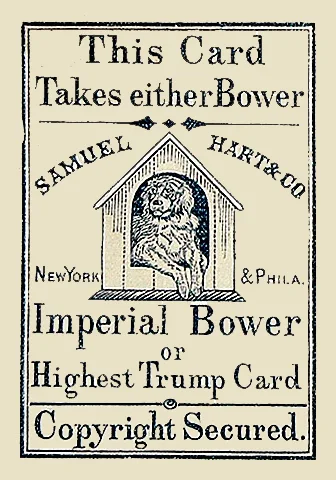
An Imperial Bower card of Samuel Hart & Co. The top panel says it takes either bower; the panels below call it the Imperial Bower or Highest Trump Card.
Credit and reuse terms
"Imperial Bower" by Samuel Hart & Co., New York and Philadelphia (card); World Web Playing Card Museum (image) — https://commons.wikimedia.org/wiki/File:Imperial_Bower.png — Public domain (card printed by Samuel Hart & Co. of New York and Philadelphia in the 1860s: published before 1931, and with no designer named its EU term ended 70 years after publication; the image is a faithful reproduction of the flat card)

Imperial Bower card, 1860s, Samuel Hart & Co., New York and Philadelphia. Collection not given, no number given.
TL;DR. The joker card began in the 1860s as an extra trump that American euchre players added above the two bowers, the jacks at the head of the trump suit, and makers printed it with names such as Highest Trump and Imperial Bower. The card was called the joker in print by 1875; David Parlett dates the spread of its jester picture to the end of the century, but Mrs. John King Van Rensselaer wrote in 1912 that the card is "never represented by Mercury, or a fool, or a clown."
In this file5 sections
An early form of the joker states its rank in a sentence: This Card Takes either Bower. Read that top panel on the card above, then look below it, where a dog sits in a kennel between the maker's name, SAMUEL HART & CO, and two cities, New York and Philadelphia. The bottom panels name the card twice over: Imperial Bower, or Highest Trump Card. In the stranger's read, shapes and positions only, it is an upright white card with no suit sign and no corner index, a kennel at fess point, heraldry's name for the center of a shield, between lettered panels in chief and in base, the top and bottom of the field.
There is a joker in the pack because of euchre, a trick-taking game in which the two highest trumps were jacks, the right and left bowers. American players added a card that beat both. The International Playing-Card Society (IPCS) says the card "was called the Imperial Bower or the Best Bower," and adds: "This was the genesis of the Joker."
A trump above the two bowers
The euchre rule book of 1862, The Law and Practice of the Game of Euchre, plays with 32 cards, the seven up in each suit. Its best trump is the knave of trumps, "the Right-Bower as it is termed," and the next is "the other Knave of the same color, termed the Left-Bower." The book has no extra card. The euchre page follows its rules step by step.
Cards made to outrank both bowers were already being printed in the 1860s. Catherine Perry Hargrave's A History of Playing Cards, as David Parlett reported in 2007, describes a card of 1862 that shows a tiger and is labeled Highest Trump. She also describes one of 1865 with the wording of the card above, and Parlett notes that the 1865 card is confirmed elsewhere as part of a euchre pack.
Dates for the Hart card itself differ. Its Wikimedia Commons description dates the image to about 1863, while The World of Playing Cards, a collectors' reference site, says Hart's Imperial Bower first appeared during the 1860s and was probably the first American joker. Other makers used other names: the IPCS shows a card lettered Best Bower, attributed to Lawrence and Cohen, from about 1869.
Parlett concludes from surviving packs that the spare card "was associated with Euchre from the first." With it in play, the trump suit grows by one card.
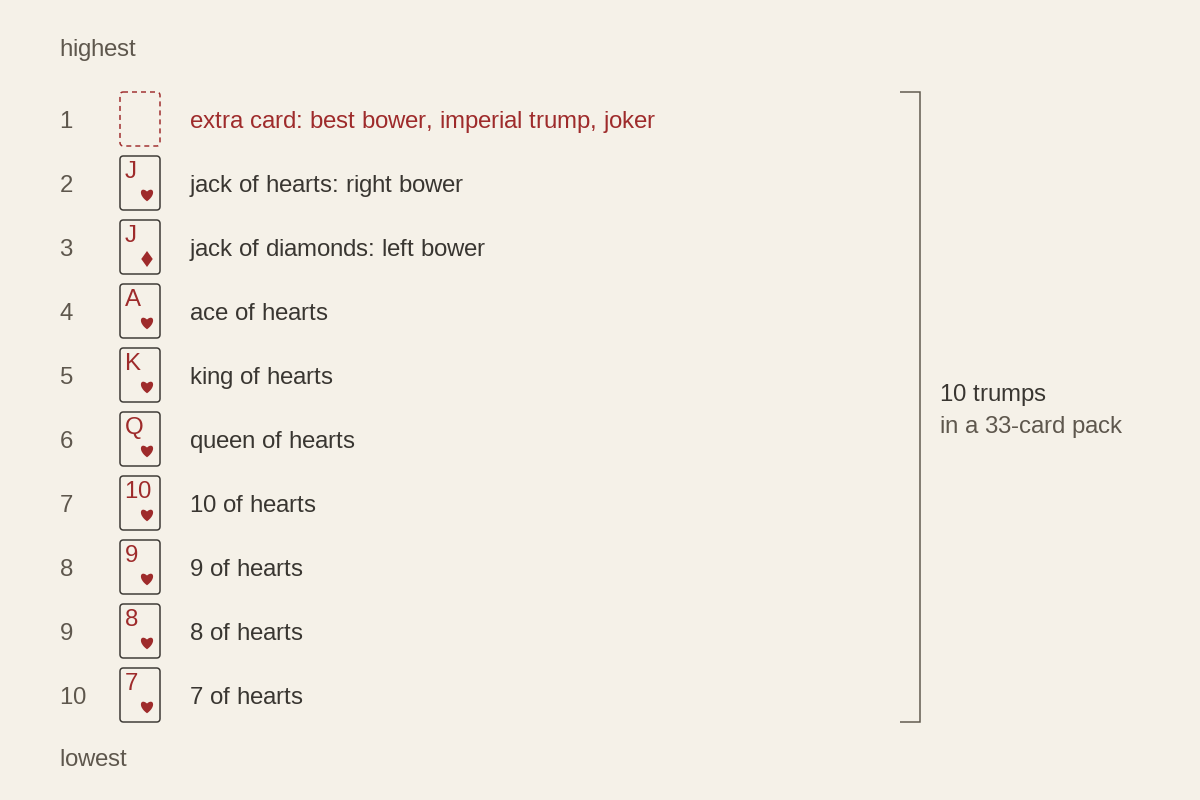
Slide the drawing sideways to read every label, or open it at full size.
Euchre trumps with the extra card when hearts are trumps, highest first: the extra card, the jack of hearts, the jack of diamonds, then the ace down to the seven (tincture, not official).
Credit and reuse terms
"Euchre trumps with the extra card, hearts as trumps" by Banners & Banknotes, https://bannersandbanknotes.com/playing-cards/joker/, licensed under CC BY 4.0 (https://creativecommons.org/licenses/by/4.0/)
By this page's count, 10 of the 33 cards are trumps when hearts are trumps, one more than the 9 of the 32-card pack. Download the pack counts (CSV) provenance and license of joker-packs.csv
Look at the Hart card once more. It has no suit to belong to and no letter in its corner, so it says in words what it beats.
Other cards were getting letters around then: the IPCS dates the move to corner indices to the middle of the 19th century, when makers settled on K, Q and J for the court cards. For words squeezed into letters on coins, see the Coin Legend Decoder.
When was the joker first called the joker?
The earliest rule found for this page that uses the name is in the tenth edition of The American Hoyle, whose preface is dated April 1875. That preface lists Railroad Euchre among its additions, "now very generally played in all parts of the country." The chapter calls for 33 cards: "a regular Euchre pack, and an additional blank card which is usually called the 'Joker,' or imperial trump."
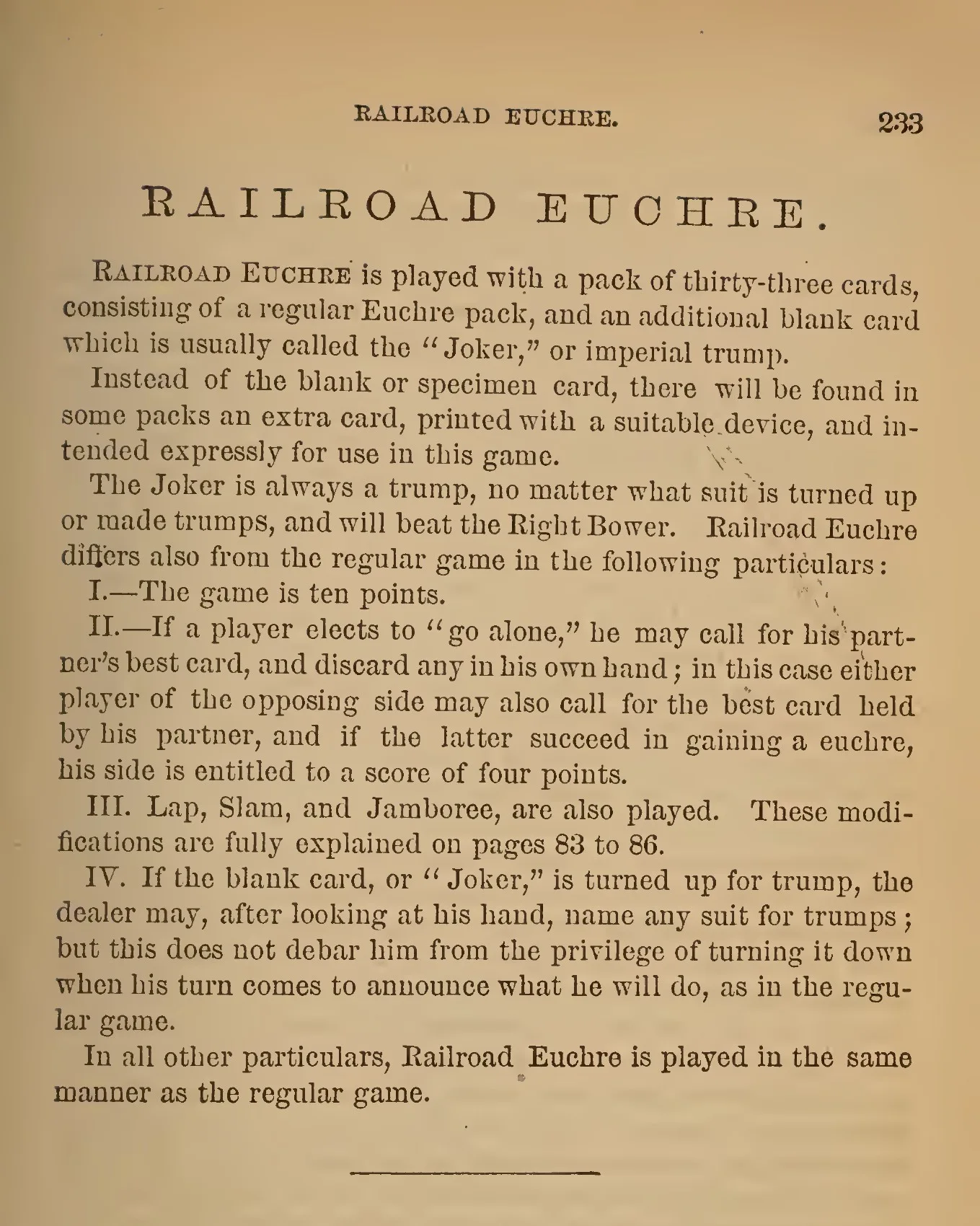
Page 233 of The American Hoyle, 1875: Railroad Euchre is played with 33 cards, the extra one usually called the Joker, which always counts as a trump.
Credit and reuse terms
"The American Hoyle (IA americanhoyleorg00dick 1)" by William Brisbane Dick, The American Hoyle, 10th ed. (New York: Dick & Fitzgerald, 1875) — https://commons.wikimedia.org/wiki/File:The_American_Hoyle_(IA_americanhoyleorg00dick_1).pdf — Public domain (book published in New York in 1875; its compiler, William Brisbane Dick, died in 1901; the scan is a faithful reproduction of the printed page); changes: printed page 233 (PDF page 243) extracted at 200 dpi and cropped to the Railroad Euchre section
The American Hoyle (page 233), 1875, Dick & Fitzgerald, New York. Library of Congress, no number given.
The joker on that page "is always a trump" and "will beat the Right Bower." The same page tells where the card came from: players could use "the blank or specimen card" of a pack, while some packs held an extra card "printed with a suitable device" for the game.
A play printed in Cambridge, Massachusetts, that same year shows both names in use. In J. B. Greenough's The Queen of Hearts (1875), a herald announces "The White Knight, called the Joker, otherwise the Best Bower," and hails him as "Crown Prince of Euchre."
Mrs. John King Van Rensselaer later gave a reason for the blank. In her history of 1912 she wrote that makers printed it in an unused corner of the sheet and put it outside the wrapper to show the design of the back.
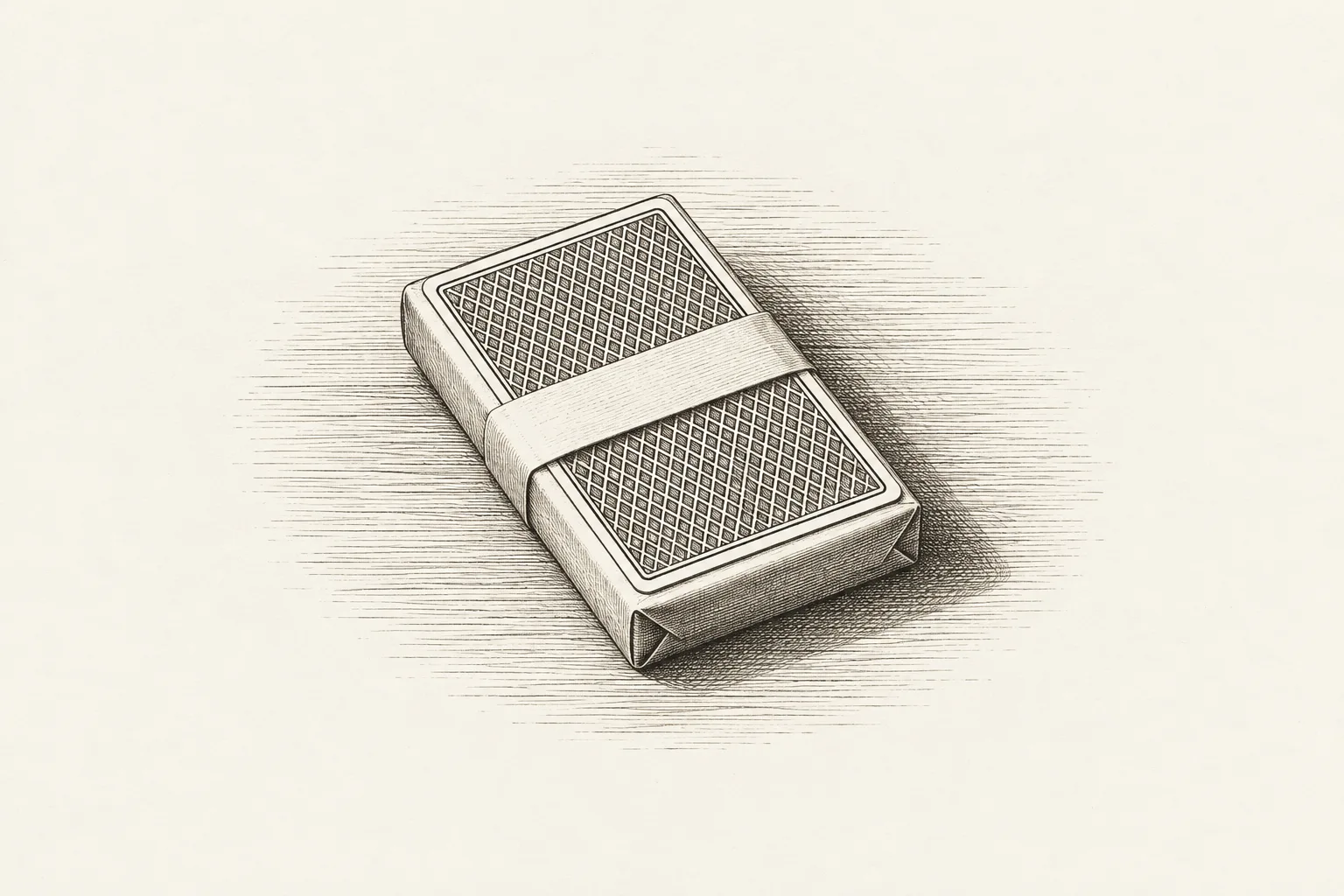
A wrapped pack with one card outside the wrapper, back up. Van Rensselaer wrote in 1912 that makers put the blank card there to show the design of the back.
Illustration: Banners & Banknotes. Generated schematic illustration — not a photograph or historical record. © Banners & Banknotes, all rights reserved.
The rule books disagree on one point: what happens when the joker is the card turned up to set the trump suit. The table below lines up their answers.
| Year | If the joker is turned up | Source |
|---|---|---|
| 1875 | The dealer may look at his hand and name any suit | The American Hoyle, p. 233 |
| 1887 | The dealer turns up the next card, which sets the suit | Keller, The Game of Euchre, p. 48 |
| 1914 | Players usually agree on a suit before play | Foster's Complete Hoyle, p. 282 |
For about thirty years the card went by several names, as the timeline below shows. Keller's book of 1887 still gives two of them in one line: "The joker, or imperial trump as it is sometimes called, is always the best trump."
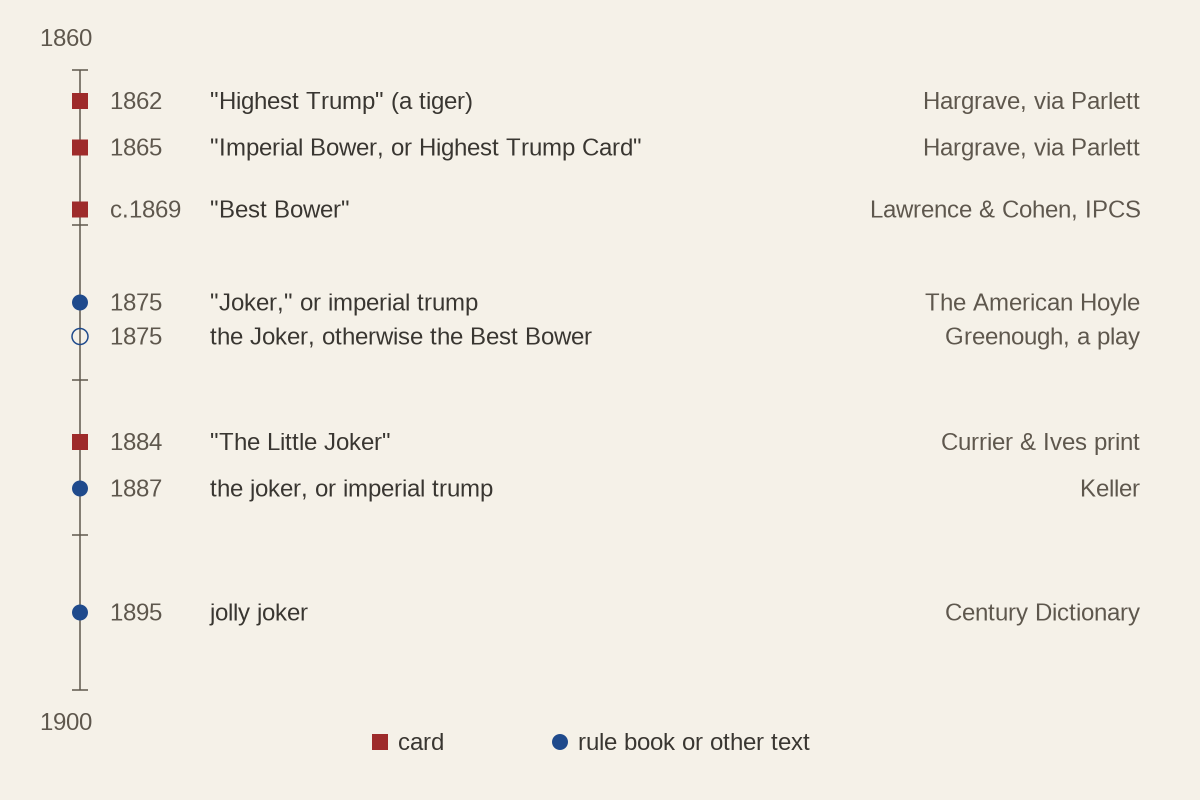
Slide the drawing sideways to read every label, or open it at full size.
Names for the extra euchre card in the sources on this page, 1862 to 1895. Squares mark cards; circles mark rule books and other texts.
Credit and reuse terms
"Names for the extra euchre card, 1862 to 1895" by Banners & Banknotes, https://bannersandbanknotes.com/playing-cards/joker/, licensed under CC BY 4.0 (https://creativecommons.org/licenses/by/4.0/)
Why is the joker a jester?
The early cards show many kinds of pictures. The IPCS finds "much greater diversity" among best bowers and early jokers than the name would lead one to expect, with trickster figures but also "children, stage characters, animals." Hart's card has a dog, and the 1862 card in Hargrave's account a tiger.
A Currier & Ives print of 1884, titled "Euchered," puts a child on the card. In the detail below, a hand in a dark sleeve holds up five cards, and the top one reads THE LITTLE JOKER above a small child standing in an open box, a doll in one hand.
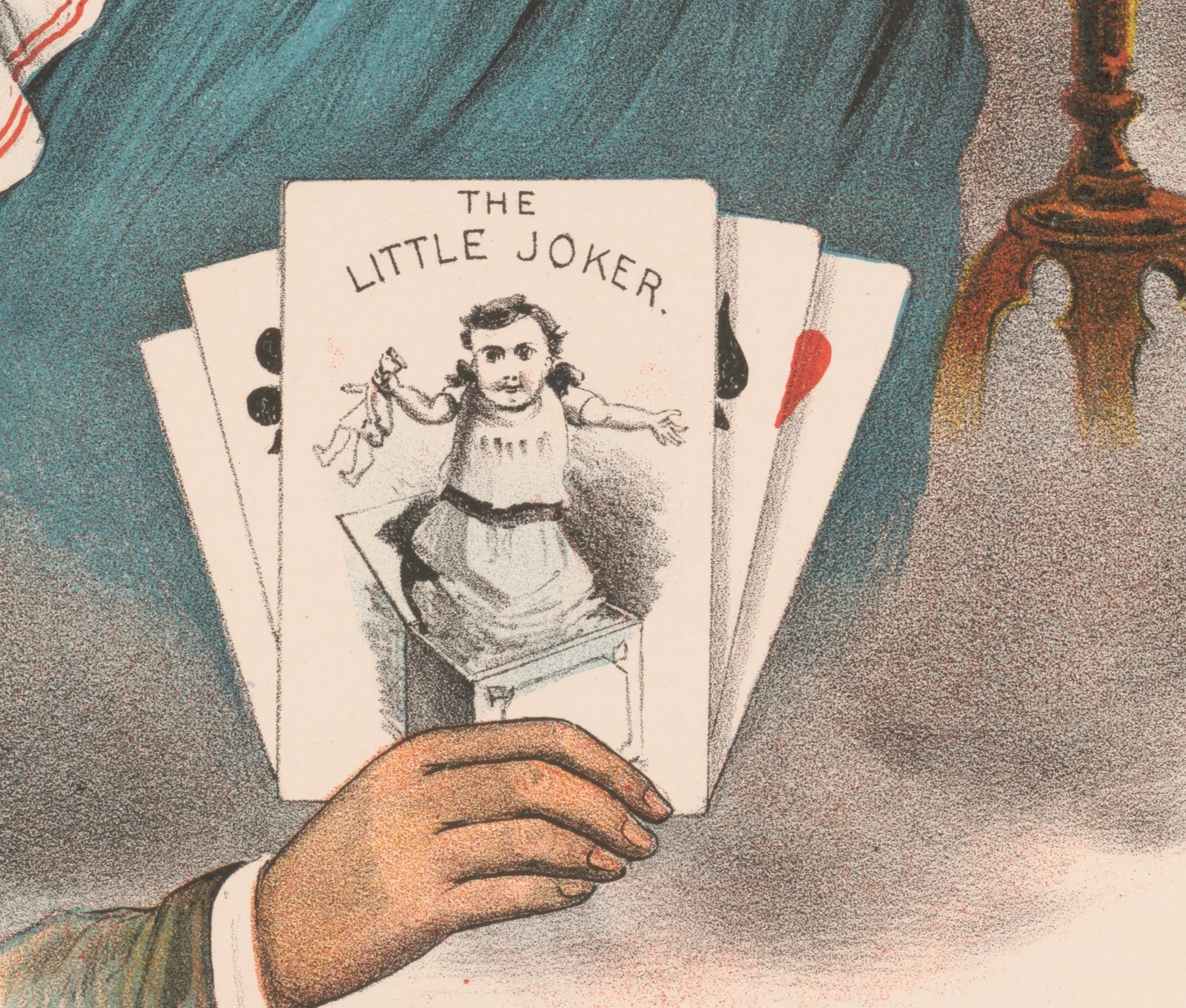
Detail of "Euchered," a Currier & Ives print of 1884. The top card of the hand, THE LITTLE JOKER, shows a small child standing in an open box with a doll.
Credit and reuse terms
"Euchered" by Currier & Ives, New York (publisher), artist signed F.C. — https://commons.wikimedia.org/wiki/File:%22Euchered%22_LCCN2001697234.jpg — Public domain (lithograph published in New York by Currier & Ives in 1884, before 1931; the artist signed only with the initials F.C. and is not identified in the Library of Congress record, so the EU term of 70 years from publication ended in 1954; the image is a faithful reproduction of the flat print); changes: cropped to the hand of cards: 2000 × 1700 pixels from the 5508 × 7132 original, left 1950, top 3850

"Euchered," lithograph, 1884, Currier & Ives, New York. Library of Congress, LCCN 2001697234.
Stop on the child. There is no cap and no bell, only the card's name lettered in an arc above.
In its 1895 printing, The Century Dictionary describes a card with no fixed picture. It defines the joker as a card "either blank or having some comical or other special device," always a trump and "generally the highest trump," and adds: "Often called jolly joker." Parlett dates the change in the picture: "It was not until the end of the century that the depiction of Joker as a kind of court jester became widespread." Van Rensselaer wrote the opposite in 1912, finding it "peculiar that the card is never represented by Mercury, or a fool, or a clown."
Neither the dictionary nor Parlett explains the choice of a jester. The IPCS offers two guesses: the word joker may itself have suggested jesters to designers, or the jester was a logical choice "because of his unpredictable behavior" and because "he complements the court cards," since European royal courts kept jesters. Parlett puts the first guess as a question, asking whether "the visual image was inspired by what the card was already called."
Is the joker descended from the tarot's Fool?
The comparison goes back at least to 1890. In The Devil's Picture-Books, Van Rensselaer described the tarot's unnumbered card, the Fou or il Matto, and wrote: "This 'Joker,' as we should term it, has no value of its own." Her book of 1912 went further: of the Fool she wrote, "we know it as the Joker," and she said American players had given the blank card "the position originally occupied by Il Matto."
The Fool is far older than the joker. The IPCS dates the first tarot cards to Renaissance Italy, probably between 1410 and 1430. By the end of the 15th century, it says, a pack of 78 cards with 21 trumps, 14 cards per suit "and a fool" had become fairly standard. In the Piedmontese tarot, according to IPCS pattern sheet 4, "the Fool is called 'Il Matto,'" and the sheet lists Vergnano of Turin among the pattern's makers.
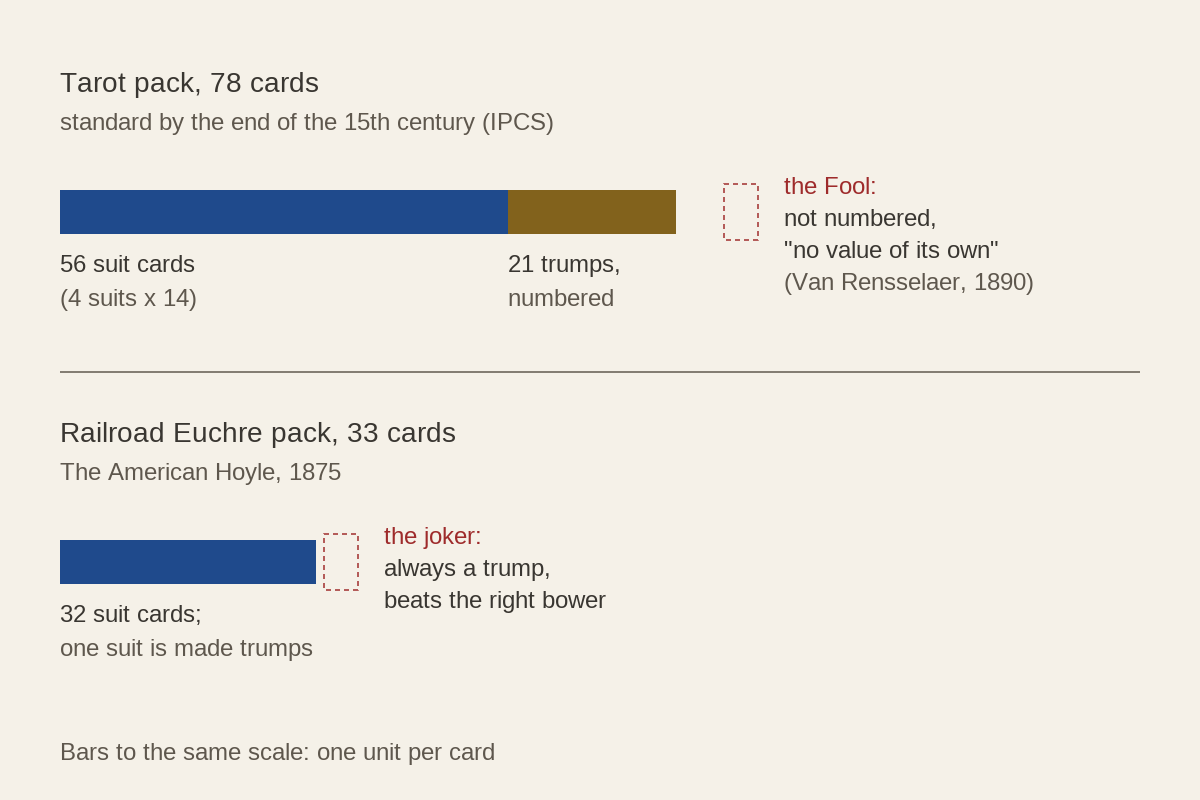
Slide the drawing sideways to read every label, or open it at full size.
Two packs drawn to one scale: the tarot's 78 cards, with the Fool set apart from the 21 numbered trumps, and Railroad Euchre's 33, where the joker is always a trump (1875).
Credit and reuse terms
"Two packs and their extra card: the tarot's Fool and the euchre joker" by Banners & Banknotes, https://bannersandbanknotes.com/playing-cards/joker/, licensed under CC BY 4.0 (https://creativecommons.org/licenses/by/4.0/)
Against a descent stand the dated cards. The IPCS calls it "certain that the Joker card itself was not a European invention," and Parlett ties the spare card to euchre "from the first." Even Van Rensselaer's own account starts the American card as a blank, not as a copy of the Fool.
The two cards also did different jobs: Van Rensselaer's Fool of 1890 "has no value of its own," while the joker of the rule books of 1875 and 1887 is always a trump and the highest one. The tarot's place among Europe's packs is set out on the five suit systems page.
Two jokers and the games that use them
The joker stayed the top trump in the euchre family. Foster's Complete Hoyle of 1914 gives Railroad Euchre 25 cards, the nines up plus the joker, and Seven-Handed Euchre all 53, with the joker "always the best trump." A rule book published in Wellington, New Zealand, in 1950 does the same for Five Hundred, a game played with bowers: "The joker is the highest trump when there is a trump bid."
Other games gave the card other jobs. In Dom Pedro, also called Snoozer, Foster's joker counts 15 points yet ranks as the lowest trump. In canasta, a rummy game, the 1950 book lets players use jokers and deuces "as cards of any rank" when melding, and builds the pack from 108 cards, "made by adding four jokers to two standard 52-card decks." There the joker works like a coin with no face value of its own, passing for whatever rank a meld needs.
How many jokers came in a pack changed with the games. In 1912 Van Rensselaer wrote that in the United States "a pack is incomplete without the Joker, which then makes fifty-three cards to a standard pack." The 1950 rule book describes a 53rd card, the joker, and "a fifty-fourth card which is blank and may be used as an extra joker." The World of Playing Cards links the pair to canasta, which it says reached the United States in 1949, and dates the makers' move to two jokers, "rather than just one," to around 1950.
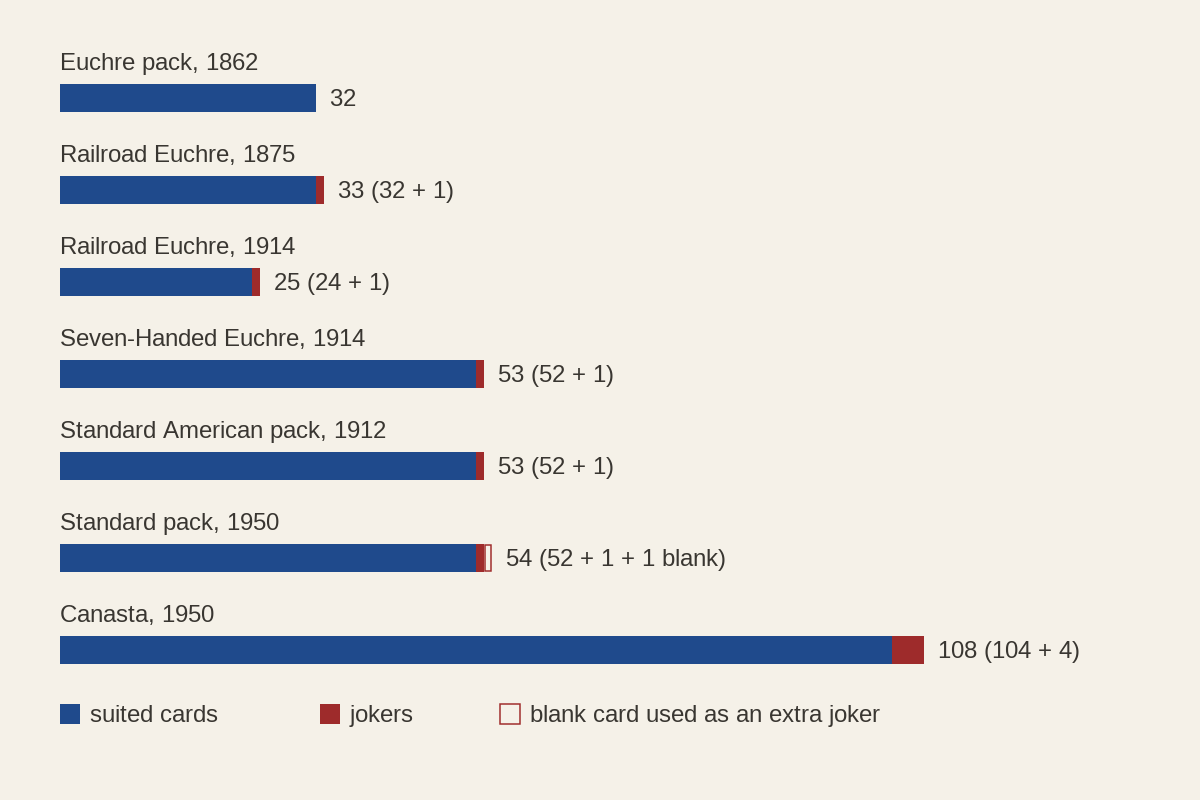
Slide the drawing sideways to read every label, or open it at full size.
Seven packs from the sources on this page, counted card by card: suited cards in blue, jokers in red, and the 1950 blank card that may serve as an extra joker.
Credit and reuse terms
"Seven packs with and without the joker, 1862 to 1950" by Banners & Banknotes, https://bannersandbanknotes.com/playing-cards/joker/, licensed under CC BY 4.0 (https://creativecommons.org/licenses/by/4.0/)
Take two of the 54-card packs of 1950. By this page's count, together they make 108 cards, with four jokers once each blank card serves as one: the canasta pack.
Two packs side by side, backs up, on a card table. By this page's count, two 54-card packs of 1950 make the 108-card canasta pack.
Illustration: Banners & Banknotes. Generated schematic illustration — not a photograph or historical record. © Banners & Banknotes, all rights reserved.
Shrink strip
At 16 pixels the Hart card is a pale chip, and at 48 the kennel shrinks to a dark spot inside the frame. At 160 pixels the largest words, This Card and Imperial Bower, can still be made out; in the blurred copy the frame and the kennel hold their shape, while the smaller lettering smears into soft dark bands.
Shown at its drawn size. On a narrow screen, scroll sideways to see the whole strip.
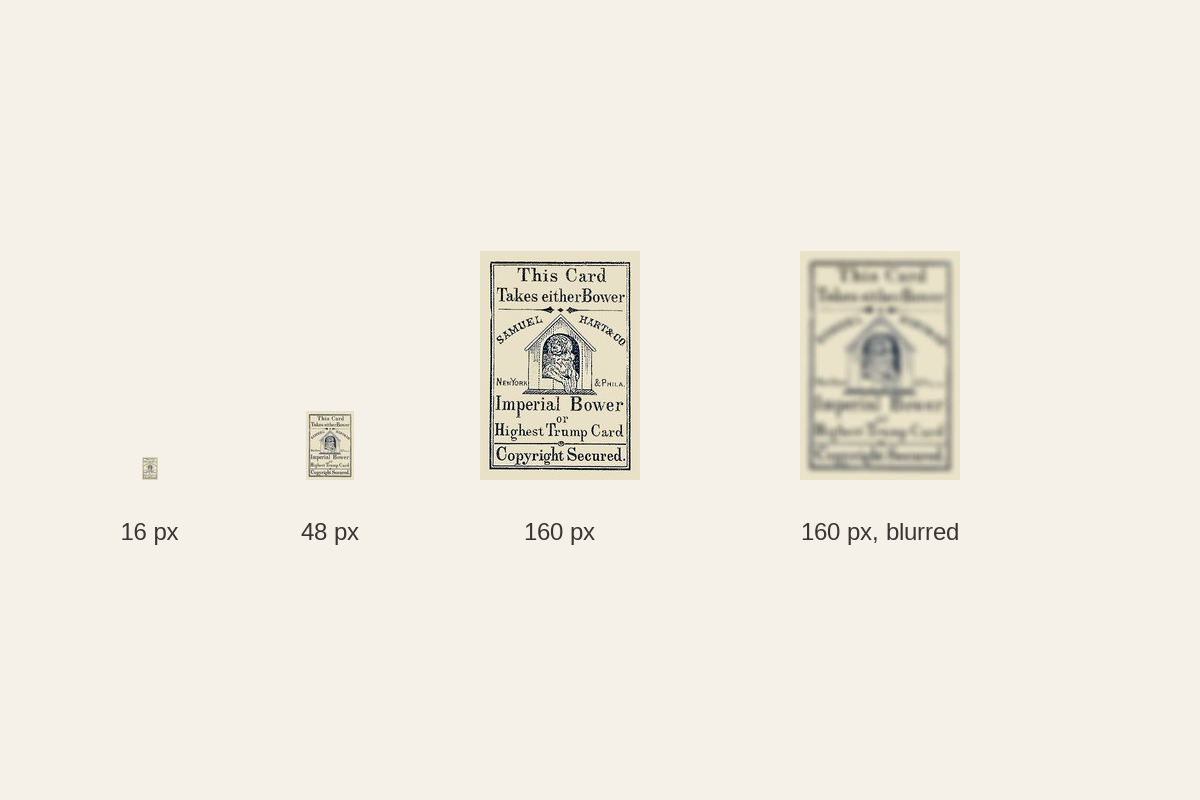
The Imperial Bower card of the opening image at 16, 48 and 160 pixels wide, plus a blurred copy. Reduction preview, not a legibility test.
Credit and reuse terms
"Shrink strip: the Imperial Bower card at 16, 48 and 160 pixels" by Banners & Banknotes, https://bannersandbanknotes.com/playing-cards/joker/, licensed under CC BY 4.0 (https://creativecommons.org/licenses/by/4.0/). Derived from "Imperial Bower". "Imperial Bower" by Samuel Hart & Co., New York and Philadelphia (card); World Web Playing Card Museum (image) — https://commons.wikimedia.org/wiki/File:Imperial_Bower.png — Public domain (card printed by Samuel Hart & Co. of New York and Philadelphia in the 1860s: published before 1931, and with no designer named its EU term ended 70 years after publication; the image is a faithful reproduction of the flat card)
Meaning ledger
| Meaning | Earliest we can document | Year | Label | Notes |
|---|---|---|---|---|
| The joker is the tarot's Fool, il Matto, returned to the pack | Van Rensselaer, Prophetical, Educational and Playing Cards, pp. 58 and 225–227 ("we know it as the Joker") | 1912 | [first recorded later] | Her Devil's Picture-Books of 1890 (pp. 13–14) only compares the two. Against a descent: the IPCS calls the joker "not a European invention," Parlett (2007) ties the spare card to euchre "from the first," and Van Rensselaer's own account starts the American card as a blank card. |
| The name joker means one who jokes, a jester | The Century Dictionary, vol. 4, p. 3240 (the card listed as the second sense of joker) | 1895 | [first recorded later] | The name is in print by 1875 (The American Hoyle; Greenough). The dictionary's first sense is "one who jokes, in speech or in deed; a jester." Van Rensselaer (1912, p. 227) glosses the Joker as "the one who played tricks and took them." |
| The name joker comes from euchre, through "Euchre card" heard as "Juker card," or the German spelling Jucker | Parlett, "Euchre and other five-trick games" (put as a question) | 2007 | [first recorded later] | The IPCS (undated page, read 2026) calls the "Euchre card" version "the latest theory" and notes that "Eucher card" and "Juker card" have not been found on actual cards or in 19th-century literature. |
| The joker stands for the unexpected | Van Rensselaer, Prophetical, Educational and Playing Cards, p. 55 ("the unforeseen, the unexpected") | 1912 | [first recorded later] | She draws it from her account of the tarot's Fool. The IPCS (undated) says the name may mean one that "pops up unexpectedly" and calls the jester a logical choice "because of his unpredictable behavior." |
How each label is decided: The After-Meaning, the four labels.
Sources
- A Professor [Charles Henry Wharton Meehan], The Law and Practice of the Game of Euchre (Philadelphia: T. B. Peterson & Brothers, 1862), pp. 32–33. archive.org Read: pages 32–33
- [William Brisbane Dick], The American Hoyle; or, Gentleman's Hand-Book of Games, 10th ed. (New York: Dick & Fitzgerald, 1875), preface to the tenth edition (p. viii) and p. 233. commons.wikimedia.org Read: preface to the tenth edition and page 233
- [J. B. Greenough], The Queen of Hearts: A Dramatic Fantasia for Private Theatricals (Cambridge, Mass.: Charles W. Sever, 1875), pp. 13 and 24. archive.org Read: title page and pages 13 and 24
- John W. Keller, The Game of Euchre (New York: Frederick A. Stokes, 1887), pp. 47–48. archive.org Read: pages 47–48
- William Dwight Whitney and Benjamin E. Smith, eds., The Century Dictionary: An Encyclopedic Lexicon of the English Language, vol. 4 (New York: The Century Co., 1895), p. 3240, s.v. "joker." archive.org Read: page 3240
- R. F. Foster, Foster's Complete Hoyle (New York: Frederick A. Stokes, 1914), pp. 282, 284 and 334. archive.org Read: pages 282, 284 and 334
- Canasta and Other Card Games: The Official Rules of Canasta, Cribbage, Euchre, Five Hundred, Gin Rummy, Rummy and Whist (Wellington: Harlequin Books, 1950), pp. 7, 9, 11 and 29–30. archive.org Read: pages 7, 9, 11 and 29–30
- Mrs. John King Van Rensselaer, The Devil's Picture-Books: A History of Playing Cards (New York: Dodd, Mead and Company, 1890), pp. 13–14. archive.org Read: pages 13–14
- Mrs. John King Van Rensselaer, Prophetical, Educational and Playing Cards (London: Hurst & Blackett, 1912), pp. 55, 58 and 225–228. archive.org Read: pages 55, 58 and 225–228
- Wikimedia Commons, "File:Imperial Bower.png" (uploaded 2019), file description. commons.wikimedia.org Read: file page
- Wikimedia Commons, file "Euchered" LCCN2001697234.jpg (uploaded 2018 from the Library of Congress, Popular Graphic Arts collection), file description. commons.wikimedia.org Read: file page
- International Playing-Card Society, "Joker." i-p-c-s.org Read: full text
- International Playing-Card Society, "An introduction." i-p-c-s.org Read: full text
- International Playing-Card Society, Pattern sheet 4, "Tarocco Piemontese" (undated). i-p-c-s.org Read: full text
- International Playing-Card Society, "Why is the jack called a jack?" i-p-c-s.org Read: full text
- David Parlett, "Euchre and other five-trick games," Historic Card Games, parlettgames.uk; first published in The Playing-Card 35, no. 4 (April–June 2007), pp. 255–261. parlettgames.uk Read: full text
- Catherine Perry Hargrave, A History of Playing Cards and a Bibliography of Cards and Gaming (New York: Dover Publications, 1966), Internet Archive catalogue record. archive.org Read: catalogue record
- Simon Wintle, "Samuel Hart, 1846-1871," The World of Playing Cards (published 2010, updated 2024). wopc.co.uk Read: full text
- Simon Wintle, "Canasta," The World of Playing Cards (published 2015, updated 2025). wopc.co.uk Read: full text
Counter-sign
Counter-sign: The blank card of German packs, as Van Rensselaer described it in 1912. German makers, she wrote, often put a blank card in the wrapper, but it "has not been incorporated into any of the local games."
- Euchre: the game whose two bowers the extra card was printed to beat.
- Europe's Five Suit Systems: the tarot pack of 78 cards, with 21 trumps and the Fool, beside the other packs.
Cite this page
Banners & Banknotes. “Joker: The Extra Card Began as Euchre's Best Bower.” Published 14 October 2026; last substantive revision 23 October 2026. https://bannersandbanknotes.com/playing-cards/joker/. Accessed [date you read it].
Corrections
- 2026-10-23 — The TL;DR said the jester picture "spread only toward the end of the century," giving Parlett's date as the only account, although the "Why is the joker a jester?" section also gives Van Rensselaer's opposite statement of 1912 — It now gives both: Parlett's date for the spread of the jester picture, and Van Rensselaer's statement that the card is "never represented by Mercury, or a fool, or a clown" — Mrs. John King Van Rensselaer, Prophetical, Educational and Playing Cards (London: Hurst & Blackett, 1912), p. 228; David Parlett, "Euchre and other five-trick games" (2007) (both listed under Sources)
- 2026-10-15 — The "Why is the joker a jester?" section gave only Parlett's date for the jester picture — It now also gives Van Rensselaer's opposite statement of 1912, that the card is "never represented by Mercury, or a fool, or a clown" — Mrs. John King Van Rensselaer, Prophetical, Educational and Playing Cards (London: Hurst & Blackett, 1912), p. 228 (listed under Sources)