Side by side · No. 0004
Hearts, Bells, Coins, Acorns: Europe's Five Suit Systems
Blazon card
- Field
- An upright paper card; each suit sign sits on its plain face, drawn on Argent (pale) in this page's figuresR. Decker, IPCS Playing-card History, French cards
- Charge
- Four suit signs per system. French: cœur, carreau, trèfle, pique. German: Rot, Schellen, Eichel, Grün. Swiss: Rosen, Schellen, Eicheln, Schilten. Italian: coppe, denari, spade, bastoni. Spanish: copas, oros, espadas, bastosIPCS, An introduction
- Tincture
- French signs in red and black only (Decker, IPCS); other colors in this page's figures are site tinctures (tincture, not official)R. Decker, IPCS Playing-card History, French cards
- Difference
- Italian and Spanish packs share all four signs; in the IPCS account Italian makers straightened the polo sticks of the Mamluk cards into ceremonial batons, while the Spanish design uses knobbly cudgelsIPCS, An introduction
- Issued by
- No single issuer: each system was made by many cardmakers, in Rouen, Paris, Basel, Venice, Madrid and elsewhere; the IPCS ties standard patterns to places or to makersIPCS, An introduction; pattern sheets 20, 35, 48, 85, 112
- First documented
- Earliest we can document: cards first mentioned in Spain 1371 and described in Switzerland 1377; stenciled cards with the German hearts, bells and acorns, no later than 1440 by Chatto's 1848 estimate from their style, and a German-suited pack of 1511; French suits c. 1470; first Swiss pattern, Basel, c. 1530IPCS, An introduction; Decker, IPCS; Chatto 1848, pp. 204–205, 236; IPCS pattern sheet 85
- Spec source
- IPCS pattern sheets 20, 35, 48, 49, 52, 85, 112; pack counts in suit-systems-decks.csv (this page)IPCS; Banners & Banknotes
Blazon card as CSV suit-systems-blazon.csvprovenance and license of suit-systems-blazon.csv
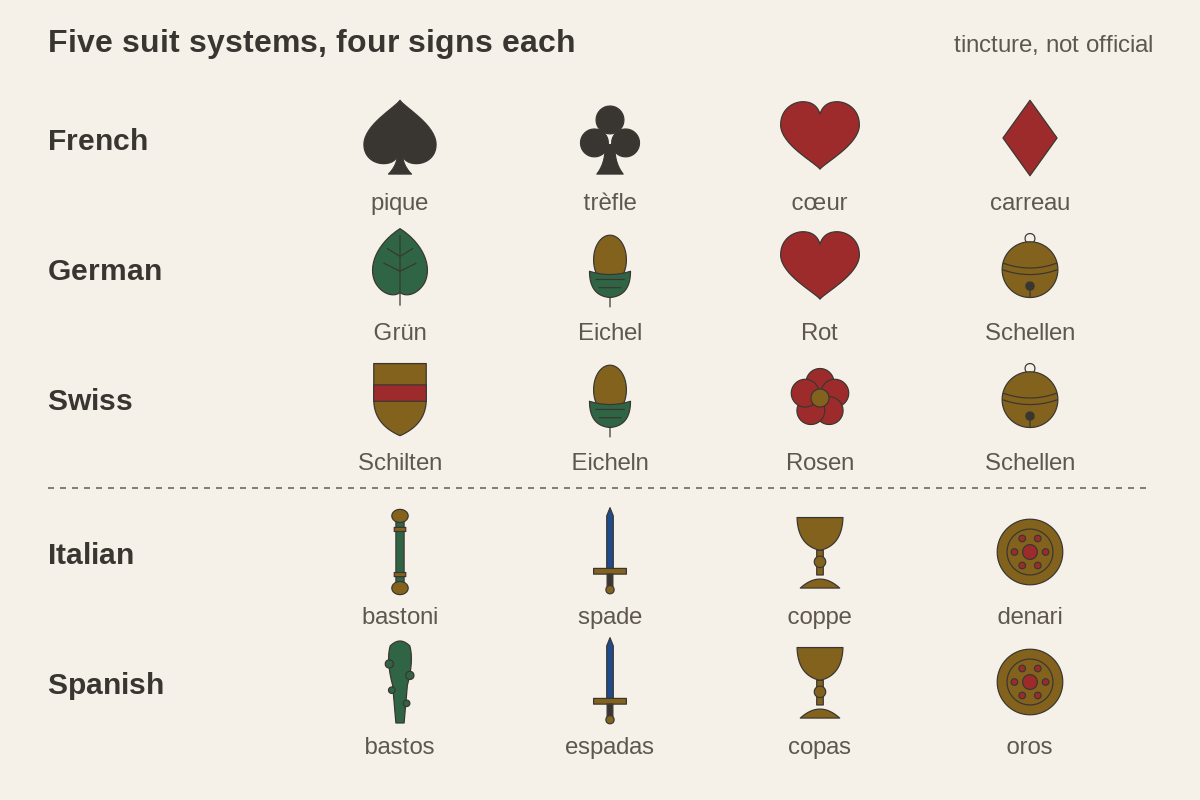
Slide the drawing sideways to read every label, or open it at full size.
Twenty suit signs, four per system. French, German and Swiss columns follow the order of the International Playing-Card Society's suit lists; the Italian and Spanish rows are not matched to them (tincture, not official).
Credit and reuse terms
"Europe's five suit systems, four signs each" by Banners & Banknotes, https://bannersandbanknotes.com/playing-cards/suit-systems/, licensed under CC BY 4.0 (https://creativecommons.org/licenses/by/4.0/)
TL;DR. Italian and Spanish packs keep the cups, coins, swords and sticks of the cards that reached Europe by the 1370s. German and Swiss packs use hearts, bells, leaves, acorns, roses and shields, and French makers around 1470 cut their four signs down to red and black silhouettes that a stencil could print. The International Playing-Card Society, in a pattern sheet first issued in 1994, says the English pattern is now used in almost every country and traces it to designs from Rouen rather than to the Paris pattern.
In this file10 sections
Two of Europe's five systems of playing card suits share the same four signs: cups, coins, swords and batons. Look first at the suit of sticks. The International Playing-Card Society (IPCS) writes that Italian makers turned the polo sticks of their Mamluk models into straight ceremonial batons, while Spanish makers drew knobbly cudgels. In the stranger's read, shapes and colors only, the five suit systems are twenty charges, heraldry's word for figures set on a field: French hearts, tiles, trefoils and pikes in red and black; German hearts, bells, leaves and acorns; Swiss roses, bells, acorns and shields; and Italian and Spanish cups, coins, swords and sticks.
According to the IPCS, playing cards are first mentioned in Spain in 1371 and described in detail in Switzerland in 1377. This page keeps three things apart. The suit system is the set of four signs; the pattern is the standard design of a whole pack, often named for a city or region; the lineage is which pattern was copied from which.
Which suits match across the five systems?
The IPCS lists the French and German suits in the same order, and William Andrew Chatto's 1848 summary table sets them in the same columns: hearts with Rot (red, the German heart), diamonds with Schellen (bells), clubs with Eichel (acorns) and spades with Grün (green, the leaf suit). Some of those pairs also match by shape. Chatto judged the French heart and pike "evidently derived" from the heart and the leaf of the German pack, and saw "good reason to believe" that the trefoil was copied from the acorn. No source read for this page draws the French tile from the German bell.
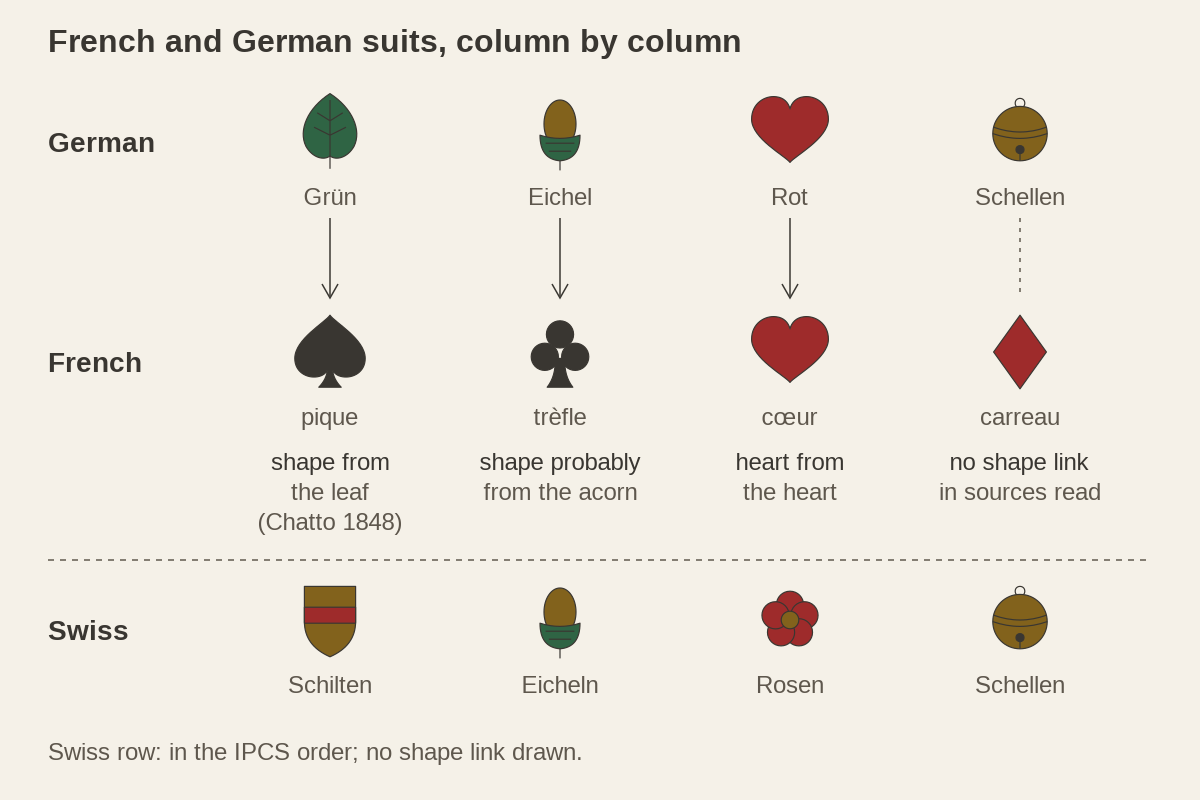
Slide the drawing sideways to read every label, or open it at full size.
German and French suits in matching columns. Arrows show the shape links Chatto proposed in 1848; the Swiss row follows the IPCS order with no link drawn (tincture, not official).
Credit and reuse terms
"French and German suits, column by column" by Banners & Banknotes, https://bannersandbanknotes.com/playing-cards/suit-systems/, licensed under CC BY 4.0 (https://creativecommons.org/licenses/by/4.0/)
Ron Decker's history for the IPCS gives a different order, calling spades, hearts and clubs "presumably adapted from the German Leaves, Hearts and Hawk Bells." Read in that order, his club comes from the bell, where Chatto's trefoil came from the acorn.
The IPCS lists the Swiss suits in the same order, with shields beside leaves, acorns beside acorns, roses beside hearts and bells beside bells. A French writer quoted in Willshire's 1876 catalog of the British Museum's cards paired them the other way, saying the Swiss put shields in place of hearts and flowers in place of leaves.
The Latin suits line up less neatly. Chatto's 1848 summary of the three kinds of pack sets cups beside hearts, swords beside leaves, batons beside acorns and money beside bells, while the IPCS lists put batons in the place of spades and swords in the place of clubs.
The English suit names may be a leftover of the Latin suits. Chatto thought "clubs" a translation of the Italian bastoni and "spades" probably a corruption of spade or espadas, swords, though he noted that the Dutch call the suit scop, a shovel.
| French | German | Swiss | Italian | Spanish | |
|---|---|---|---|---|---|
| Suit signs | cœur, carreau, trèfle, pique | Rot, Schellen, Eichel, Grün | Rosen, Schellen, Eicheln, Schilten | coppe, denari, spade, bastoni | copas, oros, espadas, bastos |
| In English | heart, tile, clover, pike | heart, bell, acorn, leaf | rose, bell, acorn, shield | cups, coins, swords, batons | cups, coins, swords, clubs |
| Court cards | Roi, Dame, Valet | König, Ober, Unter | König, Ober, Under | Re, Cavallo, Fante | Rey, Caballo, Sota |
| A queen? | yes | no | no | no | no |
| Common packs | 52, 32 | 36, 32 | 36 | 40, 52 | 48, 40 |
Which suit system is the oldest?
The Latin suits of Italy and Spain are the oldest of the five on present evidence. The IPCS describes a nearly complete Mamluk pack in the Topkapi Sarayi Museum in Istanbul, found by L. A. Mayer in 1939, with suits of swords, polo sticks, cups and coins. The society calls it "virtually identical" with the Italian Latin-suited pack. The pack itself is no older than 1400, but a fragment of a similar card is tentatively dated to the 12th or 13th century, and on that evidence the IPCS concludes that the Mamluk pack came first.
When those suits reached Europe is less settled. Ron Decker's history pages for the IPCS put the arrival of cards with coins, cups, swords and sticks in southern Europe at about 1350. The society's introduction gives 1371 for the first mention, in Spain, and says it is hard to push the date back further.
The other systems appear later in the record this page can document. Nearly a century before the Mamluk pack came to light, Chatto judged some stenciled cards with hearts, bells and acorns to be no later than 1440 by their style, and he thought the German marks as old as any. He also reproduced cards from a German pack of 1511. Decker dates the French suits to about 1470, and IPCS pattern sheet 85 says the first distinct Swiss pattern seems to have come from Basel around 1530.
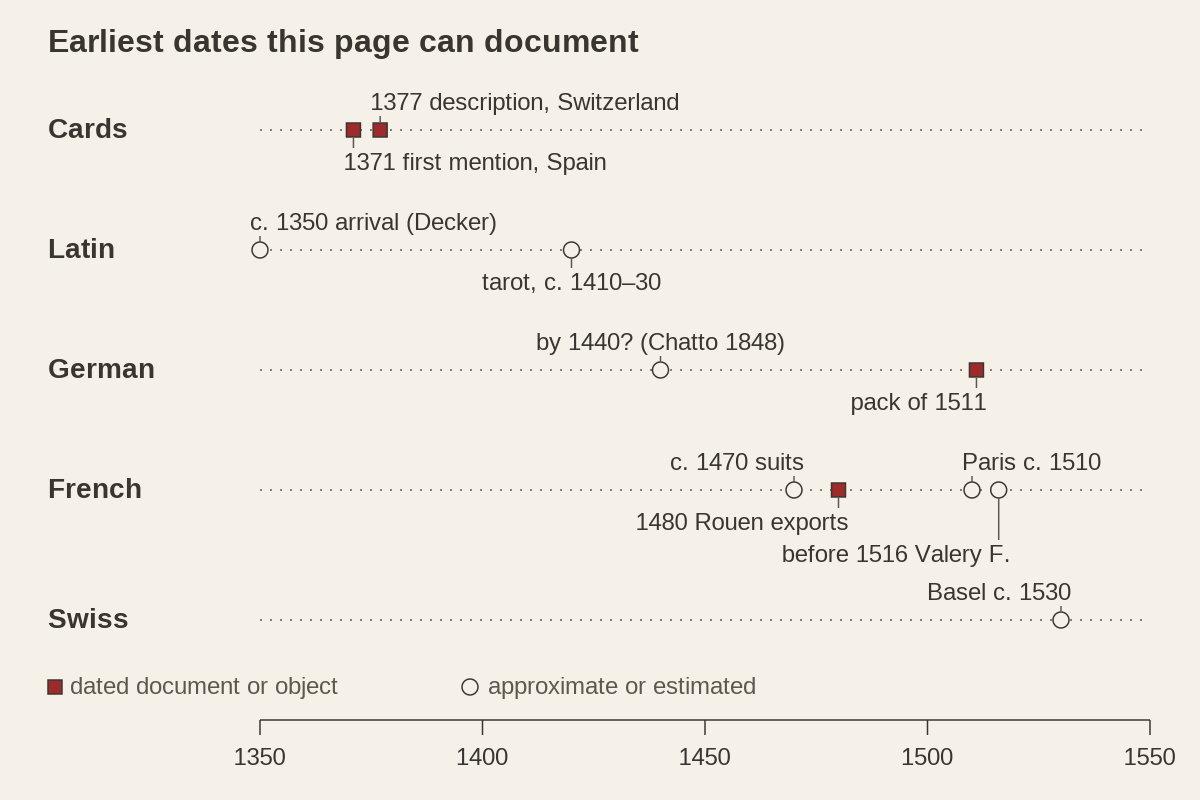
Slide the drawing sideways to read every label, or open it at full size.
Earliest dates this page can document for each system, 1350 to 1550. Squares mark dated documents or objects; circles mark approximate or estimated dates, including Chatto's 1848 estimate for the German suits.
Credit and reuse terms
"Earliest dates this page can document, by suit system" by Banners & Banknotes, https://bannersandbanknotes.com/playing-cards/suit-systems/, licensed under CC BY 4.0 (https://creativecommons.org/licenses/by/4.0/)
Cups, coins, swords and batons in Italy and Spain
The Latin suits survive in two families of drawing. The seven of batons below comes from a tarot pack that Chatto's book of 1848 copies from a plate in an older study by Breitkopf, and Chatto found its suit marks "precisely the same as in modern Tarots." The IPCS adds that for the tarot's first 350 years its suits were always the Latin ones.
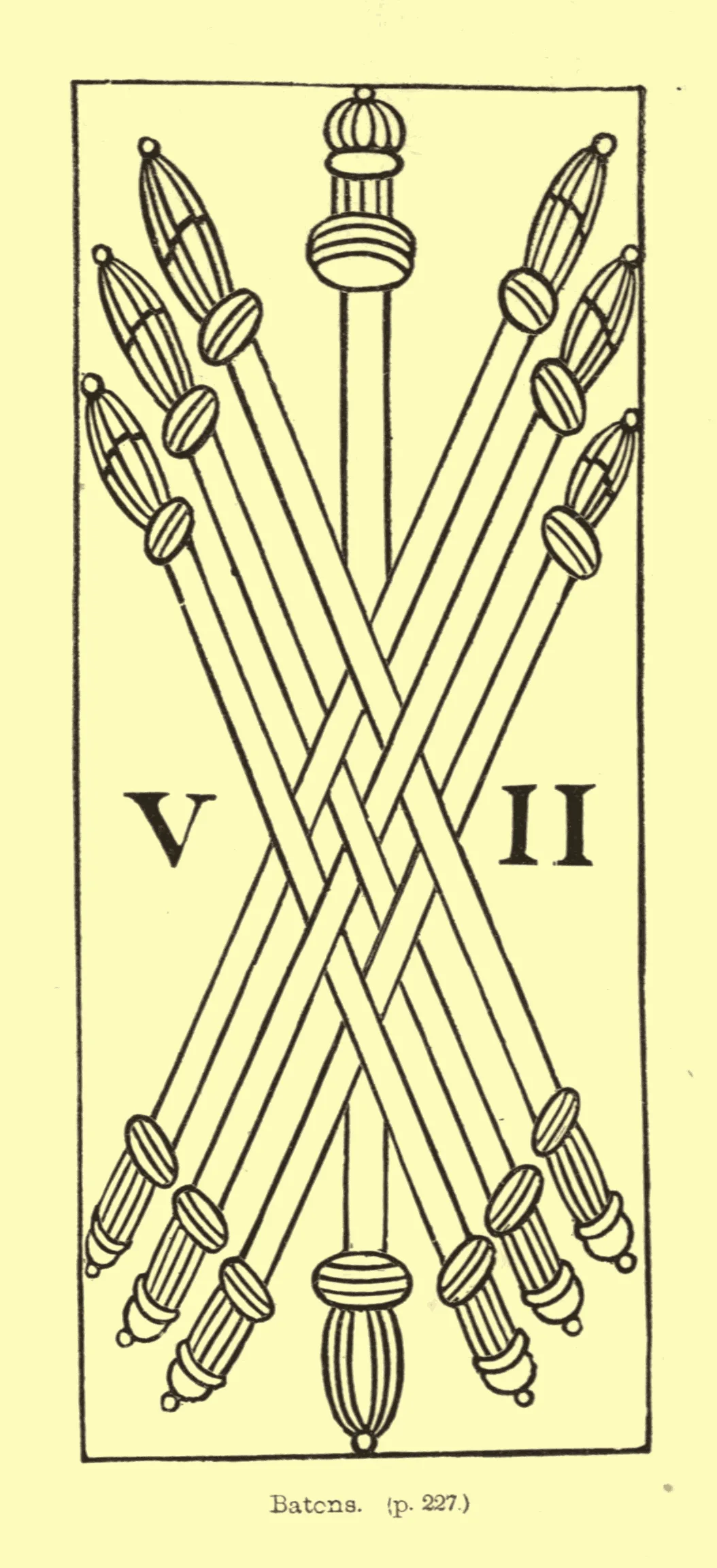
Seven of batons from a tarot pack, with seven straight batons woven across the card and a Roman VII. Chatto printed it in 1848, copied from a plate in Breitkopf.
Credit and reuse terms
"History of Playing Cards (1848) 34" by F. W. Fairholt and George Vasey, in W. A. Chatto, Facts and Speculations on the Origin and History of Playing Cards (1848) — https://commons.wikimedia.org/wiki/File:History_of_Playing_Cards_(1848)_34.png — Public domain (plate in W. A. Chatto, Facts and Speculations on the Origin and History of Playing Cards, London, 1848, p. 227, copied from a plate in Breitkopf; the preface names F. W. Fairholt (died 1866) as the copyist and George Vasey, already engraving in 1848, as the wood engraver, so a death after 1955 would mean a life of more than 120 years; published 1848; the scan is a faithful reproduction of the printed page)

Seven of batons, tarot pack, date not given, maker not given. Collection not given, no number given.
The card shows its number twice, once as seven batons and once as a numeral. For a picture system built on that kind of counting by repetition, see Isotype.
The usual Spanish packs have no tens. IPCS pattern sheet 20, on the Spanish National pattern, gives its packs as 48 or 40 cards, with king, cavalier and jack (rey, caballo, sota) above the ace to nine or the ace to seven. The sheet notes that 52-card packs were not uncommon around 1800. In a Spanish-suited pack of 1830 from the Hospital General de Pamplona, the jack, the knight and the king carry the numbers 10, 11 and 12 in their corners.
Why do Italian and Spanish packs have no queen?
The regular Italian and Spanish packs have no queen. Their three courts are the Italian re, cavallo and fante and the Spanish rey, caballo and sota, in English king, cavalier and jack; the Mamluk cards the IPCS describes also had three court ranks, labeled king, deputy king and second deputy.
Queens were tried early. Decker cites a Swiss report of about 1377 saying that Europeans experimented with as many as six courts, a queen and a lady among them, and writes that Italian cardmakers kept the queen, with a king, a knight and a valet, for the new game of tarocco around 1420. Chatto adds that early Italian packs sometimes put a queen in place of the cavallo.
The French pack made the queen its second court in place of a male figure, a change Chatto in 1848 says the French claimed as their own. In the German pack, Decker writes, the queen was banished.
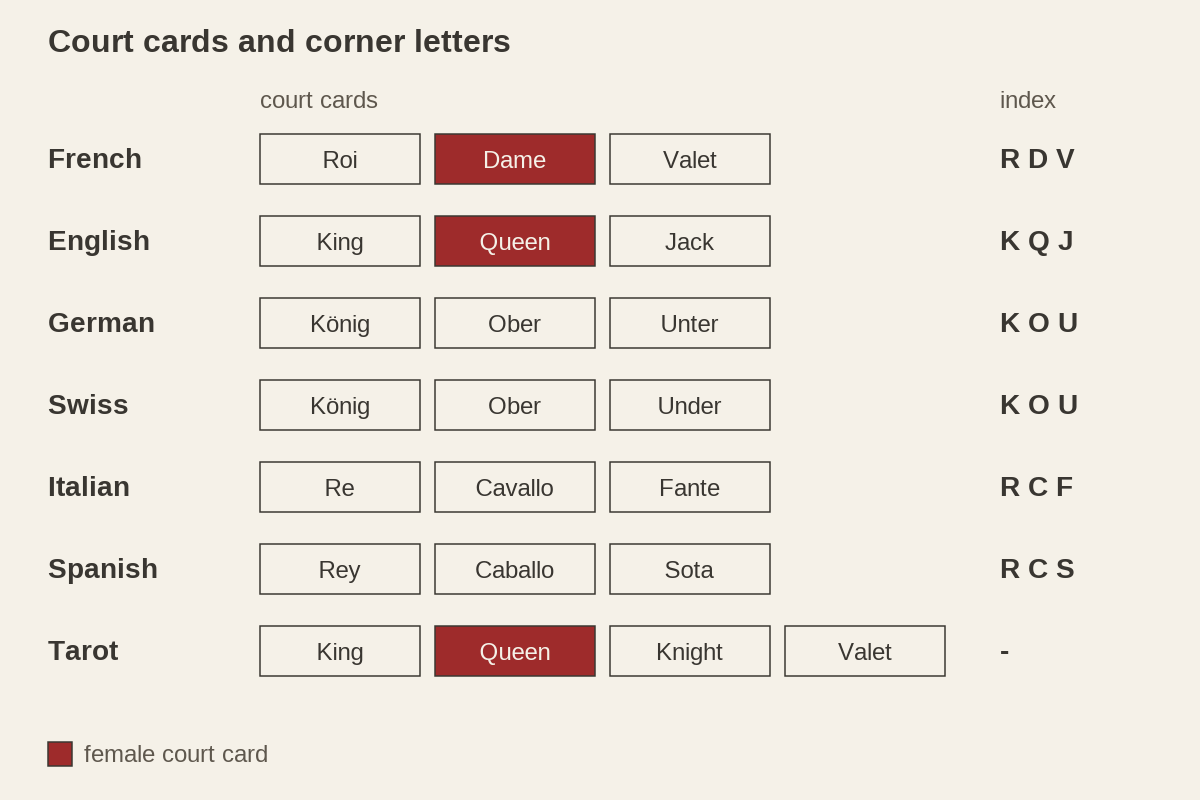
Slide the drawing sideways to read every label, or open it at full size.
Court cards and the corner letters the IPCS lists for each suit system, with rows added for the English pattern and the tarot. Only the French, English and tarot rows include a queen.
Credit and reuse terms
"Court cards and corner letters, by suit system" by Banners & Banknotes, https://bannersandbanknotes.com/playing-cards/suit-systems/, licensed under CC BY 4.0 (https://creativecommons.org/licenses/by/4.0/)
The corner letters squeeze each court's name to one letter: R, D and V on French cards, K, Q and J on English ones, R, C and S on Spanish ones, according to the IPCS. In its account of the London makers, IPCS pattern sheet 48 dates indices on their English-pattern cards to about 1880. Another IPCS page, on why the jack is called a jack, puts the change to corner indices earlier, in the middle of the 19th century. For the same squeezing of words into letters on coins, see the Coin Legend Decoder.
Hearts, bells, leaves and acorns
Look at the figure in the plate below. He holds an acorn on a branch, the mark of his suit. He is an Ober, the second court card that Chatto calls "a kind of superior officer," standing where Spanish and Italian packs put a horseman and French packs a queen. Chatto reproduced him in 1848 from a German pack engraved on wood that he dates to 1511 and thought had once held 52 cards; 36 of them were then in the royal library in Paris.
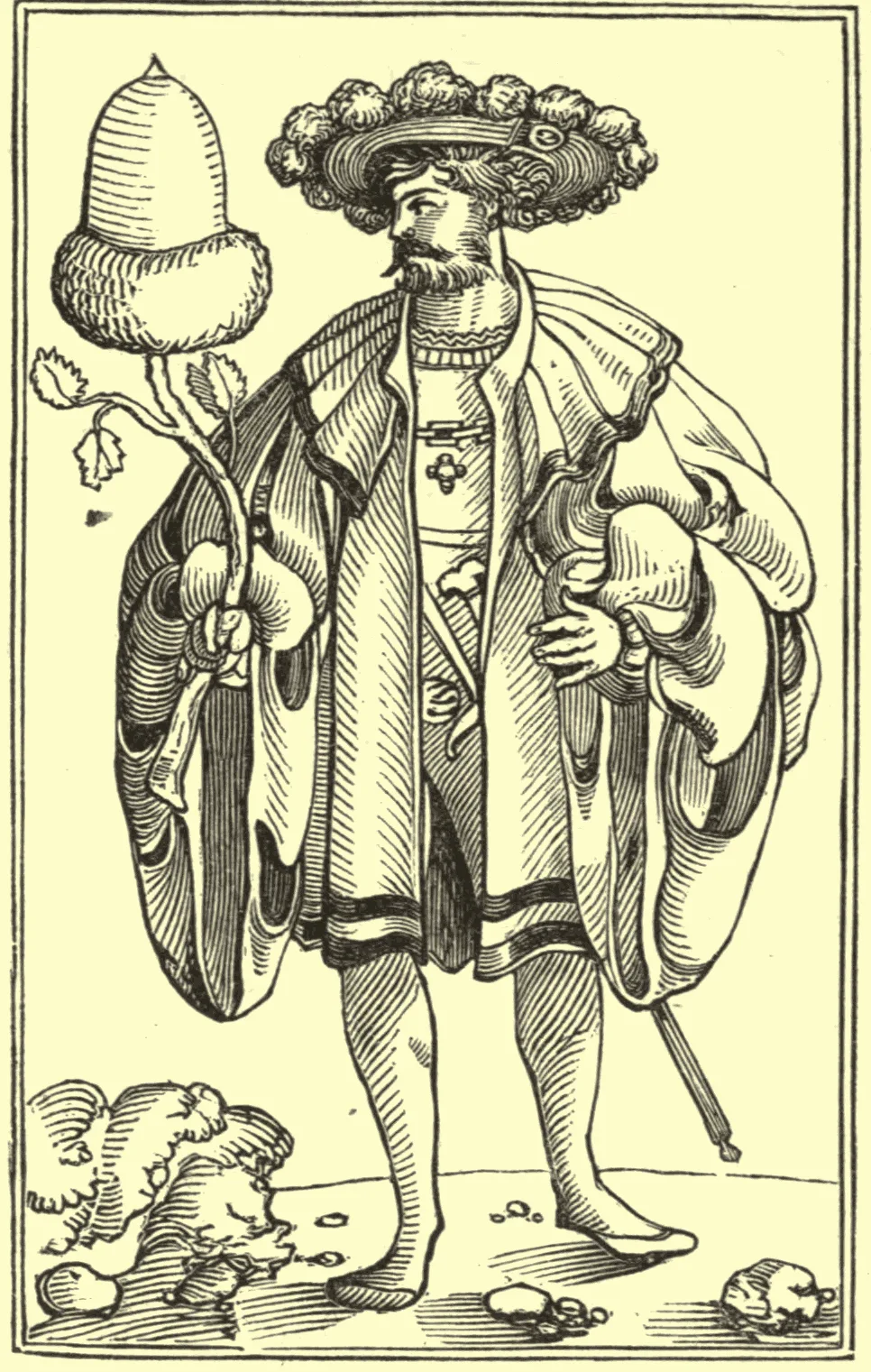
The Ober of Acorns from a German pack of 1511, holding an acorn branch, as Chatto reproduced it in 1848.
Credit and reuse terms
"History of Playing Cards (1848) 36" by F. W. Fairholt and George Vasey, in W. A. Chatto, Facts and Speculations on the Origin and History of Playing Cards (1848) — https://commons.wikimedia.org/wiki/File:History_of_Playing_Cards_(1848)_36.png — Public domain (plate in W. A. Chatto, Facts and Speculations on the Origin and History of Playing Cards, London, 1848, p. 236, after a German pack of 1511; the preface names F. W. Fairholt (died 1866) as the copyist and George Vasey, already engraving in 1848, as the wood engraver, so a death after 1955 would mean a life of more than 120 years; published 1848; the scan is a faithful reproduction of the printed page); changes: cropped to the card's printed border, removing book text above and below

Ober of Acorns, 1511, maker not given. Bibliothèque du Roi, Paris (as of 1848), no number given.
The IPCS sheet for the Saxon pattern gives that pattern 36 cards at first and, after the spread of Skat, usually 32: Daus, King, Ober and Unter, then 10 to 7 or 10 to 6. The Daus stands where the ace would be. A writer cited as M. Merlin in Willshire's 1876 catalog wrote that in such packs "the ace has been displaced by the two."
Roses and shields in Switzerland
Swiss packs share the bells and acorns of the German ones and have roses and shields for their other two suits. IPCS pattern sheet 85 says the first distinct pattern with these signs seems to have come from Basel around 1530, and gives the pack as 36 cards: Deuce, King, Ober, Under and 10 to 6, the ten drawn as a banner carrying the suit sign. An older 48-card pack without aces was still made in small quantities for the game of Kaisern as of the sheet's 2007 edition.
Stop on the top row of the Ravensburg cards below. The deuce of bells carries a lettered panel with the maker's name, KUTTER, the deuce of shields another with his town, spelled RAVENSPURG, and the third card is a ten drawn as a banner.
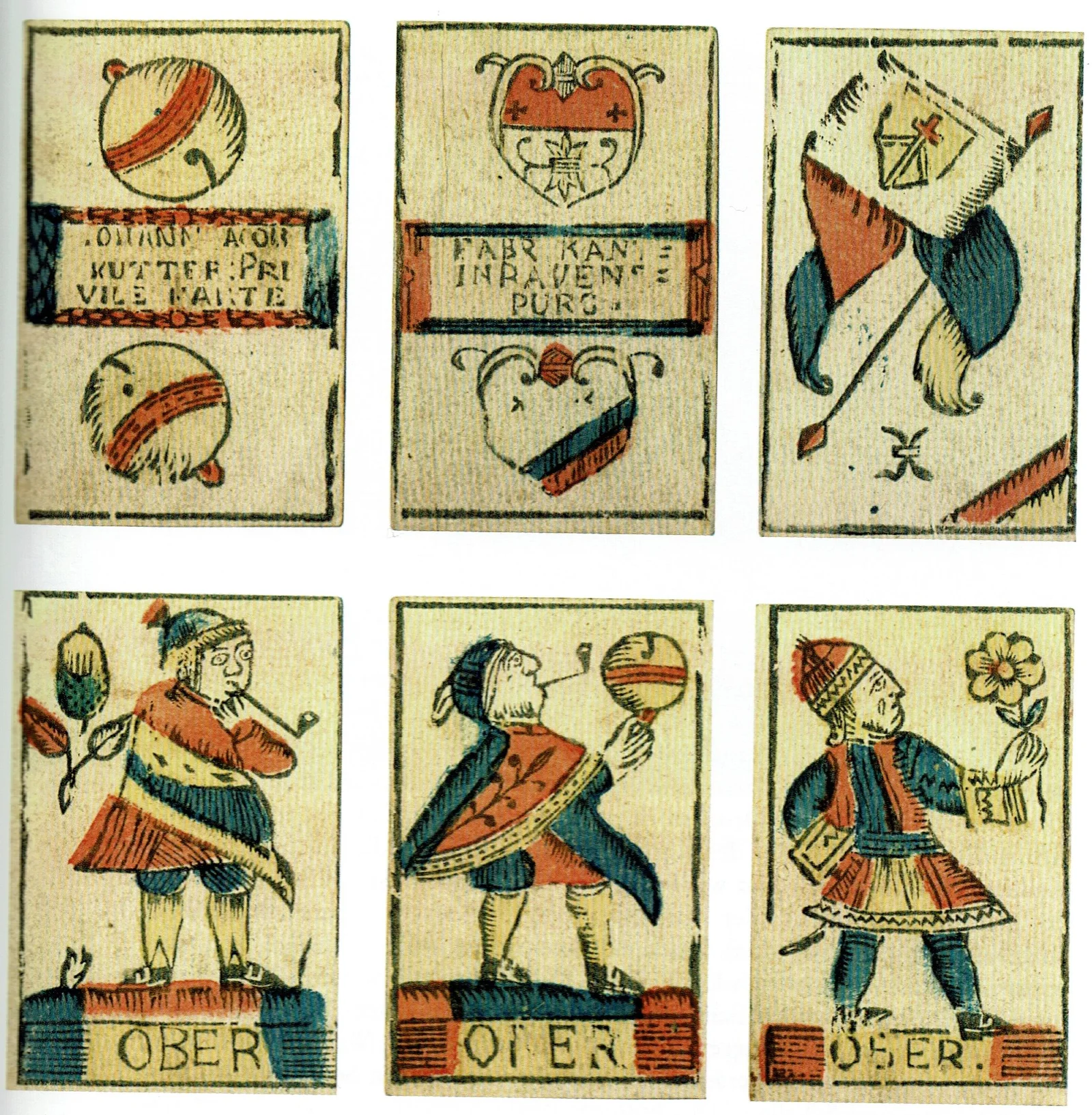
Six Swiss-suited cards by Johann Jacob Kutter of Ravensburg, around 1805: deuces of bells and shields, a banner ten, and three figures labeled OBER holding an acorn, a bell and a rose.
Credit and reuse terms
"Kutter jass karten" by Johann Jacob Kutter — https://commons.wikimedia.org/wiki/File:Kutter_jass_karten.jpg — Public domain (Jass cards made by Johann Jacob Kutter (1782–1815) of Ravensburg around 1805, as Maren Hyneck dates and credits them (Ulm und Oberschwaben 60, 2017, pp. 82–83); published before 1930 and the maker died in 1815; the image is a faithful reproduction of the flat printed cards)

Swiss-suited Jass cards, c. 1805, Johann Jacob Kutter, Ravensburg. Museen der Stadt Kempten, no number given.
From Rouen to the English pattern
The French suits were built for speed. Decker writes that the four flat silhouettes, printed in black and red only, could be made cheaply with ordinary stencils instead of carved blocks, which gave French cardmakers an advantage over the rest. Rouen was already exporting cards to the British Isles in 1480, and London cardmakers emerged only at the very end of the 16th century, according to IPCS pattern sheet 48.
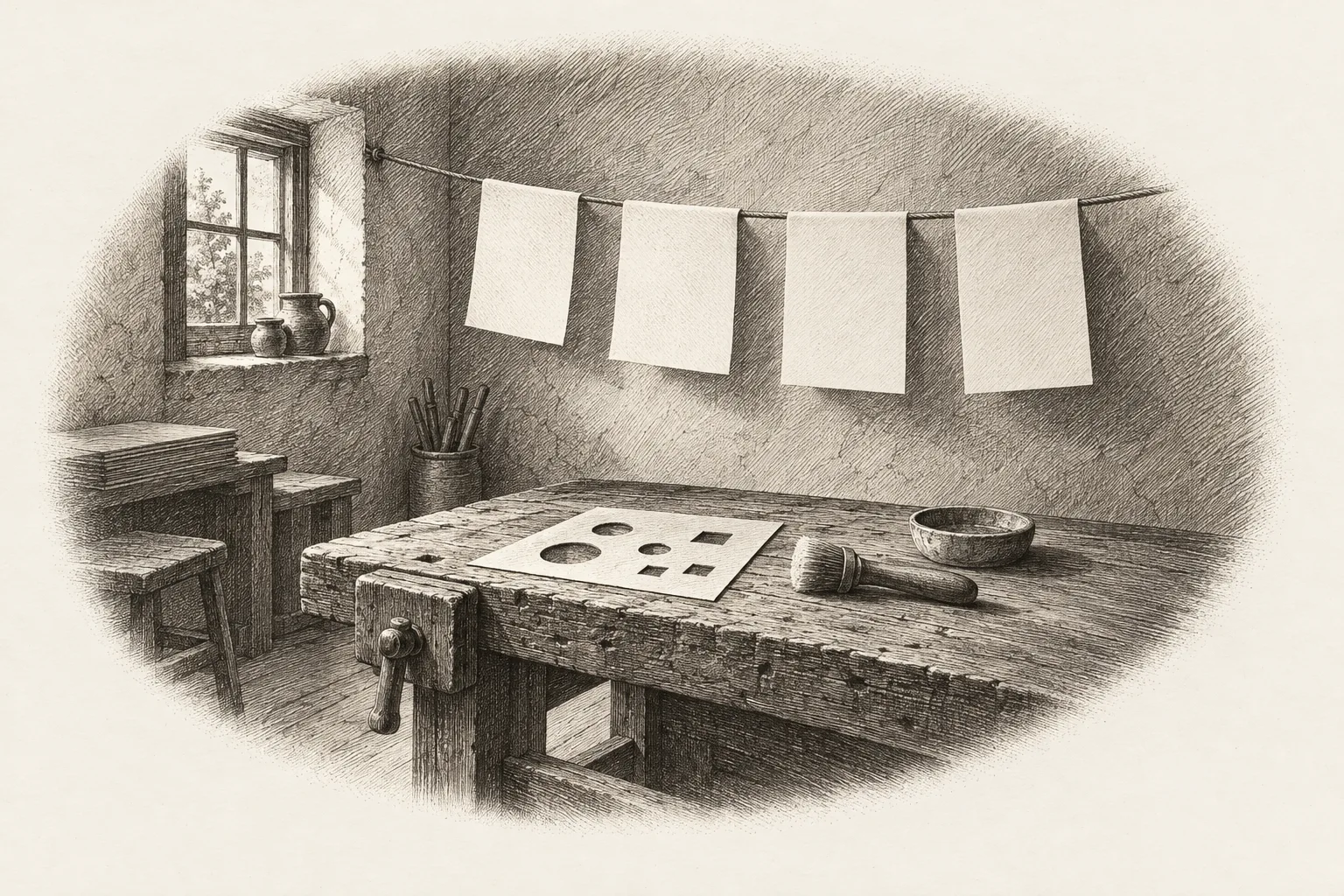
A workbench with a cut stencil and a brush, and blank sheets hung on a cord. Decker writes that the French suits' flat silhouettes could be made cheaply with ordinary stencils.
Illustration: Banners & Banknotes. Generated schematic illustration — not a photograph or historical record. © Banners & Banknotes, all rights reserved.
That sheet names the earliest evidence of the English pattern: cards made by Valery F., identified as Valery Faucil and dated before 1516, in the British Museum. Chatto found four such jacks in the binding of an old book in 1841. He dated them no earlier than 1480. Willshire's 1876 catalog of the museum's cards lists them, with question marks, as last quarter of the 15th century and Paris.
The IPCS reads "Valery F." as the maker's name. Chatto took Valery for the name of the jack himself.
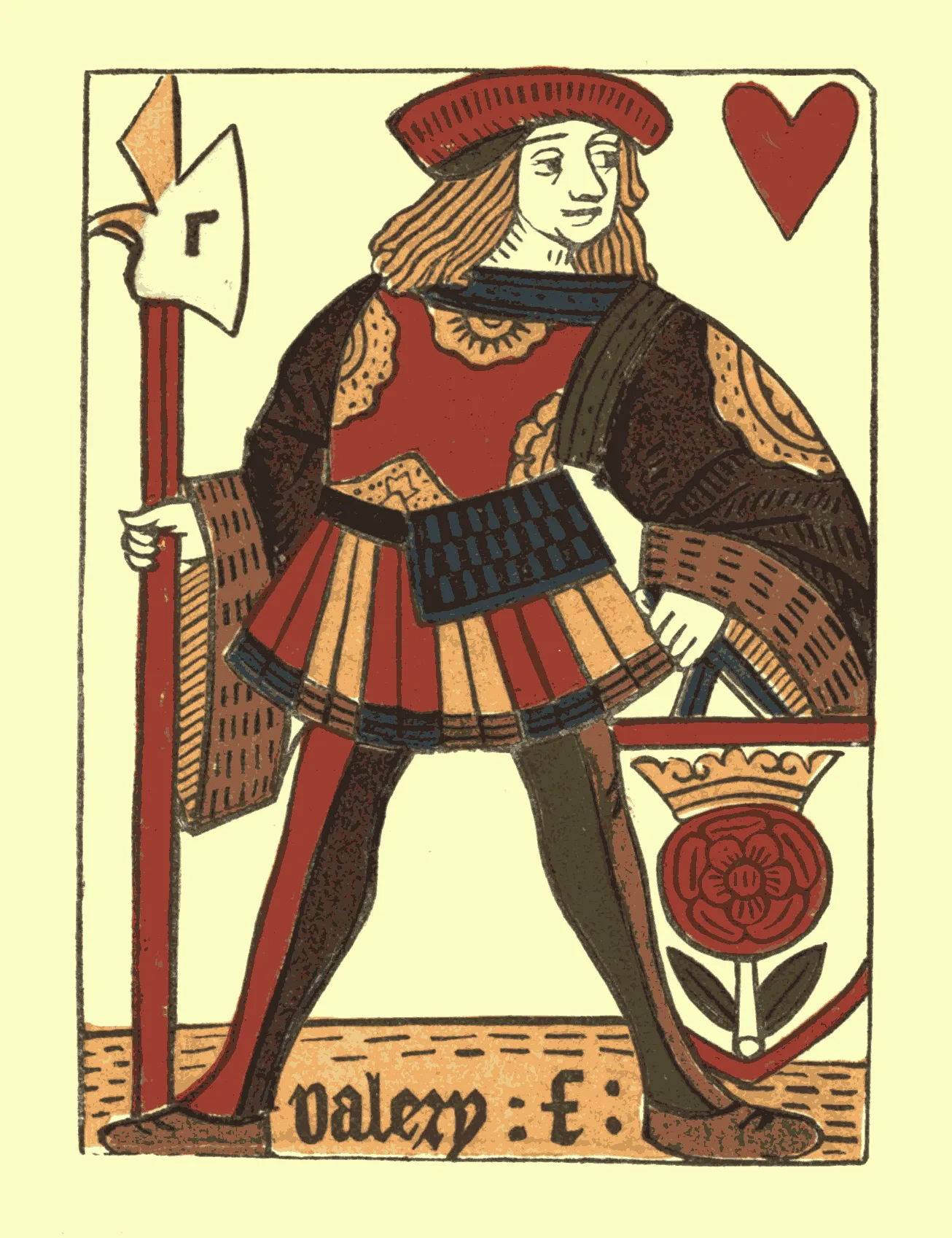
The jack of hearts inscribed "Valery: f" from the four jacks Chatto found in 1841, in the colored copy printed in his book of 1848. He holds a shield with a red rose.
Credit and reuse terms
"History of Playing Cards (1848) 23" by F. W. Fairholt and George Vasey, in W. A. Chatto, Facts and Speculations on the Origin and History of Playing Cards (1848) — https://commons.wikimedia.org/wiki/File:History_of_Playing_Cards_(1848)_23.png — Public domain (colored plate in W. A. Chatto, Facts and Speculations on the Origin and History of Playing Cards, London, 1848, facing p. 214, after a jack of the late 15th or early 16th century; the preface names F. W. Fairholt (died 1866) as the copyist and George Vasey, already engraving in 1848, as the wood engraver, so a death after 1955 would mean a life of more than 120 years; published 1848; the scan is a faithful reproduction of the printed page)

Jack of hearts, late 15th or early 16th century, inscribed Valery: f. British Museum, Willshire F. 42.
The English pattern bears no names on its courts, while the Paris pattern names all of them except the jack of clubs, from David and Judith to Hector. IPCS pattern sheet 48 still finds the two stylistically very close, and it records the English courts going double-ended by about 1860.
Suit system, pattern, lineage
The IPCS ties a standard pattern to a place, by custom or by law, or to a maker's design, and says these regional patterns took recognizable shape in the 17th, 18th or, most often, the 19th century. A pattern lives inside a suit system but has its own line of descent. The English and Paris patterns share the French suits, yet the IPCS derives the English pattern from Rouen designs and the official French pattern of 1813 from the old Paris pattern.
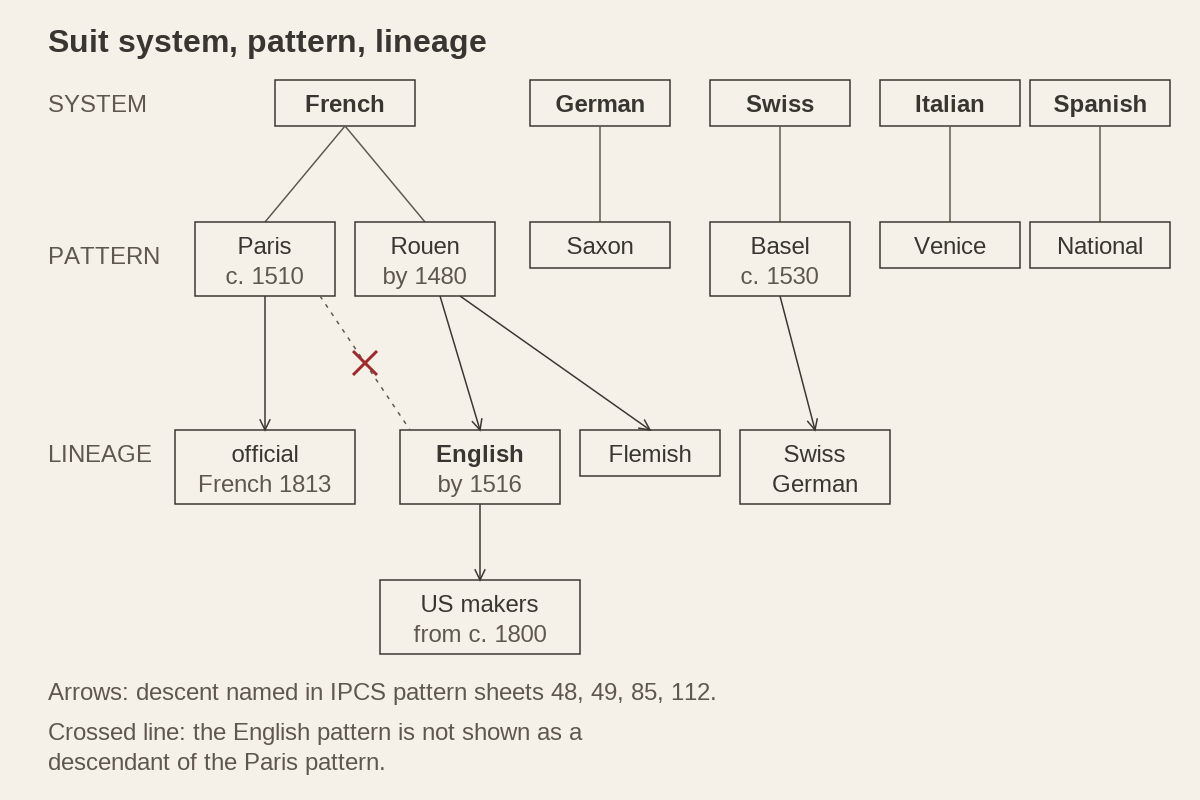
Slide the drawing sideways to read every label, or open it at full size.
Suit systems, patterns and lines of descent named in IPCS pattern sheets. The crossed line marks what the English pattern is not: a descendant of the Paris pattern.
Credit and reuse terms
"Suit system, pattern and lineage kept apart" by Banners & Banknotes, https://bannersandbanknotes.com/playing-cards/suit-systems/, licensed under CC BY 4.0 (https://creativecommons.org/licenses/by/4.0/)
Rouen also made an export pattern apparently designed for what are now Belgium and the Netherlands, the Flanders or Rouen I pattern, according to IPCS pattern sheet 49. In Switzerland, sheet 85 treats the small Basel cards of about 1530 as the precursor of the Swiss German pattern.
How many cards are in each pack?
Pack sizes differ more than the suits do. By this page's count, made card by card from the ranks each source lists, the ten standard packs in the CSV run from 32 to 78 cards, and every total matches the figure its source gives. The French 52 and the Venetian 52 share the same arithmetic, four suits of 13, with different court cards.
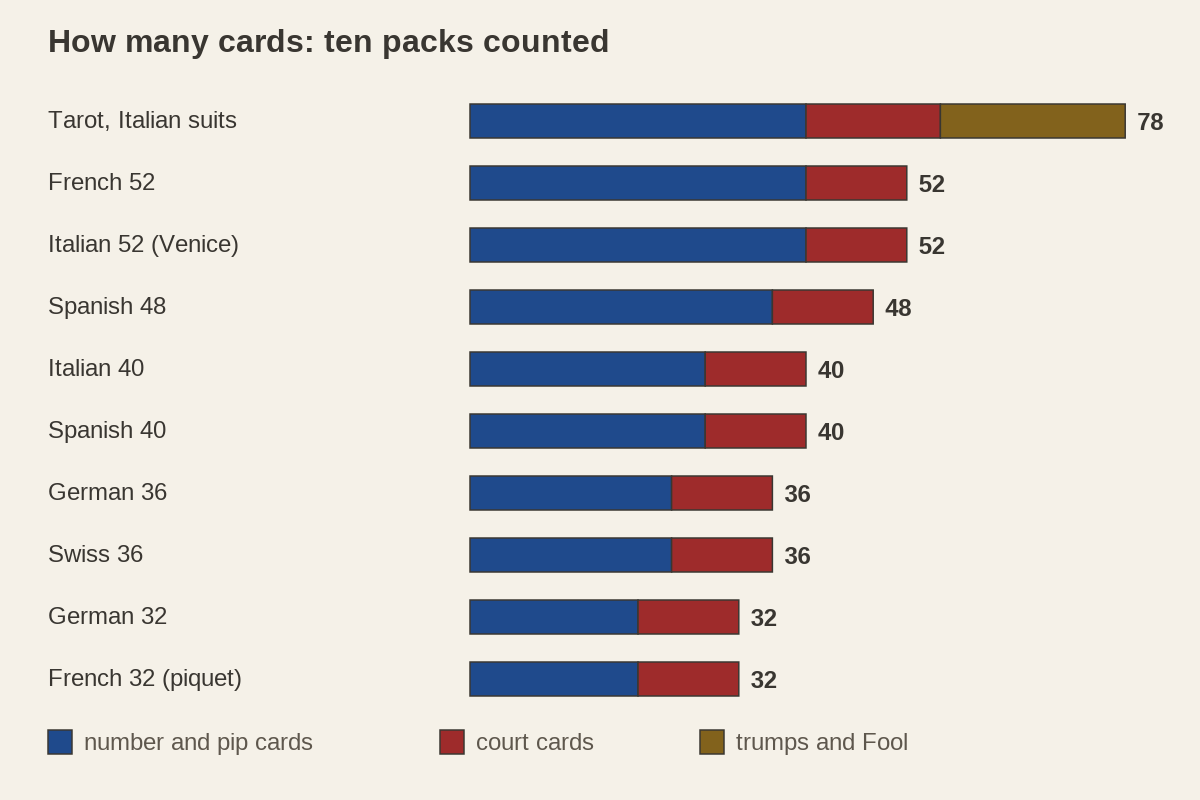
Slide the drawing sideways to read every label, or open it at full size.
Ten packs counted card by card: number cards in blue, courts in red, the tarot's trumps and Fool in gold. Totals match the sources; data in the CSV.
Credit and reuse terms
"How many cards: ten packs counted" by Banners & Banknotes, https://bannersandbanknotes.com/playing-cards/suit-systems/, licensed under CC BY 4.0 (https://creativecommons.org/licenses/by/4.0/)
Most of the differences are cuts at the low end. The German 32-card pack drops the sixes of the 36-card pack, the Spanish 40 drops the eights and nines of the 48, and the French piquet pack keeps only the ace and 10 to 7 below its courts. The tarot is the outlier, with four courts and ten number cards in each suit, then 21 trumps and the Fool, 78 cards in all. Download the pack counts (CSV) provenance and license of suit-systems-decks.csv
Did the four suits stand for four classes?
Writers have read the suits as the orders of society, but every reading this page can date comes centuries after the suits. For the Italian and Spanish suits, the earliest record found for this page is Samuel Weller Singer's Researches into the History of Playing Cards of 1816, which reports that they "have been said to signify" the nobility (swords), the clergy (cups), the citizens (coins) and the peasantry (batons).
Singer gives a French version too, with pique for the nobles, cœur for the clergy, trèfle for husbandmen and carreau for vassals. He also quotes an older report, Gough's account in the Archaeologia of 1787, that Dr. Stukeley read the German bells, hearts, leaves and acorns as nobility, ecclesiastics, gentry and peasants.
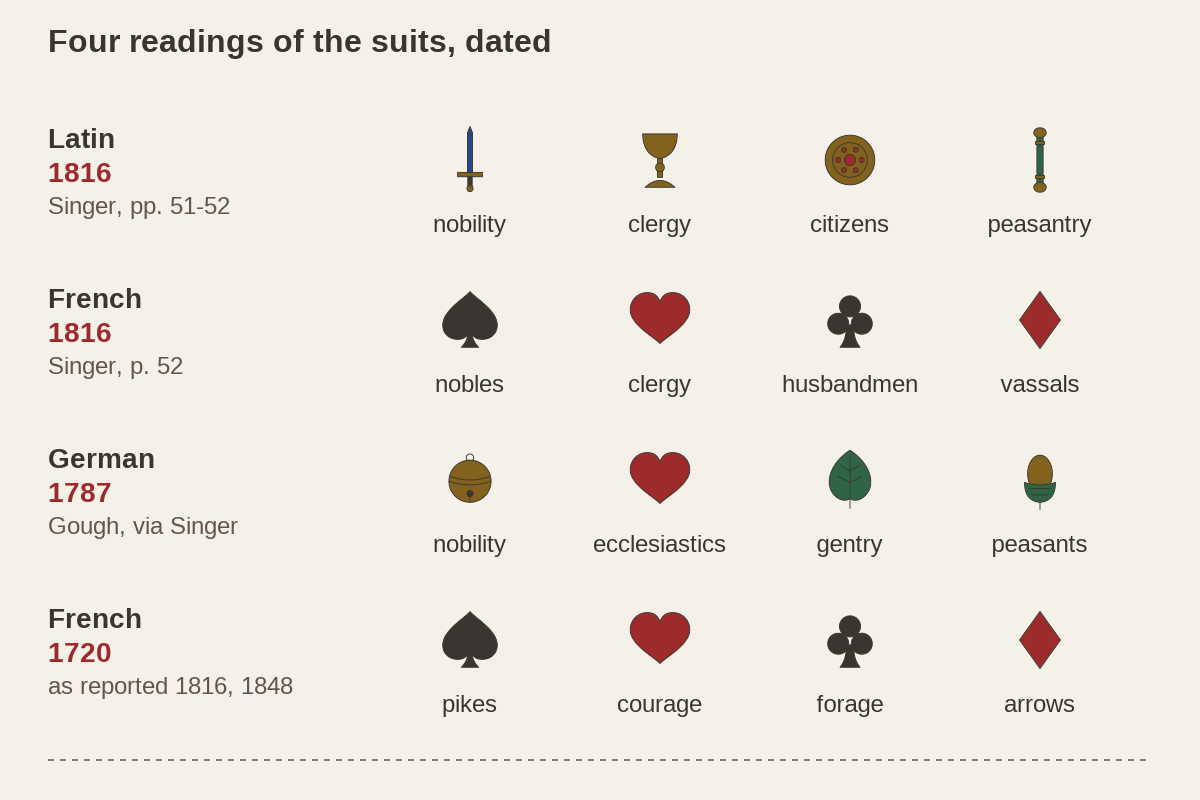
Slide the drawing sideways to read every label, or open it at full size.
Four readings of the suits with the earliest year this page can document: two from Singer's 1816 book, one from Gough's 1787 account, one from a 1720 dissertation.
Credit and reuse terms
"Four readings of the suits, dated" by Banners & Banknotes, https://bannersandbanknotes.com/playing-cards/suit-systems/, licensed under CC BY 4.0 (https://creativecommons.org/licenses/by/4.0/)
A dissertation printed at Trévoux in 1720 read the French suits another way, as the needs of war: forage for the trèfle, arms for the pique and carreau, courage for the cœur. Singer and Chatto both report it. Chatto names the author as Père Daniel and says his readings could be shown to be "the mere seethings of his own working imagination."
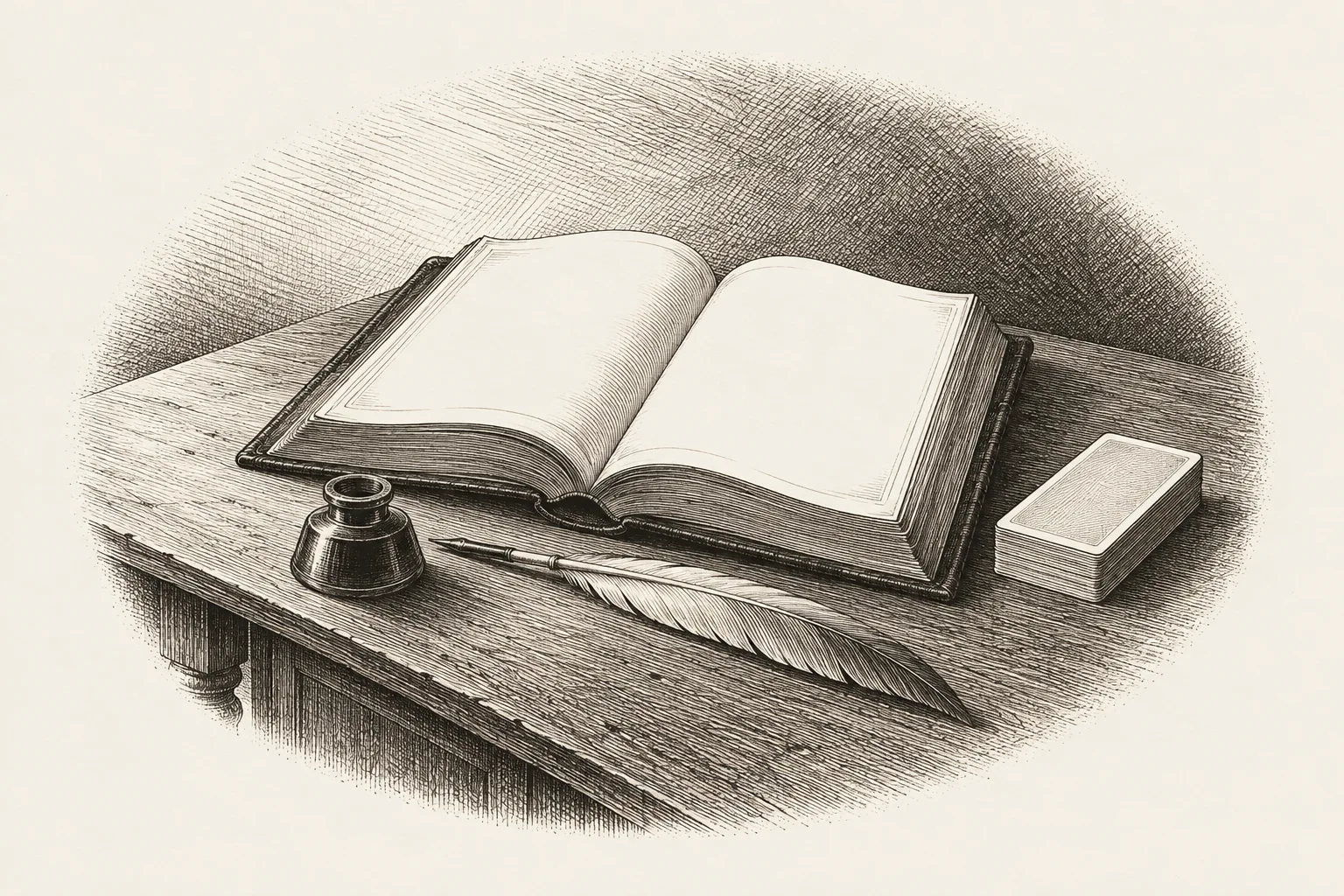
An open old book, a stack of cards and a quill. Every reading of the suits dated on this page, from 1720, 1787 and 1816, comes centuries after the suits themselves.
Illustration: Banners & Banknotes. Generated schematic illustration — not a photograph or historical record. © Banners & Banknotes, all rights reserved.
Shrink strip
At 16 pixels wide the twenty signs are specks of color. At 160 pixels the bells have lost their loops and sit beside the coins as gold disks, and in the blurred copy the black pike and trefoil turn into similar blots.
Shown at its drawn size. On a narrow screen, scroll sideways to see the whole strip.
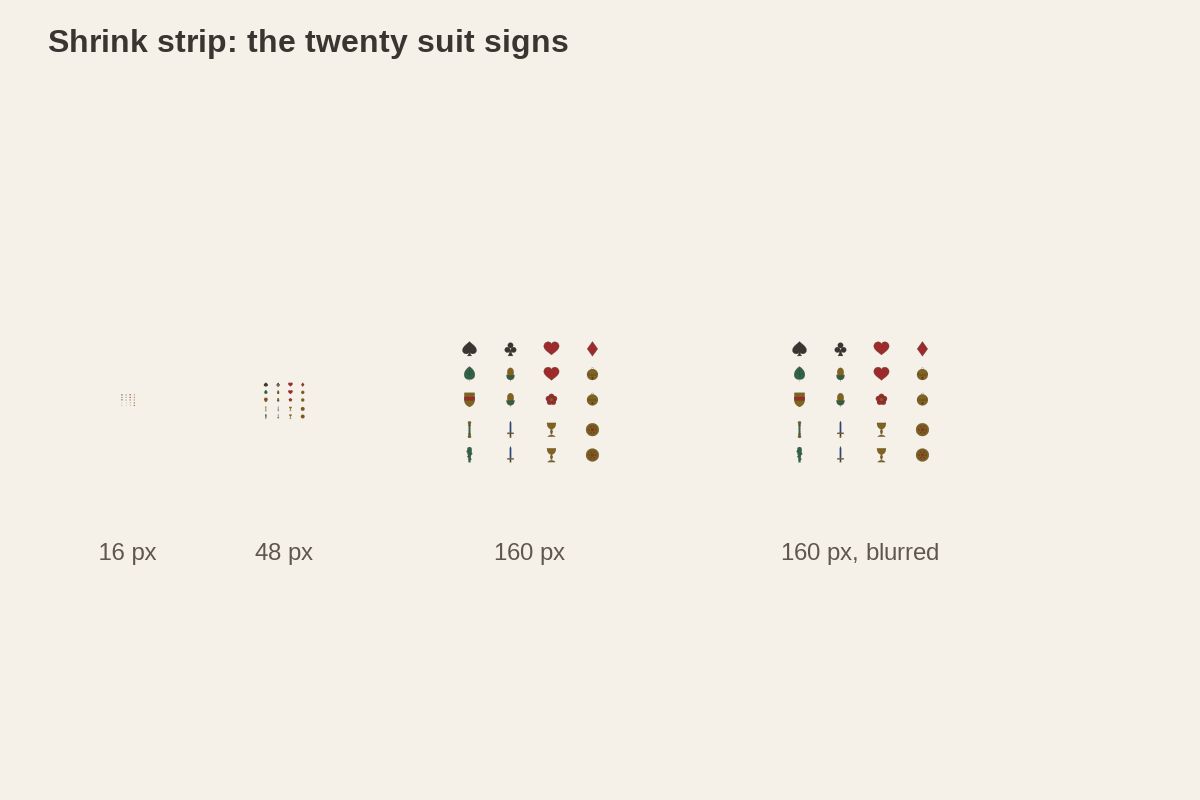
The twenty signs of the opening figure at 16, 48 and 160 pixels wide, plus a blurred copy. Reduction preview, not a legibility test.
Credit and reuse terms
"Shrink strip: Europe's twenty suit signs at 16, 48 and 160 pixels" by Banners & Banknotes, https://bannersandbanknotes.com/playing-cards/suit-systems/, licensed under CC BY 4.0 (https://creativecommons.org/licenses/by/4.0/). Derived from "Europe's five suit systems, four signs each".
Meaning ledger
| Meaning | Earliest we can document | Year | Label | Notes |
|---|---|---|---|---|
| Swords stand for the nobility, cups for the clergy, coins for the citizens and batons for the peasantry | Singer, Researches into the History of Playing Cards, pp. 51–52 ("have been said to signify") | 1816 | [first recorded later] | Cards are first mentioned in Europe in 1371 (IPCS). Singer names no earlier author; Chatto (1848) repeats the reading as a supposition. |
| Pique stands for the nobles, cœur for the clergy, trèfle for husbandmen and carreau for vassals | Singer, Researches, p. 52 | 1816 | [first recorded later] | French suits date from about 1470 (Decker, IPCS). Singer (p. 273) also cites Sir John Harington's Apologie for Poetrie on a London comedy, "the play of the cards," in which four knaves rob soldiers, scholars, merchants and husbandmen, and takes it as a sign that the idea of the suits as orders of society was already current in England; the passage names no suits. In a note to p. 52, Singer adds that carreau "has also been explained" as paving stones "alluding to the lowest order of the community," citing Menestrier's Bibliothèque curieuse without a page; Menestrier was not read for this page. |
| German bells stand for the nobility, hearts for ecclesiastics, leaves for the gentry and acorns for peasants | Gough's account of Dr. Stukeley's reading in Archaeologia, vol. 8 (1787), as quoted by Singer, Researches, pp. 172–174 | 1787 | [first recorded later] | Gough, as Singer quotes him, says Stukeley showed drawings of the pack to the Society of Antiquaries on November 9, 1763; Stukeley's paper and Gough's volume were not read for this page. Singer (pp. 52–53) sets out a similar German reading and then doubts that the inventors of cards intended any such allegory. |
| The French suits stand for the needs of war: trèfle forage, pique and carreau arms, cœur courage | Dissertation of 1720 in the Mémoires pour l'histoire des sciences (Trévoux), as reported by Singer (1816, p. 51) and Chatto (1848, pp. 4, 209–210) | 1720 | [first recorded later] | Chatto names Père Daniel as author and rejects the reading as imagination; that is his judgment, not a document showing the reading was invented. |
How each label is decided: The After-Meaning, the four labels.
Sources
- Samuel Weller Singer, Researches into the History of Playing Cards; with Illustrations of the Origin of Printing and Engraving on Wood (London: Robert Triphook, 1816), pp. 51–53, 172–174 and 273. archive.org Read: pages 51–53, 172–174 and 273, title page
- William Andrew Chatto, Facts and Speculations on the Origin and History of Playing Cards (London: John Russell Smith, 1848). archive.org Read: full text; preface; pages 4, 22, 47 (note), 204–210, 213–216, 227–231, 236 and 334
- William Hughes Willshire, A Descriptive Catalogue of Playing and Other Cards in the British Museum (London: British Museum, 1876), p. 49 and pp. 110–112 (no. F. 42). archive.org Read: pages 49 and 110–112
- Otto Neurath, International Picture Language: The First Rules of Isotype (London: Kegan Paul, Trench, Trubner, 1936), pp. 72–73. archive.org Read: pages 72–73
- Maren Hyneck, "Spielkarten und spielende Gesellschaft in Ravensburg und Schwaben," Ulm und Oberschwaben 60 (2017), pp. 52–91, doi:10.53458/uo.v60i.6845. doi.org Read: pages 82–83
- "Naipes del Hospital General de Pamplona," Wikimedia Commons file page (cards dated 1830; source given as Archivo Municipal de Pamplona). commons.wikimedia.org Read: file page
- The Metropolitan Museum of Art, The Cloisters Playing Cards, South Netherlandish, about 1475–80, accession 1983.515.1–.52 (catalogue record as given on the Wikimedia Commons file page "The Cloisters Playing Cards MET DP354609"). commons.wikimedia.org Read: catalogue record (file page and file titles)
- International Playing-Card Society, "An introduction." i-p-c-s.org Read: full text
- Ron Decker, "Playing-card History," International Playing-Card Society FAQ (2007), pages "Introduction into Europe," "German cards," "Tarocco," "French cards" and "Who are the court figures?" i-p-c-s.org Read: pages 3–6 and 12 of the series
- International Playing-Card Society, Pattern Sheet 48, "English pattern" (1994; web page updated 2010). i-p-c-s.org Read: full text
- International Playing-Card Society, "Why is the jack called a jack?" i-p-c-s.org Read: full text
- International Playing-Card Society, Pattern Sheet 112, "Paris pattern" (2018). i-p-c-s.org Read: full text
- International Playing-Card Society, Pattern Sheet 49, "Flanders or Flemish pattern" (1994; web page updated 2010). i-p-c-s.org Read: full text
- International Playing-Card Society, Pattern Sheet 85, "Swiss German pattern" (2007; web page updated 2011). i-p-c-s.org Read: full text
- International Playing-Card Society, Pattern Sheet 52, "Saxon pattern" (1995; web page updated 2010). i-p-c-s.org Read: full text
- International Playing-Card Society, Pattern Sheet 20, "Spanish National pattern" (1979; web page updated 2010). i-p-c-s.org Read: full text
- International Playing-Card Society, Pattern Sheet 35, "Venice or Venetian pattern" (1993; web page updated 2010). i-p-c-s.org Read: full text
- International Playing-Card Society, "Joker." i-p-c-s.org Read: full text


Counter-sign
Counter-sign: The Cloisters Playing Cards, a South Netherlandish pack of about 1475–80 in the Metropolitan Museum of Art (1983.515.1–.52). Its four suits are collars, horns, nooses and tethers, and none of them belongs to the five systems on this page.
Cite this page
Banners & Banknotes. “Hearts, Bells, Coins, Acorns: Europe's Five Suit Systems.” Published 14 October 2026. https://bannersandbanknotes.com/playing-cards/suit-systems/. Accessed [date you read it].
Corrections
No corrections yet.