System explainer · No. 0008
Euchre: Two Jacks Outrank the Ace of Trumps
Blazon card
- Field
- A short pack in the four French suits, hearts, diamonds, clubs and spades: 32 cards, seven to ace, in the 1862 and 1887 rule books; 28 or 24 cards also allowed by the 1943 Official RulesThe Law and Practice of the Game of Euchre (1862), p. 32; Keller 1887, pp. 12, 14; USPCC 1943, p. 105
- Charge
- Two jacks of one color set above the ace of the trump suit: the right bower, the jack of trumps, and the left bower, the other jack of that color, which counts as a trump for the dealThe Law and Practice of the Game of Euchre (1862), p. 82; Keller 1887, p. 14
- Tincture
- Hearts and diamonds red, clubs and spades black; the left bower always shares the trump suit's color. Colors in this page's figures are site tinctures (tincture, not official)Keller 1887, p. 14
- Difference
- From whist: the same French suits, but a pack cut to 32 or fewer cards, five cards a hand and the trump jacks promoted above the ace; Railroad Euchre adds a joker above both bowersThe Law and Practice of the Game of Euchre (1862), pp. 29-30, 32; Keller 1887, p. 47
- Issued by
- No single issuer: the game spread through play, and rule books and clubs set down its laws, from a Philadelphia rule book of 1862 to the laws the Somerset Club of Boston adopted in 1888The Law and Practice of the Game of Euchre (1862); Leeds and Dwight 1888, preface
- First documented
- Earliest we can document: uker taught on a steamboat from Louisville to New Orleans, in Joe Cowell's memoir of 1844, set in 1829; the left bower in print in the same bookCowell 1844, pp. 91, 94, 101
- Spec source
- Rule books: The Law and Practice of the Game of Euchre (Philadelphia, 1862); Keller, The Game of Euchre (New York, 1887); Official Rules of Card Games (USPCC, 1943 printing), pp. 105-107; pack counts in euchre-decks.csv (this page)Rule books as listed; Banners & Banknotes
Blazon card as CSV euchre-blazon.csvprovenance and license of euchre-blazon.csv
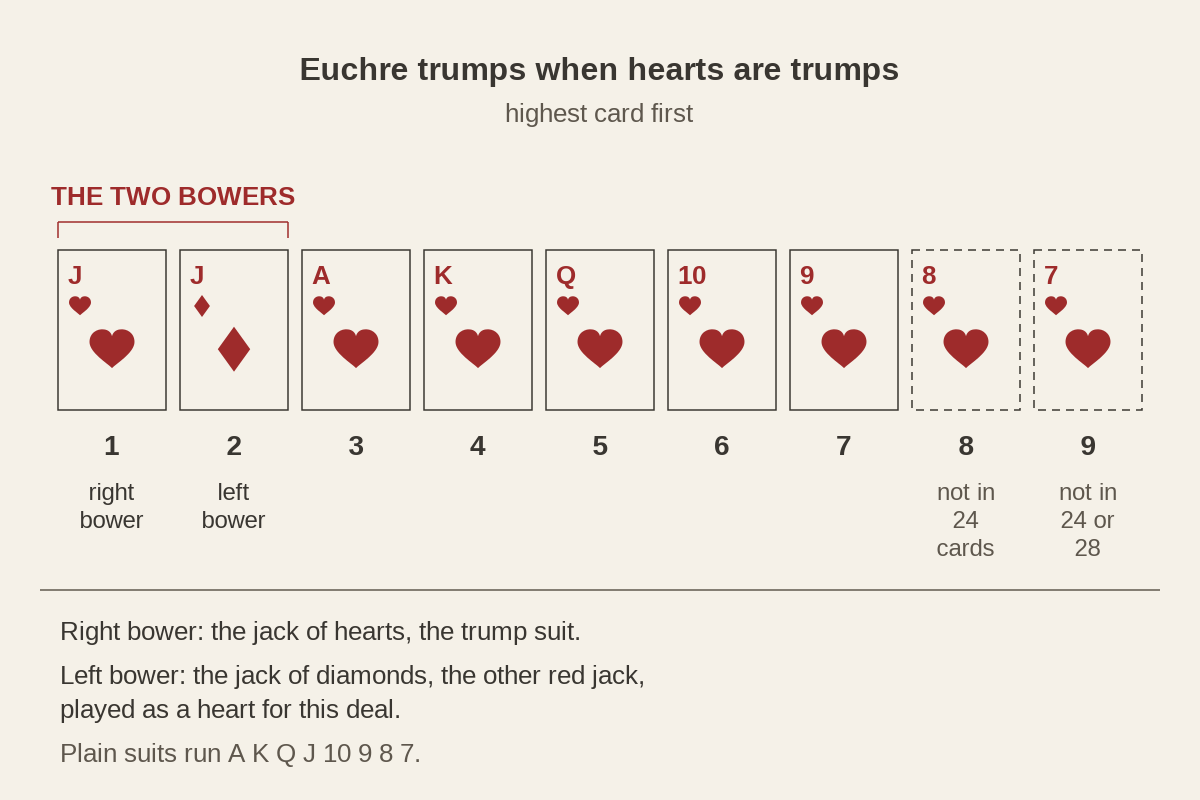
Slide the drawing sideways to read every label, or open it at full size.
Euchre's trump order when hearts are trumps, highest first: the two red jacks above the ace. The dashed seven is absent from 28-card packs, and both dashed cards from 24-card packs (tincture, not official).
Credit and reuse terms
"Euchre trump order when hearts are trumps" by Banners & Banknotes, https://bannersandbanknotes.com/playing-cards/euchre/, licensed under CC BY 4.0 (https://creativecommons.org/licenses/by/4.0/)
TL;DR. Euchre is a game for four players in two partnerships, played with a short pack: each player gets five cards, one suit becomes trumps, and the side that chose trumps must take three of the five tricks. Its rules lift two jacks above the ace of trumps, the jack of the trump suit and the other jack of the same color, and an 1899 dictionary of Alsatian dialects describes Jucker, a card game in which the Bauer, the jack, counts for more than the ace.
In this file9 sections
In euchre, one card changes suit for a whole deal: the left bower, a jack. Look at the jack of diamonds when hearts are trumps. Its corner still shows a J and a red diamond, yet for that deal it is the second-highest heart, below the jack of hearts and above the ace. In the stranger's read, shapes and positions only, the object here is nine cards of one color from a 32-card pack: two jacks in chief, heraldry's term for the top of a shield, one marked with a heart and one with a diamond, over an ace, king, queen, ten, nine, eight and seven of hearts.
The two jacks have their own names: the jack of trumps is the right bower, and the other jack of the same color is the left bower. A rule book of 1862 reports that the word bower comes from Bauer, the German name for the jack.
What cards are in a euchre deck?
Euchre uses a short pack. The rule book of 1862, The Law and Practice of the Game of Euchre, signed only "A Professor," removes the sixes, fives, fours, threes and twos from a whist pack and plays with the 32 cards that remain, seven through ace in each suit. John W. Keller's The Game of Euchre (1887) and Foster's Complete Hoyle (1914) use the same 32.
Smaller packs appear in print by 1887: Keller describes a French Euchre in which "only twenty-four cards are used," the nines and up. The Official Rules of Card Games of the United States Playing Card Company, in its 1943 printing, allows 32, 28 or 24 cards and adds: "Joker is sometimes added."
Whatever the size, four players take five cards each, 20 in all, and the dealer turns the next card face up. By this page's count, that leaves 3 cards below the turned card in a 24-card pack, 7 in a 28-card pack and 11 in a 32-card pack. Download the pack counts (CSV) provenance and license of euchre-decks.csv
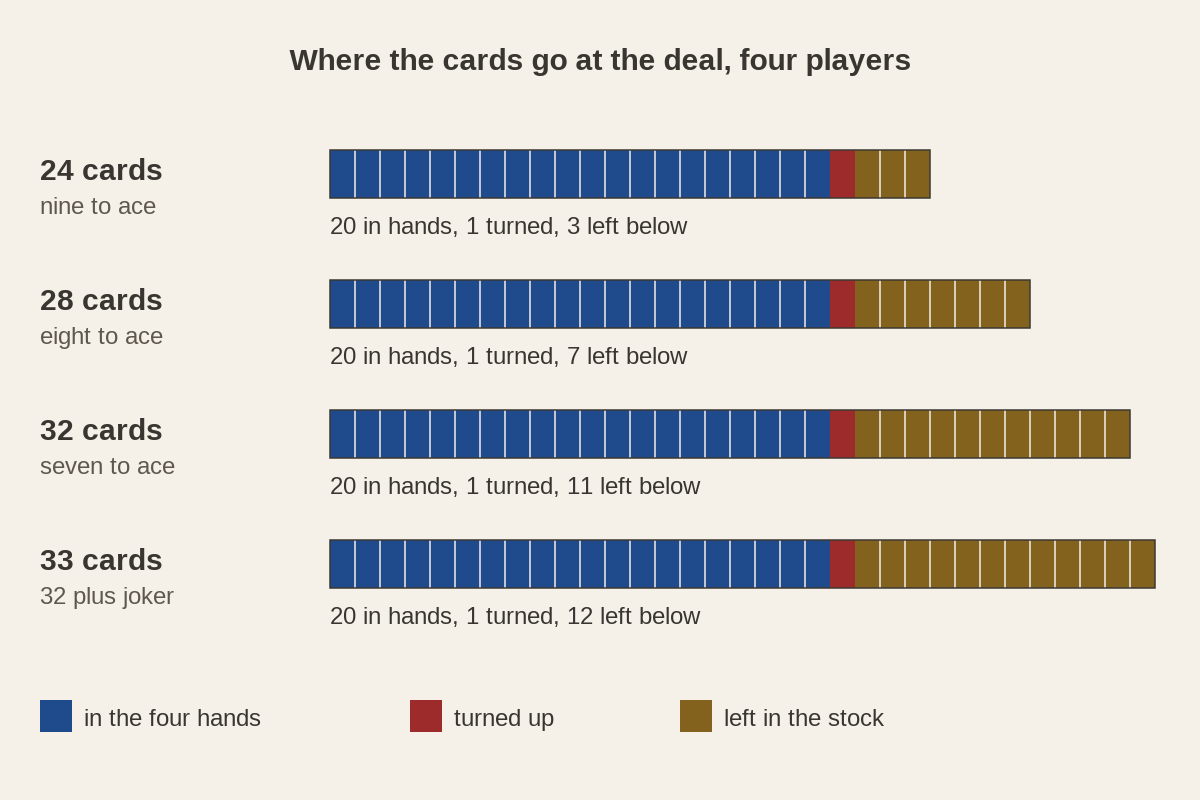
Slide the drawing sideways to read every label, or open it at full size.
Where the cards go at the deal in packs of 24, 28, 32 and 33 cards, counted by this page's script. The 33-card pack is the 32 plus a joker.
Credit and reuse terms
"Where the cards go at the deal: euchre packs of 24 to 33 cards" by Banners & Banknotes, https://bannersandbanknotes.com/playing-cards/euchre/, licensed under CC BY 4.0 (https://creativecommons.org/licenses/by/4.0/)
Why are the jacks the highest cards in euchre?
Two jacks rank above the ace of trumps because euchre's rules promote them; the rule books read for this page give no reason beyond that. In plain suits the cards run as at whist, from the ace down. In the trump suit, Keller's book of 1887 puts the jack of trumps first as "the best card in the game," called the right bower, and the other jack of the same color second, as "the second best card in the game," called the left bower.
Keller saw this change of rank as what makes the game: "As in all trick-making games, the invention of Euchre is achieved by a change in the ranking order of the cards," he wrote in 1887. He quoted a Dr. Pole on the result: in euchre "the knave is the best in trumps, the ace in other suits."
The 1862 author could find no model for it. He wrote that he could not trace "the least analogy or affinity" for the promotion of the knaves in any other card game, although Alsatian sources discussed below record one.
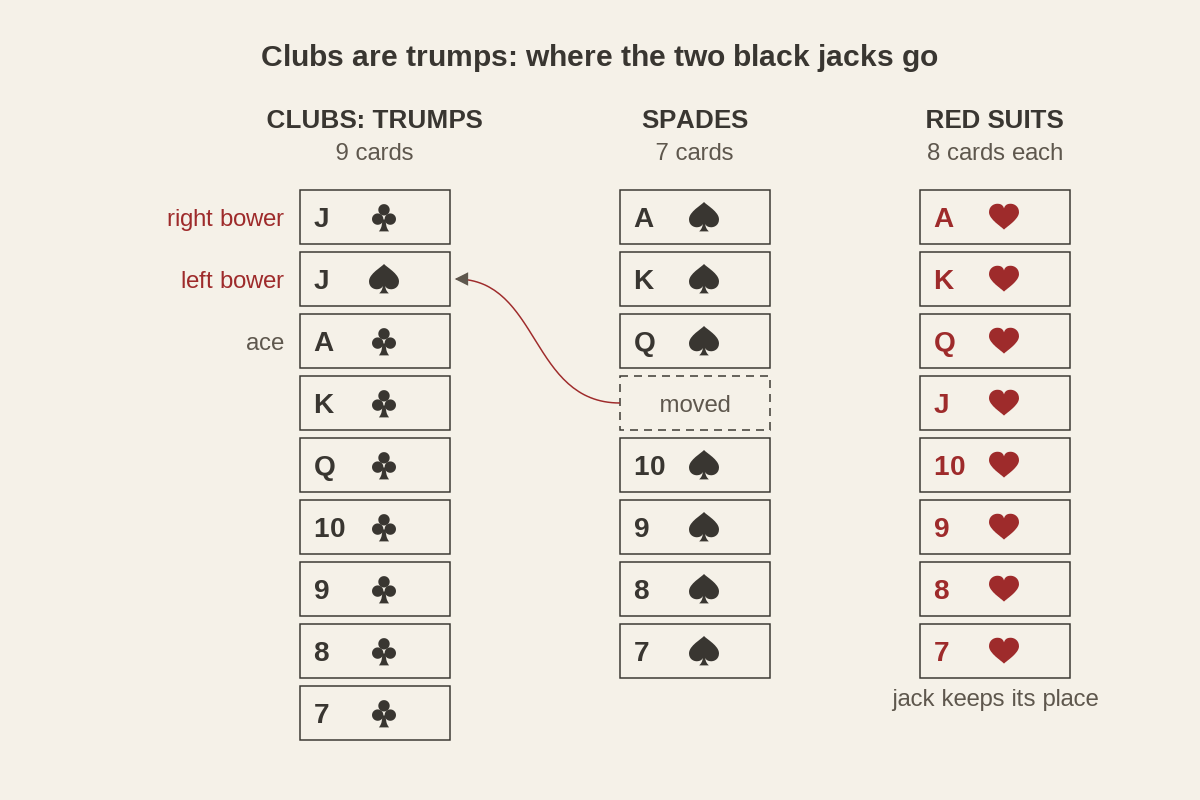
Slide the drawing sideways to read every label, or open it at full size.
With clubs as trumps in a 32-card pack, the jack of spades leaves its suit for second place in clubs, so clubs hold 9 cards and spades 7 (tincture, not official).
Credit and reuse terms
"Where the two black jacks go when clubs are trumps" by Banners & Banknotes, https://bannersandbanknotes.com/playing-cards/euchre/, licensed under CC BY 4.0 (https://creativecommons.org/licenses/by/4.0/)
Which jack is the left bower?
The left bower is the jack of the other suit with the trump suit's color. Hearts and diamonds lend each other their jacks, and so do clubs and spades. The 1862 glossary puts it in one line: "The Knave of the same color as the trump suit, which is the second best trump."
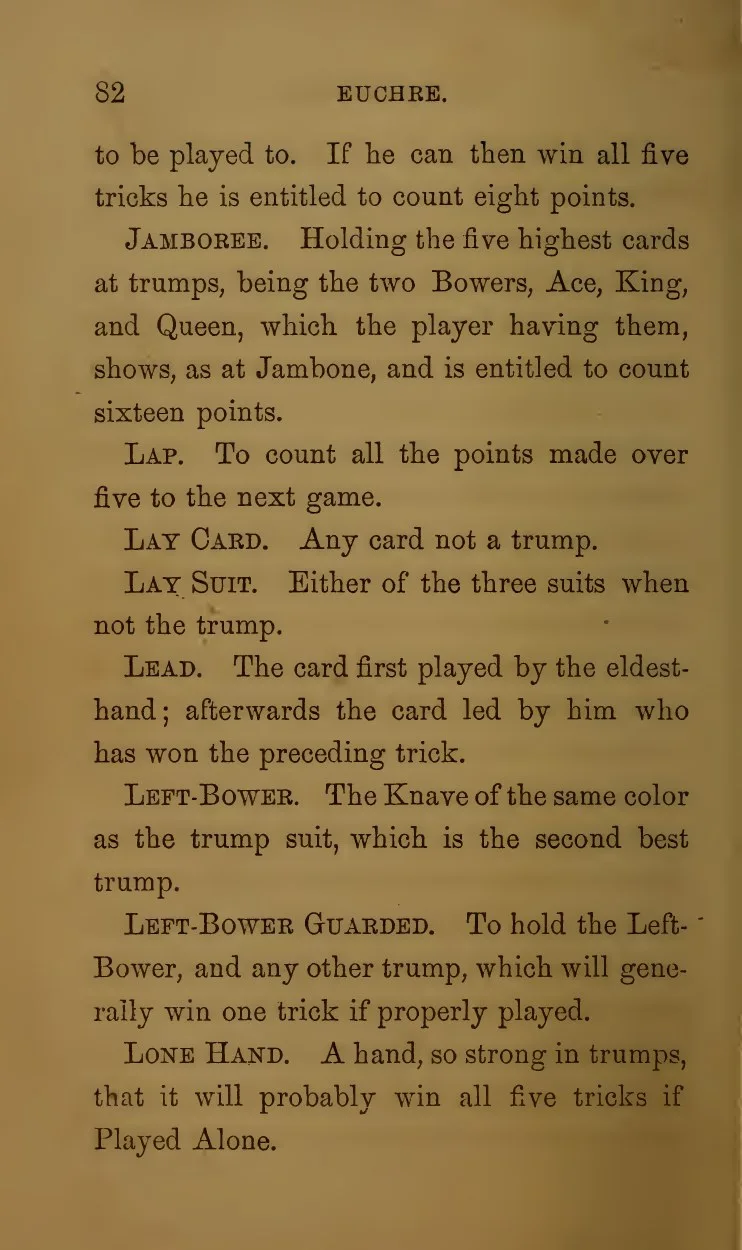
A glossary page of the 1862 rule book. The entry for the Left-Bower defines it as the knave of the trump suit's color and the second best trump.
Credit and reuse terms
"The law and practice of the games of euchre (IA lawpracticeofgam00meeh)" by Charles Henry Wharton Meehan (as "A Professor"), The Law and Practice of the Game of Euchre (Philadelphia: T. B. Peterson & Brothers, 1862) — https://commons.wikimedia.org/wiki/File:The_law_and_practice_of_the_games_of_euchre_(IA_lawpracticeofgam00meeh).pdf — Public domain (book published in Philadelphia in 1862 under the name "A Professor"; its author, Charles Henry Wharton Meehan, died in 1872; the scan is a faithful reproduction of the printed page); changes: printed page 82 (PDF page 70) extracted as a single page at 200 dpi
The Law and Practice of the Game of Euchre (page 82), 1862, T. B. Peterson & Brothers, Philadelphia. Library of Congress, no number given.
The next entry on the same page explains a phrase that Joe Cowell's memoir had already used in 1844. To hold the left bower guarded is to hold it with another trump, which, the 1862 author says, "will generally win one trick if properly played."
Because the left bower is a trump, it leaves its printed suit for that deal. The 1943 Official Rules list the suit of the same color as trumps as "A, K, Q, 10, 9, etc.," with no jack. By this page's count, a 24-card pack with hearts as trumps therefore holds 7 hearts, 6 clubs, 6 spades and only 5 diamonds.
Look at the jack of diamonds again. Nothing on its face has changed, but for one deal it counts as a heart.
Each deal works as if the left bower were reissued at a new face value: the same printed card, circulating for one hand in another suit. The next deal, with another trump suit, may return it to diamonds.
How to play euchre, step by step
The steps below follow the rule books of 1862 and 1887, with the 1943 Official Rules where they differ. Rules varied from table to table. The laws the Somerset Club of Boston adopted in 1888 open with a preface by H. C. Leeds and James Dwight: "Euchre is played in so many different ways and under so many different rules that there seems to be a necessity for more rigid and exact Laws than exist at present."
- Strip the pack: keep 32 cards, seven through ace, as the 19th-century books do, or 28 or 24 cards as the 1943 rules allow.
- Seat two partnerships: the four players cut, the two highest play against the two lowest, and partners sit opposite. In the 1862 book the lowest cut deals, with the ace counting low.
- Deal five cards each: starting at the dealer's left, give each player two cards and then three, or three and then two. Turn the next card face up on the undealt cards, the stock.
- First round, the turned suit: in turn from the dealer's left, each player may accept the suit of the turned card as trumps or pass. An opponent of the dealer orders it up, the dealer's partner assists and the dealer takes it up. Once anyone accepts, the dealer adds the turned card to his hand and discards one card face down.
- Second round, naming a suit: if all four pass, the dealer turns the card down. Each player, in the same order, may then name another suit as trumps, which is called making it, or pass. Keller's book does not allow the turned-down suit, and the 1862 laws treat naming it by mistake as a pass. A suit of the turned-down card's color is "next in suit" in the 1862 glossary, and the 1943 rules call naming it "making it next."
- Redeal if no one makes trumps: if all four pass again, the deal passes to the player on the dealer's left.
- Go alone if you choose: a player with a strong hand may announce a lone hand. The partner lays his cards face down and sits out the deal.
- Play five tricks: the player on the dealer's left leads, or the dealer's partner if the player on the dealer's left is sitting out a lone hand. Everyone must follow suit if able, and a player who cannot may trump or throw away any card. The highest trump wins the trick, or else the highest card of the suit led, and the winner leads next.
- Score the deal: the side that made trumps needs three of the five tricks, as the scoring section below sets out.
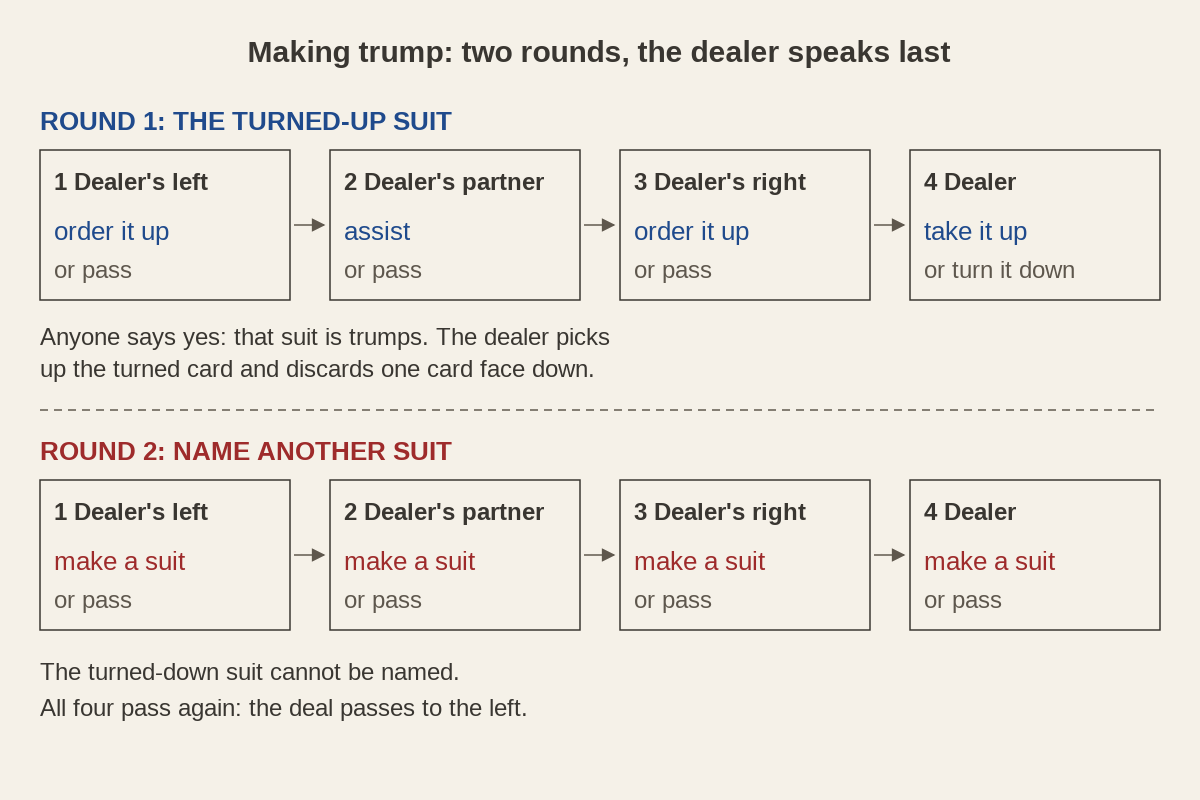
Slide the drawing sideways to read every label, or open it at full size.
The two rounds of making trump, in seat order from the dealer's left, as the 1862 and 1887 rule books describe them.
Credit and reuse terms
"Making trump in euchre: two rounds" by Banners & Banknotes, https://bannersandbanknotes.com/playing-cards/euchre/, licensed under CC BY 4.0 (https://creativecommons.org/licenses/by/4.0/)
This page's script plays these steps through for each pack size, from the deal to the end of a 5-point game, 1,000 games per pack, with every choice made at random among the legal ones. In more than 4,300 deals for each pack it found no turn without a legal card and no trick without a single winner, and every result matched exactly one scoring rule. The script tests only whether the rules fit together; it does not rate any way of playing.
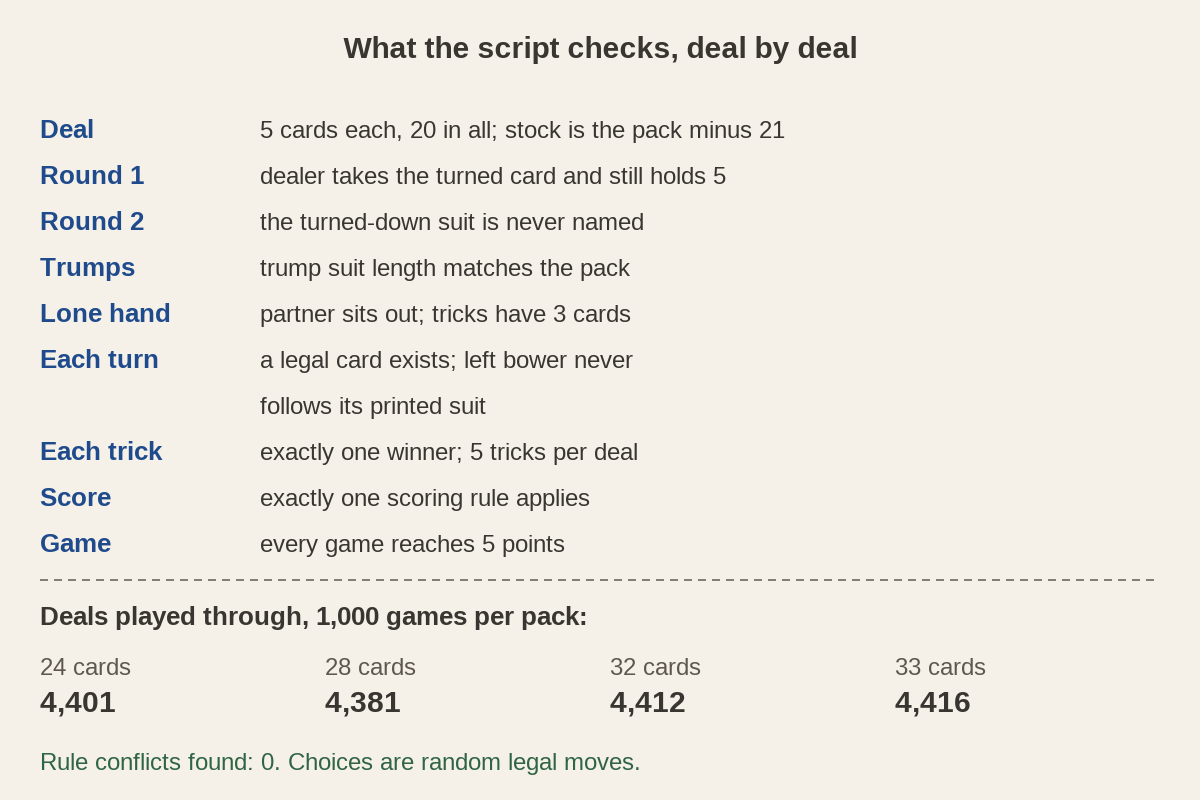
Slide the drawing sideways to read every label, or open it at full size.
The checks this page's script makes in every simulated deal, and how many deals it played through in 1,000 games for each pack size.
Credit and reuse terms
"What the euchre rule check tests" by Banners & Banknotes, https://bannersandbanknotes.com/playing-cards/euchre/, licensed under CC BY 4.0 (https://creativecommons.org/licenses/by/4.0/)
Playing the five tricks
Following suit is where the left bower matters, and the 1862 book states the rule plainly: a player "must always play a card of the suit led, if he holds one," or the opponents score two points for the revoke. Only a player with no card of the suit led may trump or discard.
In the deal below, hearts are trumps and North leads the ace of diamonds. East holds the jack of diamonds and no other diamond. For this deal that jack is a heart, so East has no diamond to play and may trump with it, and the left bower takes the trick over North's ace of diamonds.
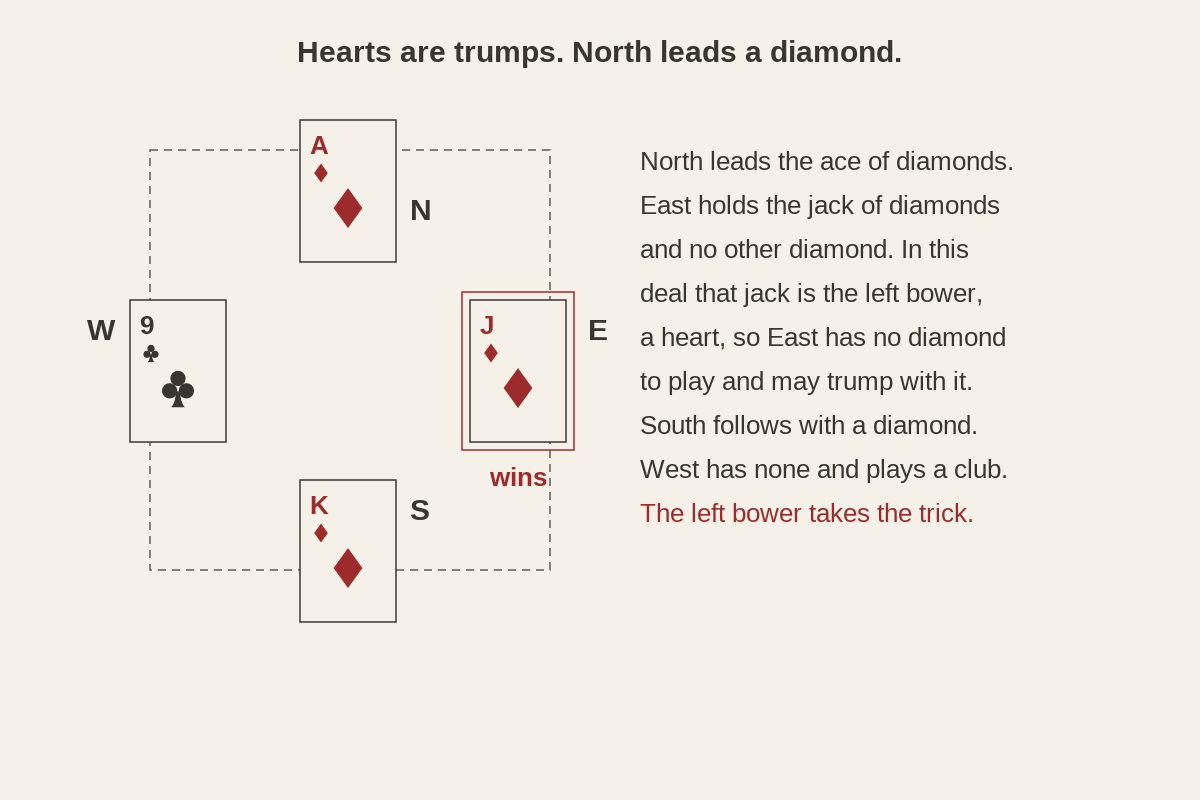
Slide the drawing sideways to read every label, or open it at full size.
One trick with hearts as trumps. East, holding no other diamond, plays the jack of diamonds as a trump and wins (tincture, not official).
Credit and reuse terms
"A euchre trick: the left bower trumps a diamond lead" by Banners & Banknotes, https://bannersandbanknotes.com/playing-cards/euchre/, licensed under CC BY 4.0 (https://creativecommons.org/licenses/by/4.0/)
The rule also works the other way. When a trump is led, a player whose only trump is the left bower must play it, even though its face shows another suit.
Scoring and going alone
A game is 5 points in the 1862 and 1887 books, while the 1943 rules allow 5, 7 or 10 by agreement. The side that made trumps scores 1 point for three or four tricks and 2 for all five, which the 1862 book calls "making a march." If it takes fewer than three, it is euchred, and the other side scores 2.
| Result of one deal | 1862 rule book | 1943 Official Rules |
|---|---|---|
| Makers take 3 or 4 tricks | 1 | 1 |
| Makers take all 5, a march | 2 | 2 |
| Makers take fewer than 3, euchred | 2 to opponents | 2 to opponents |
| Lone hand takes all 5 | 4 | 4 |
| Lone hand takes 3 or 4 | 1 | 1 |
| Lone hand euchred | 4 to opponents | 2 to opponents |
The lone hand cost more under the older rule: the 1862 author gives the opponents of a euchred lone player four points, though he notes that some circles counted only two. The 1943 rules give two.
The books also differ on who may go alone. In 1862 the dealer could play alone after his partner assisted, while the 1943 rules call it the rule "now usually in vogue in America" that only the player who made trumps may go alone.
The score itself was kept with spare cards: in the 1862 book the five points of a game are "counted with the tray and deuce" left over from stripping the pack. Foster in 1914 uses a four and a three for the same purpose.
Picture the two counters at a score of one. The three lies face down across half of the deuce, so that a single pip of the deuce shows.
Some tables added extra scores. The 1862 book, which calls them "comparatively a modern institution," counts a lap, carrying points made beyond five into the next game, and a slam, a game won before the other side scores a point. Its jambone is a lone hand played face up, with an opponent calling one card, worth 8 points if it takes all five tricks, and its jamboree, the two bowers with the ace, king and queen of trumps shown in one hand, counts 16. Keller wrote in 1887 that none of these applies unless the players agree to it before the game.
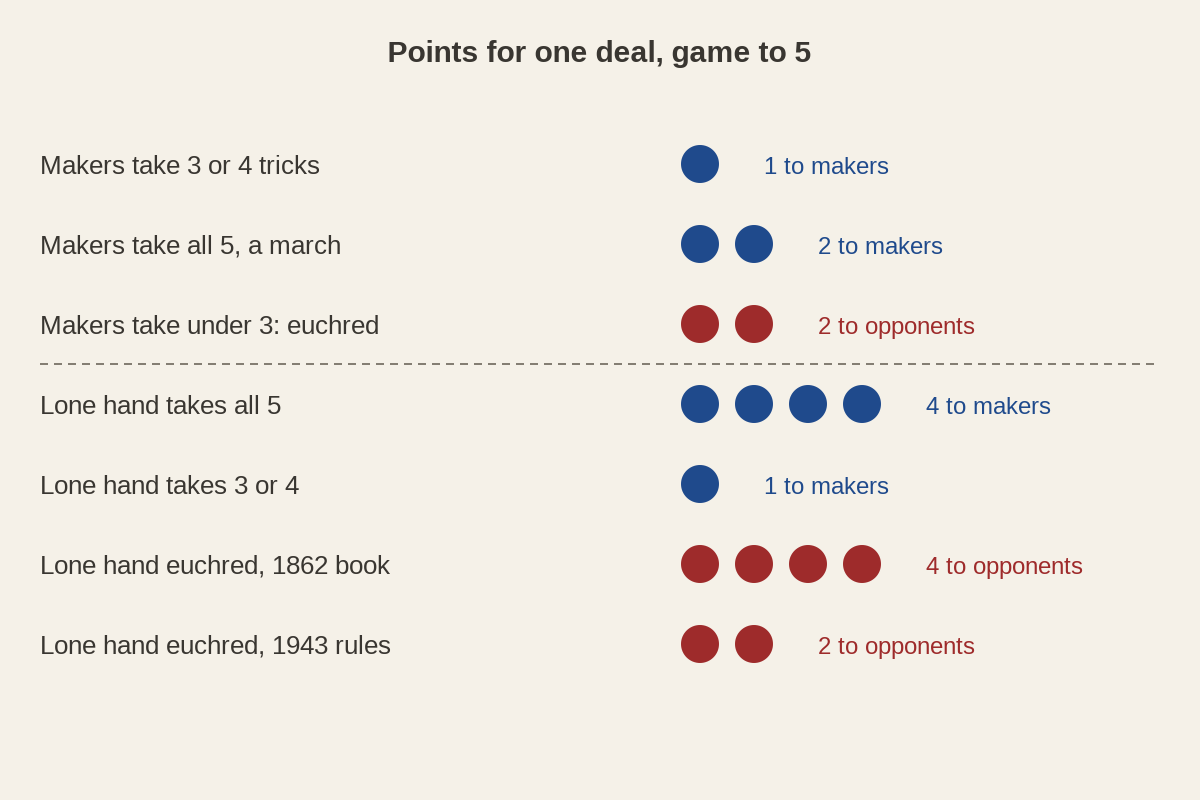
Slide the drawing sideways to read every label, or open it at full size.
Points for one deal. A euchred lone hand gives the opponents 4 points in the 1862 book and 2 under the 1943 Official Rules.
Credit and reuse terms
"Euchre scoring for one deal, 1862 and 1943" by Banners & Banknotes, https://bannersandbanknotes.com/playing-cards/euchre/, licensed under CC BY 4.0 (https://creativecommons.org/licenses/by/4.0/)
Where did euchre come from?
The earliest record found for this page is on a steamboat: in a memoir published in 1844, the comedian Joe Cowell recalls "getting instructed in the mysteries of uker" on a trip from Louisville to New Orleans that he places in 1829. A few pages later the same book mentions holding "the left bower guarded" when diamonds are trumps.
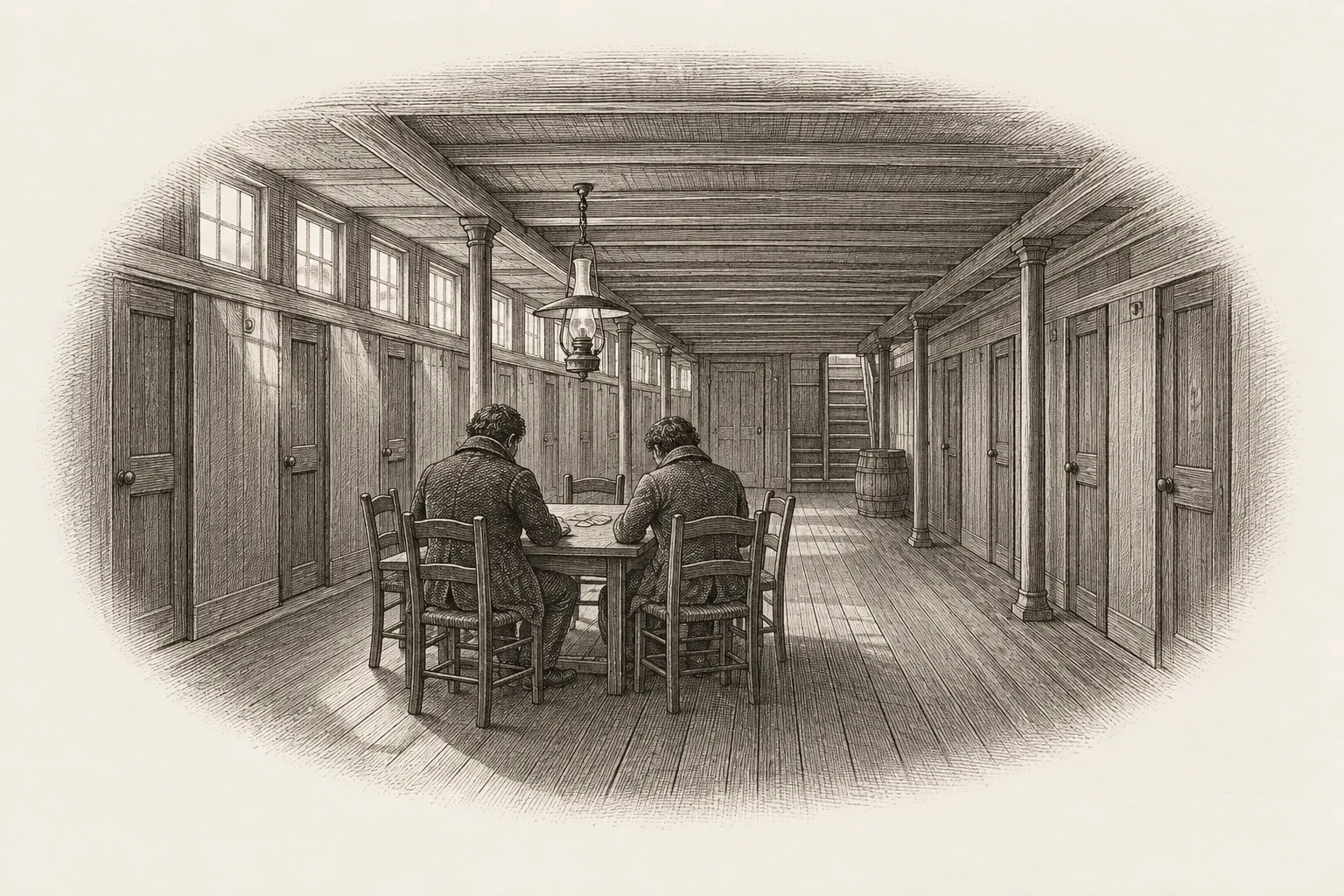
A card table under a lamp in a river steamboat's cabin. Joe Cowell's memoir of 1844 recalls learning "uker" on a Louisville to New Orleans trip that he places in 1829.
Illustration: Banners & Banknotes. Generated schematic illustration — not a photograph or historical record. © Banners & Banknotes, all rights reserved.
Printed rules followed. The 1862 author knew of a 32-page Philadelphia book of 1850, The Game of Euchre; with its Laws, while the card-game historian David Parlett dates the first description of the game to an American edition of Hoyle's games of 1845.
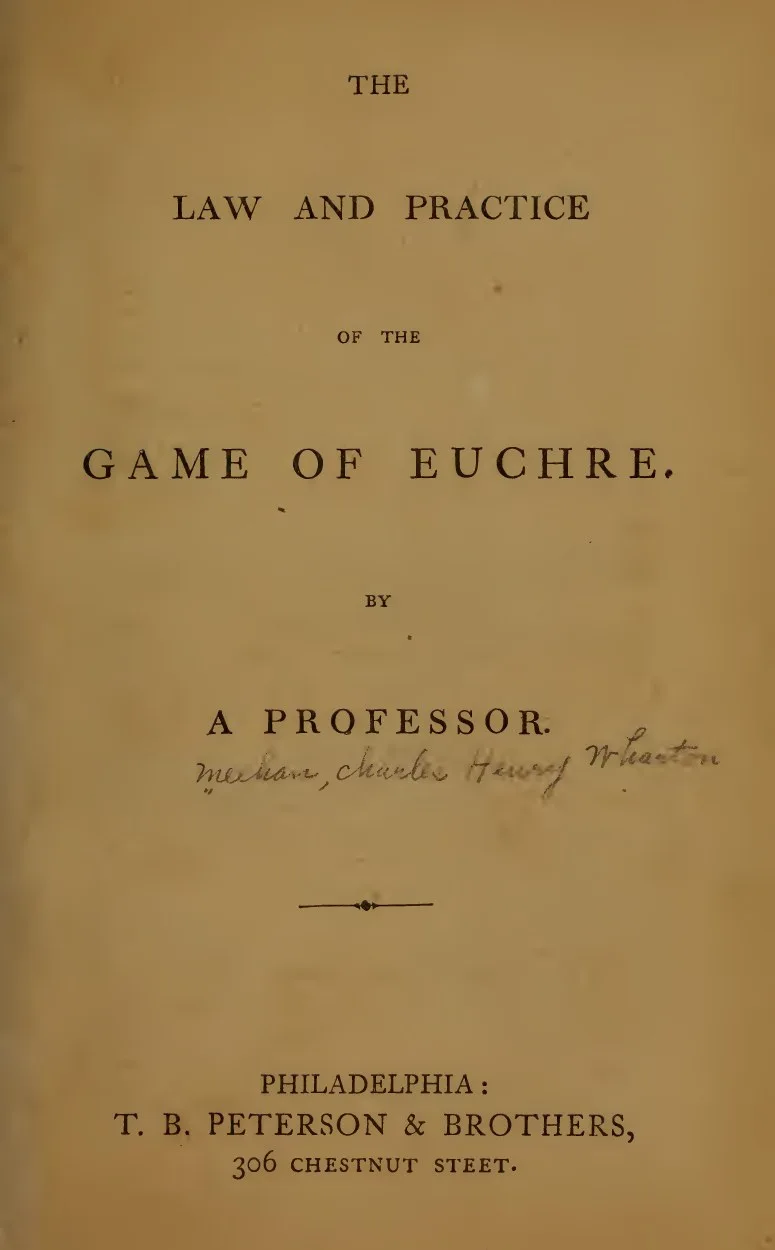
Title page of the 1862 rule book, signed only "A Professor." A handwritten note below the signature adds the name Meehan, the author the Library of Congress catalog gives.
Credit and reuse terms
"The law and practice of the games of euchre (IA lawpracticeofgam00meeh)" by Charles Henry Wharton Meehan (as "A Professor"), The Law and Practice of the Game of Euchre (Philadelphia: T. B. Peterson & Brothers, 1862) — https://commons.wikimedia.org/wiki/File:The_law_and_practice_of_the_games_of_euchre_(IA_lawpracticeofgam00meeh).pdf — Public domain (book published in Philadelphia in 1862 under the name "A Professor"; its author, Charles Henry Wharton Meehan, died in 1872; the scan is a faithful reproduction of the printed page); changes: title page (PDF page 5) extracted as a single page at 200 dpi
The Law and Practice of the Game of Euchre (title page), 1862, T. B. Peterson & Brothers, Philadelphia. Library of Congress, no number given.
The rule books disagreed about where the game came from. The 1862 author called its origin "generally admitted to be German" and thought German settlers brought it to Pennsylvania. Keller wrote in 1887 that euchre "is traced back easily and directly" to the French game Triomphe, carried to America by French settlers. In 1914 R. F. Foster judged it "of mixed stock," probably an attempt to play the Irish game Spoil Five with a piquet pack.
The French and Alsatian accounts need not exclude each other; Parlett traces Jucker itself back to Triomphe, probably by way of the French game la Bête. He also quotes Charles Cotton's Compleat Gamester of 1674 on French Ruff, the English name for Triomphe: "To win two tricks signifies nothing, to win three or four signifies one, but to win five is the winning of five." Euchre's scoring has the same shape: one point for three or four tricks, more for all five.
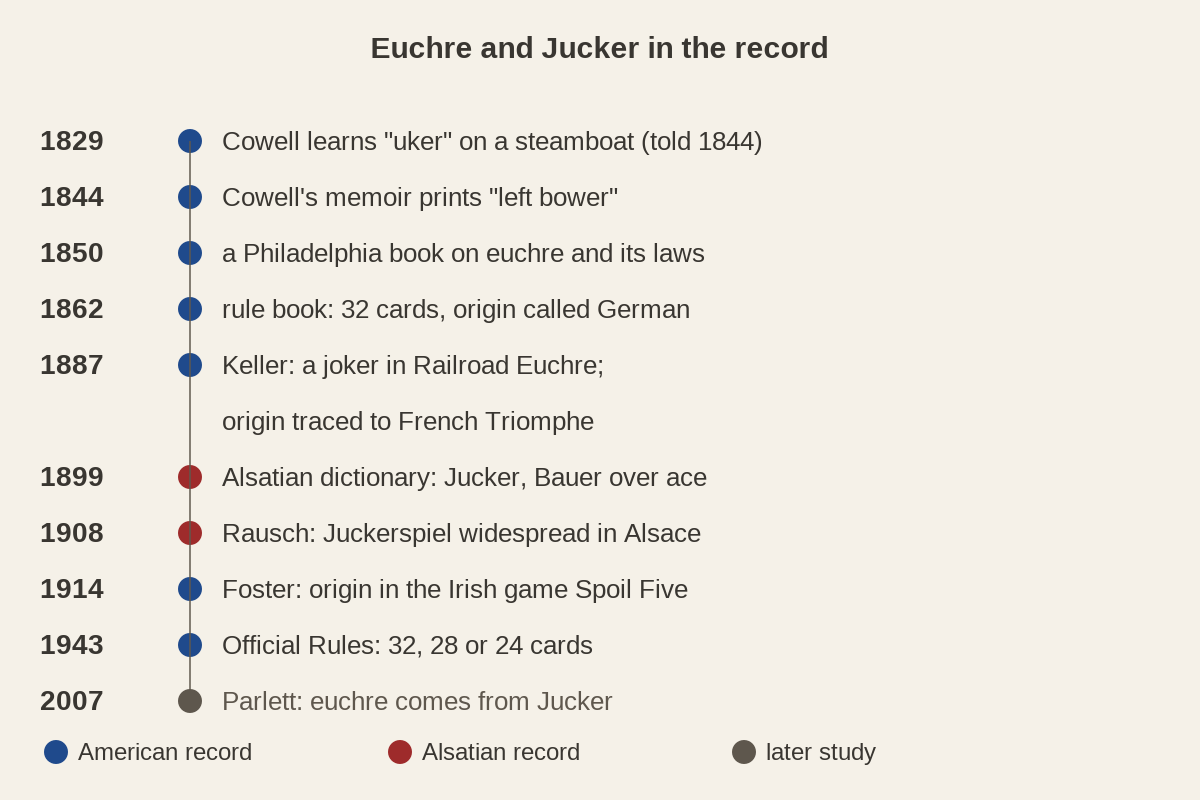
Slide the drawing sideways to read every label, or open it at full size.
Euchre and the Alsatian game Jucker in the documents read for this page, 1829 to 1943, with Parlett's study of 2007 at the end.
Credit and reuse terms
"Euchre and Jucker in the record, 1829 to 2007" by Banners & Banknotes, https://bannersandbanknotes.com/playing-cards/euchre/, licensed under CC BY 4.0 (https://creativecommons.org/licenses/by/4.0/)
The bower and the Bauer
One clue is the name of the two top cards. The 1862 author explained it in one sentence: "The word Bauer, the German for Jack, or Knave, Americanized to Bower, is said to be the only term used in the game which has been adopted from the German."
Alsatian sources describe a game with the same top card. In 1899 the Wörterbuch der elsässischen Mundarten, Ernst Martin and Hans Lienhart's dictionary of the Alsatian dialects, defined Jucker as a card game "bei welchem der Bauer mehr gilt als das Ass," one in which the Bauer counts for more than the ace. Under Marsch the same dictionary gives the Juckerspiel phrase for taking all five tricks, the feat the 1862 book calls a march.
Heinrich Rausch, in a Strasbourg dissertation of 1908, called Juckerspiel widespread in Alsace and wrote that in it the Bauer is the highest card. On that evidence Parlett concludes that euchre derives from the Alsatian game of Jucker. The International Playing-Card Society (IPCS) also places the game's beginnings in Alsace-Lorraine.
Yet the dated record runs the other way. Euchre is in American print by 1844, while the earliest Alsatian description found for this page is the 1899 dictionary, which quotes an older Strasbourg text for the verb juckere, to play cards. Parlett identifies that text as one of 1856.
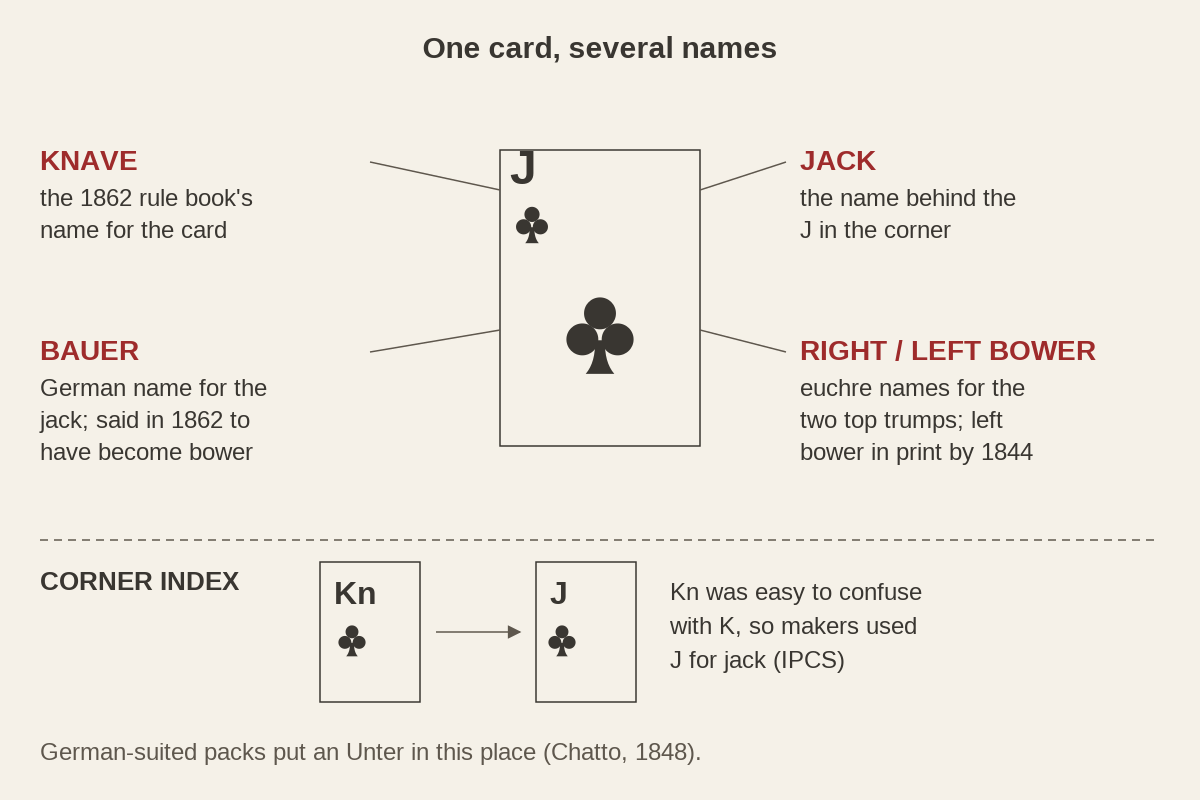
Slide the drawing sideways to read every label, or open it at full size.
Names for the same card in the sources on this page, with the corner index that changed from Kn to J (tincture, not official).
Credit and reuse terms
"One card, several names: knave, jack, Bauer, bower" by Banners & Banknotes, https://bannersandbanknotes.com/playing-cards/euchre/, licensed under CC BY 4.0 (https://creativecommons.org/licenses/by/4.0/)
English had its own names for the card: the 1862 book's rules call it the knave. The IPCS explains that when makers began marking card corners with indices in the middle of the 19th century, the Kn of the knave was easy to confuse with the K of the king, so jack and J took over. For the same squeezing of names into letters on coins, see the Coin Legend Decoder. In German-suited packs the card in this place is the Unter, which Chatto in 1848 matched to the English knave; the five suit systems page sets the German and French suits side by side.
Does euchre use a joker?
The 1862 rules for euchre have no joker, but by 1887 a popular version of the game did. Keller describes Railroad Euchre, which had "to a large extent, superseded" the older game, played with 33 cards: the 32 of a euchre pack and "an extra card known as the joker." In his words, "The joker, or imperial trump as it is sometimes called, is always the best trump," and it beats the right bower.
In some packs, Keller adds, the joker was a blank card, and in others it carried a device of its own; if it was the card turned up, the dealer turned the next card to fix the trump suit. Railroad Euchre also changed the lone hand: a player going alone could call for the best card in his partner's hand, and either opponent could then do the same and play alone against him.
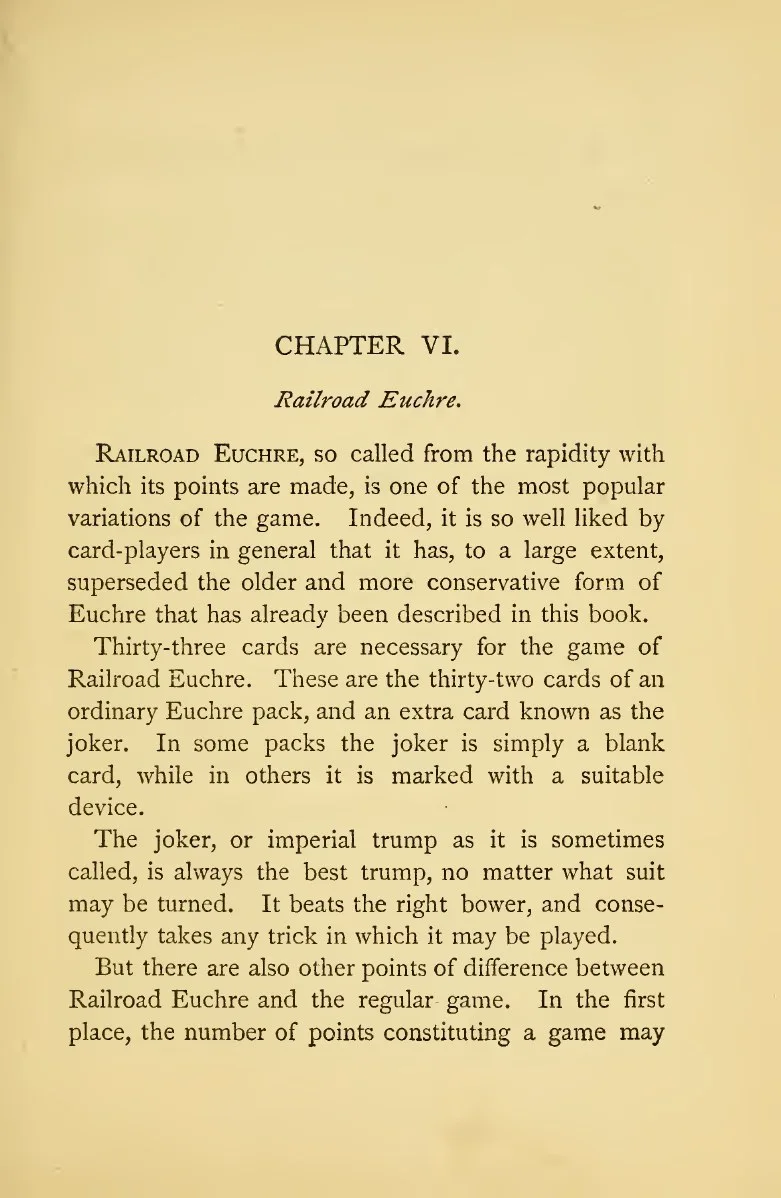
The opening of the chapter on Railroad Euchre in Keller's book of 1887: 33 cards, and the joker as the best trump, above the right bower.
Credit and reuse terms
"The game of euchre (IA gameofeuchre00kell)" by John W. Keller, The Game of Euchre (New York: Frederick A. Stokes, 1887) — https://commons.wikimedia.org/wiki/File:The_game_of_euchre_(IA_gameofeuchre00kell).pdf — Public domain (book published in New York in 1887; its author, John William Keller, died in 1919; the scan is a faithful reproduction of the printed page); changes: printed page 47 (PDF page 51) extracted as a single page at 200 dpi
The Game of Euchre (page 47), 1887, Frederick A. Stokes, New York. Library of Congress, no number given.
Foster's rules of 1914 say the same: "When the Joker, or blank card is used, it is always the best trump, ranking above the right bower." The 1943 Official Rules list the joker as an option and rank it as the highest trump when used.
That extra trump is where the joker card begins, according to the IPCS. Its account says Americans added to the euchre deck a card higher than the bowers, "called the Imperial Bower or the Best Bower," and calls it "the genesis of the Joker." Parlett, citing Catherine Perry Hargrave's history of playing cards, mentions a card of 1862 labeled Highest Trump and one of 1865 inscribed Imperial Bower. The Joker page follows that card from best bower to jester.
Shrink strip
At 160 pixels wide the corner letters are too small to read, so nothing marks the two jacks off from the ace; only the left bower's diamond still differs from the hearts. In the blurred copy it does not, and at 16 pixels the row is a pale sliver.
Shown at its drawn size. On a narrow screen, scroll sideways to see the whole strip.
The card row of the opening figure at 16, 48 and 160 pixels wide, plus a blurred copy (tincture, not official). Reduction preview, not a legibility test.
Credit and reuse terms
"Shrink strip: the euchre trump order at 16, 48 and 160 pixels" by Banners & Banknotes, https://bannersandbanknotes.com/playing-cards/euchre/, licensed under CC BY 4.0 (https://creativecommons.org/licenses/by/4.0/). Derived from "Euchre trump order when hearts are trumps".
Meaning ledger
| Meaning | Earliest we can document | Year | Label | Notes |
|---|---|---|---|---|
| The name bower is the German Bauer, the jack | The Law and Practice of the Game of Euchre, pp. 28–29 ("is said to be") | 1862 | [first recorded later] | The word bower is in print by 1844 (Cowell). Martin and Lienhart (1899) record a Jucker in which the Bauer counts for more than the ace, and Rausch (1908) calls the Bauer its highest card; Parlett (2007) writes that bower "clearly derives" from Bauer. |
| The right and left bowers are named for a ship's main anchors | The Law and Practice of the Game of Euchre, p. 25 ("It is also narrated") | 1862 | [first recorded later] | The same 1862 author reports it as a story about a sailor's invention and gives the German derivation a few pages later. No document found shows when the story began. |
| The name euchre comes from the Alsatian game Jucker | Parlett, "Euchre and other five-trick games," first published in The Playing-Card 35, no. 4 | 2007 | [first recorded later] | The name is in print as uker by 1844. The 1862 author called the name "a mystery" and reported Professor Grimm's view that it is not a German word; Foster (1914) tied it instead to the Irish game Spoil Five. |
How each label is decided: The After-Meaning, the four labels.
Sources
- Joe Cowell, Thirty Years Passed Among the Players in England and America (New York: Harper & Brothers, 1844), pp. 90–94 and 101. archive.org Read: pages 90–94 and 101
- A Professor [Charles Henry Wharton Meehan], The Law and Practice of the Game of Euchre (Philadelphia: T. B. Peterson & Brothers, 1862), title page and pp. 23–50, 59, 81–85 and 98. archive.org Read: title page, pages 23–50, 59, 81–85 and 98
- John W. Keller, The Game of Euchre (New York: Frederick A. Stokes, 1887), pp. 9–19, 47–49 and 64. archive.org Read: pages 9–19, 47–49 and 64
- H. C. Leeds and James Dwight, The Laws of Euchre as Adopted by the Somerset Club of Boston, March 1, 1888 (Boston: Ticknor and Company, 1888), preface. archive.org Read: title page and preface
- Ernst Martin and Hans Lienhart, Wörterbuch der elsässischen Mundarten, vol. 1 (Strassburg: K. J. Trübner, 1899), pp. 406 and 713. archive.org Read: pages 406 and 713
- Heinrich A. Rausch, Das Spielverzeichnis im 25. Kapitel von Fischarts Geschichtklitterung (Gargantua), dissertation, Kaiser-Wilhelms-Universität Strassburg (Strassburg: J. H. Ed. Heitz, 1908), pp. xxxv–xxxvi. archive.org Read: title page and pages xxxv–xxxvi
- R. F. Foster, Foster's Complete Hoyle (New York: Frederick A. Stokes, 1914), pp. 263–265, 270, 415 and 419–420. archive.org Read: pages 263–265, 270, 415 and 419–420
- The United States Playing Card Company, Official Rules of Card Games: Hoyle Up-to-Date (Cincinnati: The United States Playing Card Company, 1943), pp. 105–107. archive.org Read: title page and pages 105–107
- William Andrew Chatto, Facts and Speculations on the Origin and History of Playing Cards (London: John Russell Smith, 1848), p. 228. archive.org Read: page 228
- David Parlett, "Euchre and other five-trick games," Historic Card Games, parlettgames.uk; first published in The Playing-Card 35, no. 4 (April–June 2007), pp. 255–261. parlettgames.uk Read: full text
- International Playing-Card Society, "Joker." i-p-c-s.org Read: full text
- International Playing-Card Society, "Why is the jack called a jack?" i-p-c-s.org Read: full text
Counter-sign
Counter-sign: The four jacks of Skat. Except in null games, which have no trumps, Skat makes all four jacks its top trumps in the fixed order Parlett gives, clubs, spades, hearts, diamonds, where euchre promotes only two and lets the trump suit choose them.
- Joker: the extra euchre trump, once called the best bower, that became the joker.
- Europe's Five Suit Systems: the German pack's Unter, the court card that stands where the jack does.
Cite this page
Banners & Banknotes. “Euchre: Two Jacks Outrank the Ace of Trumps.” Published 14 October 2026. https://bannersandbanknotes.com/playing-cards/euchre/. Accessed [date you read it].
Corrections
No corrections yet.